Google has introduced Nano Banana 2.1, a new artificial intelligence image-generation and editing model designed to make high-quality visual creation faster, more consistent and significantly cheaper.
The model, launched on October 6, builds on Google’s Nano Banana 2 and focuses on a challenge that is becoming increasingly important as AI-generated images move from experimentation into everyday business use: producing better visuals without pushing up costs.
One of the biggest changes is the pricing. Through the Gemini API, Nano Banana 2.1 is available at $0.0336 for a 1K image, $0.0504 for a 2K image and $0.0756 for a 4K image. The pricing is roughly half that of the previous Nano Banana 2 model, potentially making large-scale image generation more affordable for developers and businesses.
The lower cost could be particularly useful for companies that generate thousands of images for online stores, advertising campaigns, publishing, gaming and social media. Instead of treating AI image generation as an occasional creative tool, businesses can increasingly use it as part of regular production workflows.
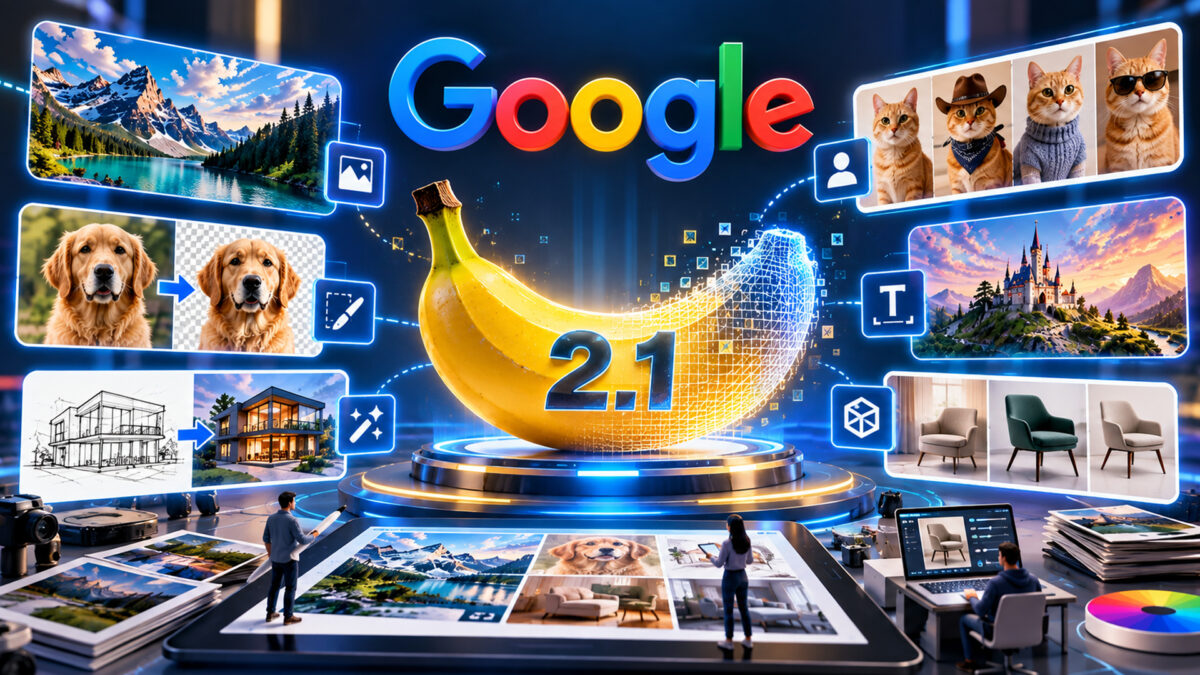
Google has also focused heavily on consistency. One of the common problems with AI-generated images is that a person, product or object can change slightly every time a new image is created. Nano Banana 2.1 is designed to improve that consistency across multiple editing and generation steps.
The model can work with as many as 14 reference images, allowing users to provide more visual information about the people, products or objects they want to include. It can support up to four characters and 10 objects in a scene, giving creators greater control over complex compositions.
Text inside AI-generated images has also received attention. Earlier image models often struggled with spelling, typography, signs, labels and detailed layouts. Nano Banana 2.1 is designed to produce more accurate text and better-organised infographic-style visuals.
That improvement could make the technology more practical for marketing material, product presentations, educational graphics and social media content, where incorrect text can quickly make an otherwise impressive image unusable.
The model supports 1K, 2K and 4K image generation, giving users the option to choose quality based on their requirements and budget. Google has also addressed problems that can appear when creating extremely wide or tall images, including visual tiling artefacts.
Another important feature is the model’s ability to use information from Google Search and Image Search to improve generated visuals. This grounding capability can help the model work with current or specific visual information rather than relying entirely on its existing knowledge.
Nano Banana 2.1 also supports video-to-image capabilities, opening up additional possibilities for creators who want to turn moments from video into new visual assets.
The technology is being made available through Google’s Gemini ecosystem, including Gemini, Google AI Studio and the Gemini API. Developers can access the model using the model identifier gemini-nano-banana-2.1.
Google is positioning Nano Banana 2.1 as part of a broader family of image-generation models. Nano Banana Pro remains aimed at more advanced visual tasks, while Nano Banana 2.1 focuses on balancing quality, speed and cost. A lighter version is also positioned for users who prioritise speed and lower computing requirements.
The launch comes as competition in AI image generation intensifies. Technology companies are increasingly trying to improve not just how realistic AI images look, but how reliably they can be produced at scale.
That shift is important for businesses. A creative team may want to generate multiple versions of a product advertisement, an online retailer may need different images for thousands of products, while a publisher could require illustrations in several formats. Consistency and cost can matter just as much as image quality in such cases.
Google’s latest model reflects that changing demand. The focus is moving beyond simply asking AI to “create a picture” towards giving users more control over characters, products, text, composition and editing.
The lower pricing may ultimately prove just as significant as the visual improvements. If AI-generated imagery becomes cheap enough to use routinely, it could change how companies approach design and content production.
Nano Banana 2.1 therefore represents another step in Google’s effort to make generative AI imagery more useful outside the novelty phase. Its combination of lower costs, stronger consistency, improved text rendering and broader editing capabilities could make AI-generated visuals easier to integrate into everyday creative and commercial work.