
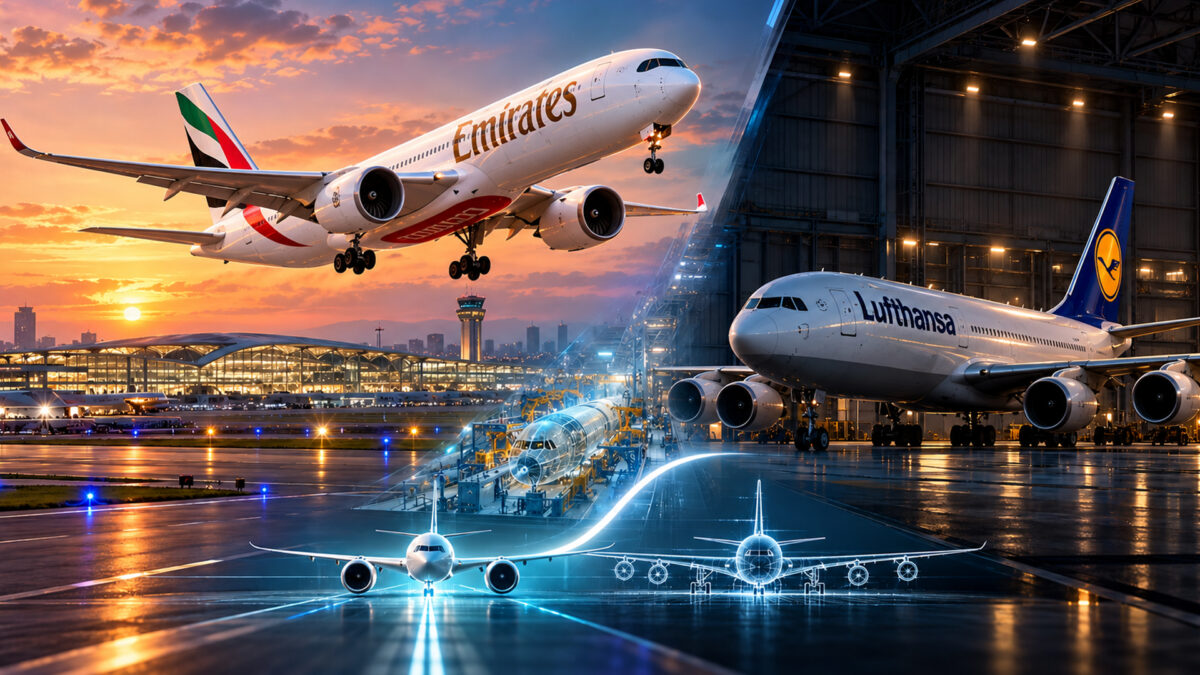
The global aviation industry is undergoing significant changes, from the development of next-generation combat aircraft to upgrades in commercial air travel and the retirement of ageing passenger jets. Three recent developments involving Airbus highlight how manufacturers, airlines and defence companies are adapting to changing technological requirements, passenger demand and operating costs. Airbus could explore a role in an international fighter programme, Emirates has introduced a new aircraft on its Kolkata-Dubai route, and Lufthansa has ended scheduled passenger operations with the Airbus A340-600.
Airbus and BAE Systems explore GCAP cooperation
Airbus and BAE Systems are preparing to discuss potential cooperation on the Global Combat Air Programme (GCAP), a next-generation fighter aircraft initiative involving the United Kingdom, Italy and Japan. The discussions could become significant as European countries reassess their defence partnerships and look for ways to share the cost of developing advanced military aircraft.
The GCAP programme aims to deliver a new supersonic combat aircraft by 2035. It is being developed by BAE Systems, Italy’s Leonardo and Japan’s Mitsubishi Heavy Industries. The project is expected to combine advanced aircraft design with digital systems, sensors, communications technology and capabilities that allow crewed aircraft to operate alongside autonomous platforms.
Airbus’s possible involvement has gained attention following difficulties in the rival Future Combat Air System (FCAS) programme involving France, Germany and Spain. Germany is considering its future options after the partnership encountered serious disagreements. The possibility of joining GCAP could offer German industry another route into next-generation fighter development.
However, bringing Airbus and German suppliers into the existing programme would not be straightforward. The founding partners have already agreed on work distribution and intellectual property arrangements. Any expansion would require negotiations over industrial responsibilities, funding and technology access. Airbus has also indicated that German industry would need a substantial role for participation to make sense.
The talks remain exploratory, and no final agreement has been announced. Potential areas of cooperation could extend beyond the fighter itself to autonomous combat aircraft and the digital networks connecting aircraft, drones, sensors and satellites. Such systems are becoming increasingly important in modern defence technology.
Emirates adds Airbus A350 to Kolkata-Dubai route
In commercial aviation, Emirates has introduced its Airbus A350 aircraft on the Kolkata-Dubai route and increased weekly services between the cities from 11 to 12, effective October 25. The move is intended to strengthen international connectivity from eastern India and provide passengers with an additional weekly flight to Dubai, a major global aviation hub.
The new aircraft received a ceremonial water cannon salute at Netaji Subhas Chandra Bose International Airport in Kolkata. The introduction of the A350 reflects the airline’s efforts to match aircraft deployment and flight frequency with demand for international travel.
The Airbus A350 is a modern wide-body aircraft designed for long-distance operations. Its advanced aerodynamics, contemporary cabin systems and fuel-efficient engines make it an important part of airlines’ fleet-modernisation strategies. For passengers, the aircraft offers a modern long-haul cabin experience, while airlines can benefit from improved operating efficiency compared with older aircraft of similar capacity.
The additional weekly service also provides travellers from Kolkata and surrounding regions with more flexibility when planning journeys through Dubai. The city serves as a major connecting hub for destinations across Europe, the Middle East, Africa and other parts of the world.
The expansion underlines the importance of aircraft technology and scheduling in meeting rising passenger demand. However, the long-term benefits will depend on sustained demand, operating economics and how effectively airlines use their available fleet capacity.
Lufthansa retires Airbus A340-600 after 23 years
Meanwhile, Lufthansa has retired the Airbus A340-600 from scheduled passenger service after 23 years of operations. The aircraft’s final scheduled commercial flight, LH419, travelled from Washington Dulles to Frankfurt, where it landed on October 19.
The aircraft, registered as D-AIHW, completed the flight with 267 passengers and 15 crew members. Its retirement marks the end of a notable chapter for the four-engine long-haul jet, which entered Lufthansa’s fleet in 2003. The airline operated 24 A340-600 aircraft during the type’s time in service.
The A340-600 was once among the world’s longest passenger aircraft, measuring 75.3 metres. However, its four-engine configuration became less attractive as airlines increasingly adopted modern twin-engine aircraft with lower fuel consumption and operating costs.
The shift reflects a wider transformation in commercial aviation. Newer aircraft, including the Airbus A350 and Boeing 787, are designed to improve fuel efficiency, reduce operating complexity and support long-haul routes with fewer engines. Lufthansa plans to expand its next-generation fleet, with around 70% of its long-haul aircraft expected to comprise newer models by 2028.
The retirement does not mean every Airbus A340 has disappeared from commercial aviation. Lufthansa’s smaller A340-300 variant continues to operate, while other airlines and specialised operators retain some A340 aircraft.
Together, these developments illustrate aviation’s changing priorities. Defence companies are exploring new partnerships for advanced combat systems, airlines are expanding routes with modern aircraft, and established carriers are replacing older jets with more efficient models.