
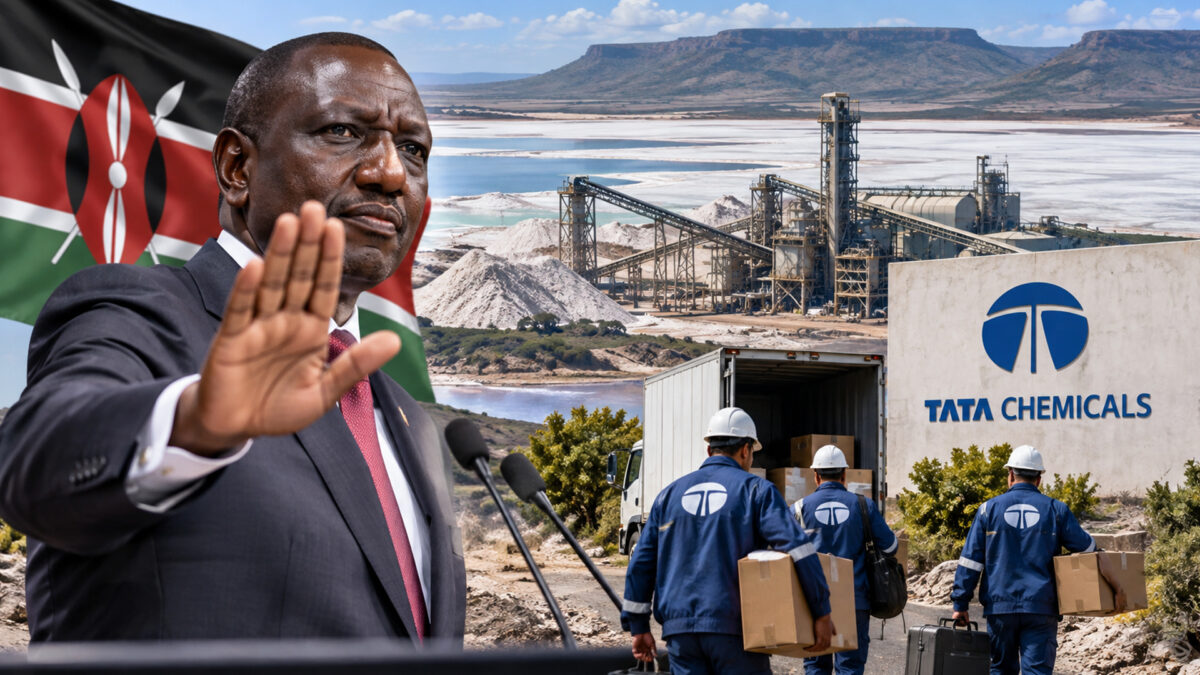
Kenya’s President William Ruto has ordered Tata Chemicals to leave the country, escalating a dispute over the Indian company’s long-running soda ash operations at Lake Magadi.
Ruto said Tata Chemicals had benefited from Kenya’s natural resources without generating enough economic value for the local community in Kajiado County. He has indicated that new investors should take over the operation and build processing facilities in Kenya.
The directive has put one of Tata Group’s longest-running overseas operations under fresh pressure and raised questions about the future of Indian investments in Kenya.
The dispute centres on Tata Chemicals Magadi Limited (TCML), which operates the Lake Magadi soda ash business. The company produces soda ash from trona, a naturally occurring mineral found around the lake. Soda ash is widely used in making glass, soaps, detergents and other industrial products.
Commercial soda ash production at Lake Magadi dates back to 1911, making it one of Kenya’s oldest mining and industrial operations. Tata Chemicals acquired the business in 2005 and has operated it for more than two decades.
Ruto’s criticism focuses largely on what Kenya gains from the operation.
Speaking during a visit to Kajiado County, the president said the company had held mining rights for many years but had not done enough to develop industries around the resource. He argued that Kenya should move beyond exporting raw or minimally processed minerals and create more jobs and manufacturing opportunities locally.
Ruto said any new investor brought into the Magadi area should establish a glass factory as well as a chemical processing facility. The objective, according to the Kenyan government, is to retain a larger share of the value generated from the country’s natural resources inside Kenya.
The latest order follows government action that began in July. Kenya’s mining ministry had directed Tata Chemicals Magadi to suspend mining operations and subsequently halted soda ash exports while regulatory and compliance issues were reviewed.
Tata Chemicals, however, has pushed back against any suggestion that it has failed to comply with Kenyan regulations.
The company said on Friday that its Kenyan subsidiary is fully compliant with regulatory requirements and has submitted the information and documents requested by the government. It is now awaiting further communication from Kenya’s Ministry of Mining as it seeks to resolve the matter through the appropriate regulatory process.
The contrasting positions leave the future of the Magadi operation uncertain.
Tata Chemicals has stressed that the business has contributed to Kenya’s economy and that it remains committed to its employees, the local community and the country. The company has also indicated that it wants to engage constructively with the authorities rather than walk away from the operation.
The stakes are significant because soda ash is an important Kenyan export.
Government data cited by the Associated Press showed that Kenya exported 254,779 tonnes of soda ash worth $56.9 million in the year to July 2025. The Magadi operation is a major part of that industry and has long been an important source of employment and export earnings.
A forced exit could therefore have consequences beyond Tata Chemicals. Any prolonged suspension could affect workers, suppliers, transport operators and other businesses linked to the soda ash supply chain.
At the same time, Kenya’s position reflects a wider push by African governments to secure greater local benefits from foreign-owned mining and industrial projects.
In Kenya, the issue is not simply about who operates Lake Magadi. It is about how the country uses its natural resources and whether more processing, manufacturing and employment can be created locally rather than having raw materials leave the country for overseas markets.
That approach could have implications for other foreign investors as well.
The Tata Chemicals dispute comes after Kenya cancelled major projects involving other Indian companies, including an airport expansion agreement involving the Adani Group. Indian companies have a long-standing commercial presence in Kenya, with investments spanning infrastructure, manufacturing, banking, telecommunications and consumer businesses.
The latest confrontation could therefore attract attention among Indian companies assessing opportunities in the East African market, particularly in sectors linked to natural resources and infrastructure.
Tata Chemicals has not indicated that it is voluntarily withdrawing from Kenya. Instead, it has maintained that it has met the regulatory requirements and is waiting for the authorities to review its submissions. That leaves room for further discussions between the company and the Kenyan government.
The eventual outcome could range from a negotiated resolution to a change in the structure or ownership of the Magadi business.
The future of a century-old soda ash operation hangs in the balance.
Kenya wants the resource beneath Lake Magadi to generate more jobs, factories and economic activity at home. Tata Chemicals says it has complied with the country’s rules and remains committed to resolving the issue.