
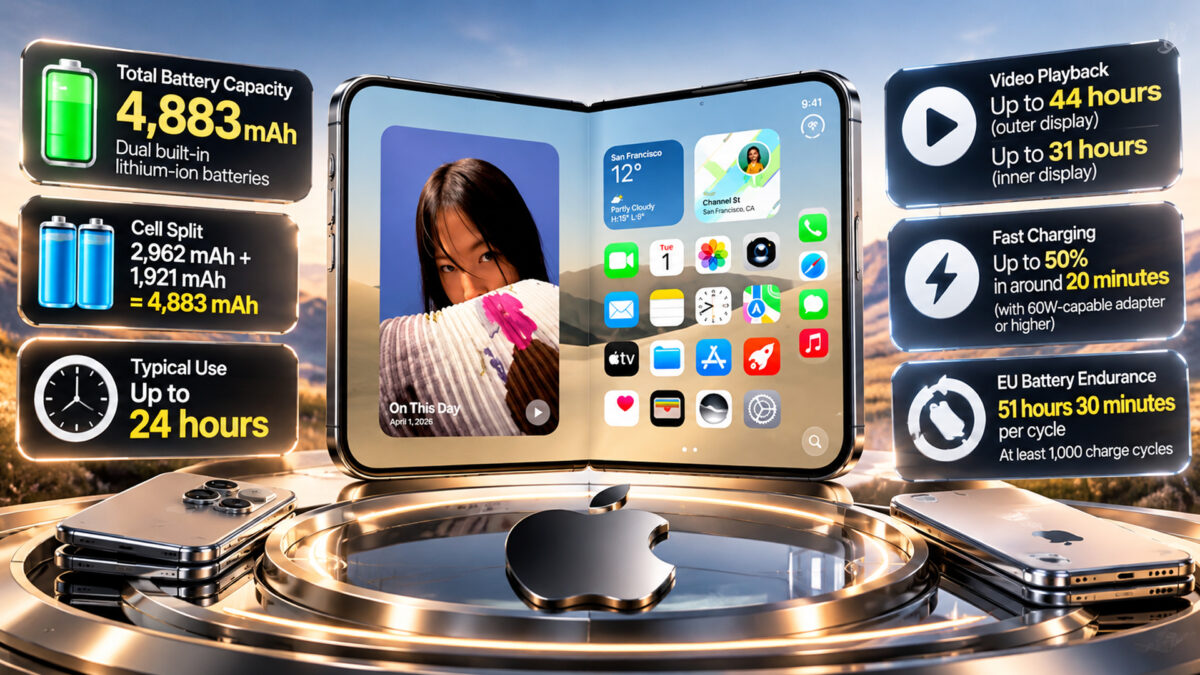
Apple has confirmed the battery capacity of its first foldable smartphone, the iPhone Duo, ahead of its arrival in stores on October 23. An energy label published in the European Union lists a total battery capacity of 4,883mAh, giving buyers a clearer idea of what powers the new device.
The information comes from the European Product Registry for Energy Labelling, known as EPREL. The listing identifies the iPhone Duo by its model number, A3720. It also provides details about battery endurance, charging cycles and the phone’s energy efficiency.
Apple does not usually highlight battery capacity in milliampere-hours (mAh) in its standard iPhone specifications. The regulatory filing therefore offers useful information for customers comparing the foldable with other premium smartphones.
The iPhone Duo uses a dual-cell battery system, with two separate cells fitted inside the device. Earlier reports identified the cells as having capacities of 2,962mAh and 1,921mAh, which together amount to 4,883mAh. The combined figure has now been confirmed through Apple’s EU filing.
The two-cell arrangement suits the phone’s book-style folding design. Unlike a conventional smartphone, the iPhone Duo needs to accommodate both an outer screen and a larger folding display. Splitting the battery into separate units gives Apple more flexibility when arranging the internal components.
The phone is available with eSIM connectivity and does not have a physical SIM card tray. This design also frees up internal space, allowing manufacturers to use the available room for other components, including the battery.
In terms of capacity, the iPhone Duo sits between Apple’s latest Pro models. The eSIM version of the iPhone 18 Pro has a 4,288mAh battery, while the iPhone 18 Pro Max has a larger 5,567mAh unit. The Duo therefore offers more battery capacity than the Pro model but less than the Pro Max.
However, a larger battery does not automatically translate into longer battery life. Power consumption depends on several factors, including screen size, brightness, processor efficiency, network use and the applications running on the phone. These factors are especially relevant for a foldable device with two displays.
The iPhone Duo has a 5.4-inch outer display and a 7.6-inch inner screen that opens like a book. The smaller display is suited to everyday activities such as checking messages, making calls and viewing notifications. Opening the phone provides a larger screen for watching videos, gaming and running multiple applications.
Apple rates the phone for up to 44 hours of locally stored video playback when using the outer display. With the larger inner display, the claimed figure falls to up to 31 hours. For streamed video, Apple estimates up to 37 hours on the outer screen and 26 hours on the inner display.
These figures are based on Apple’s testing conditions and may differ from everyday use. People who spend more time watching videos, playing games or using demanding applications may experience different results. Network strength, display brightness and background activity can also affect how often the device needs charging.
The EU energy label lists battery endurance of 51 hours and 30 minutes per charge cycle under its standardised test. This figure uses a different testing method from Apple’s video-playback estimates, so the two measurements should not be compared directly.
The regulatory document also indicates that the battery is rated for at least 1,000 full charge cycles under the specified conditions. This provides buyers with information about battery durability over time, although actual performance will depend on usage and charging habits.
Charging speed is another important feature. Apple says the iPhone Duo can reach around 50% charge in approximately 20 minutes when connected to a compatible power adapter rated at 60W or higher. With a compatible MagSafe charger and a 35W or higher adapter, the phone can reach a similar level in about 30 minutes. Charging accessories may need to be purchased separately.
The iPhone Duo is powered by Apple’s A20 Pro chip and runs iOS 27. Its software is designed to adapt to the two screen sizes, making it easier to switch between regular smartphone use and a larger workspace. The device also supports multitasking, allowing users to make better use of the inner display.
Apple has priced the iPhone Duo in India from ₹2,99,900 for the 256GB storage variant. Other options include 512GB, 1TB and 2TB models, with higher prices for larger storage capacities. Pre-orders opened on October 16, while deliveries and in-store sales are scheduled to begin on October 23.
The battery disclosure comes at an important point for Apple as it enters the foldable smartphone segment. Buyers spending a premium amount on a new device will want to know whether it can deliver reliable battery life without compromising the benefits of a larger display.
The confirmed 4,883mAh capacity provides a useful starting point, but independent reviews will offer a better understanding of real-world performance. How the phone handles long video sessions, gaming, mobile data and multitasking will help determine whether its battery can meet the expectations of foldable-phone buyers.
