
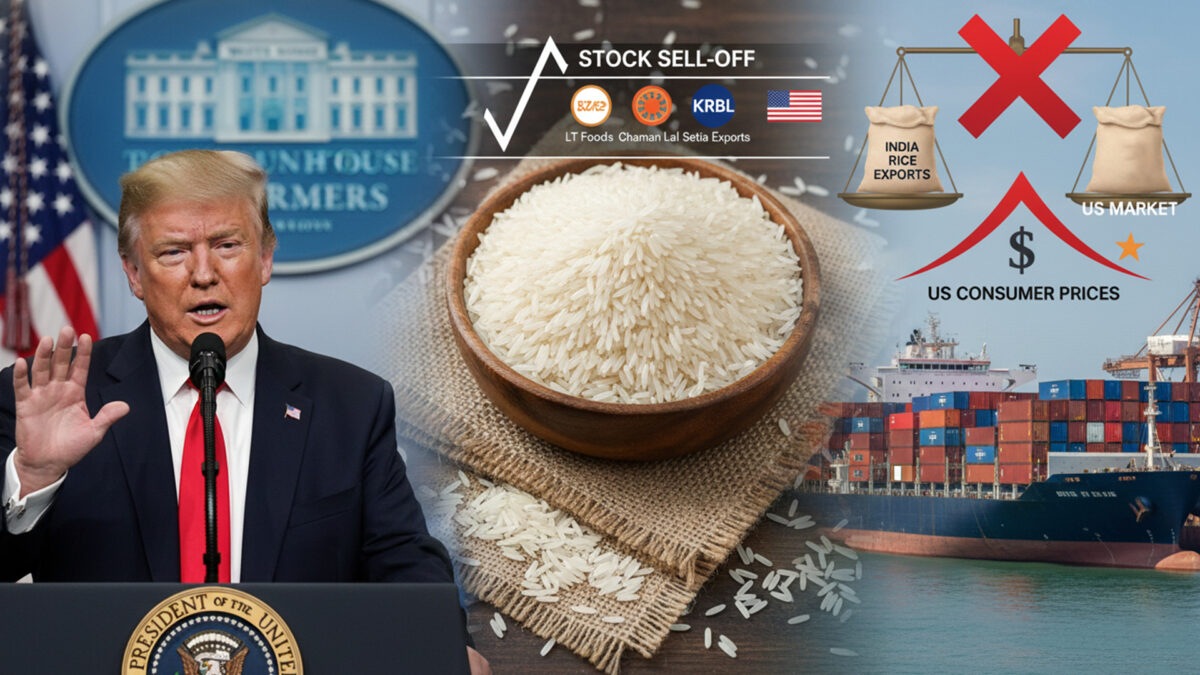
US President Donald Trump has suggested that the United States may impose additional tariffs on rice imports from India, citing concerns that Indian rice is being “dumped” at low prices. Speaking at a White House roundtable with US agricultural representatives, he questioned why India is allowed to export rice to the US and indicated that new duties could address the issue.
India already faces some of the highest tariffs globally on rice exports. Despite this, Indian rice—especially premium basmati—remains strong in the US market. According to the Indian Rice Exporters Federation (IREF), India exported around 274,213 metric tonnes of basmati rice, valued at US $337 million, and 61,341 metric tonnes of non-basmati rice, worth US $54.6 million, to the US in 2024–25.
IREF notes that Indian rice appeals to ethnic communities in the US, who prefer its aroma, texture, and cooking quality—qualities that US-grown rice often cannot match. Analysts say any new tariffs would likely have minimal impact on Indian exporters but could increase prices for US consumers. Many experts view Trump’s remarks as politically motivated, aimed at domestic farm interests ahead of upcoming elections rather than as a major shift in trade policy.
Market observers highlight that Indian rice exporters have diversified global markets, ensuring resilience against potential US trade restrictions. While US producers may gain politically from tariff discussions, the economic burden is expected to fall more on consumers than on Indian exporters.
This development underscores the complexity of global trade, where political moves, domestic industry pressures, and international demand intersect. Despite the uncertainty, Indian rice exporters remain confident in sustaining growth, supported by strong overseas demand, premium positioning, and established supply chains.