
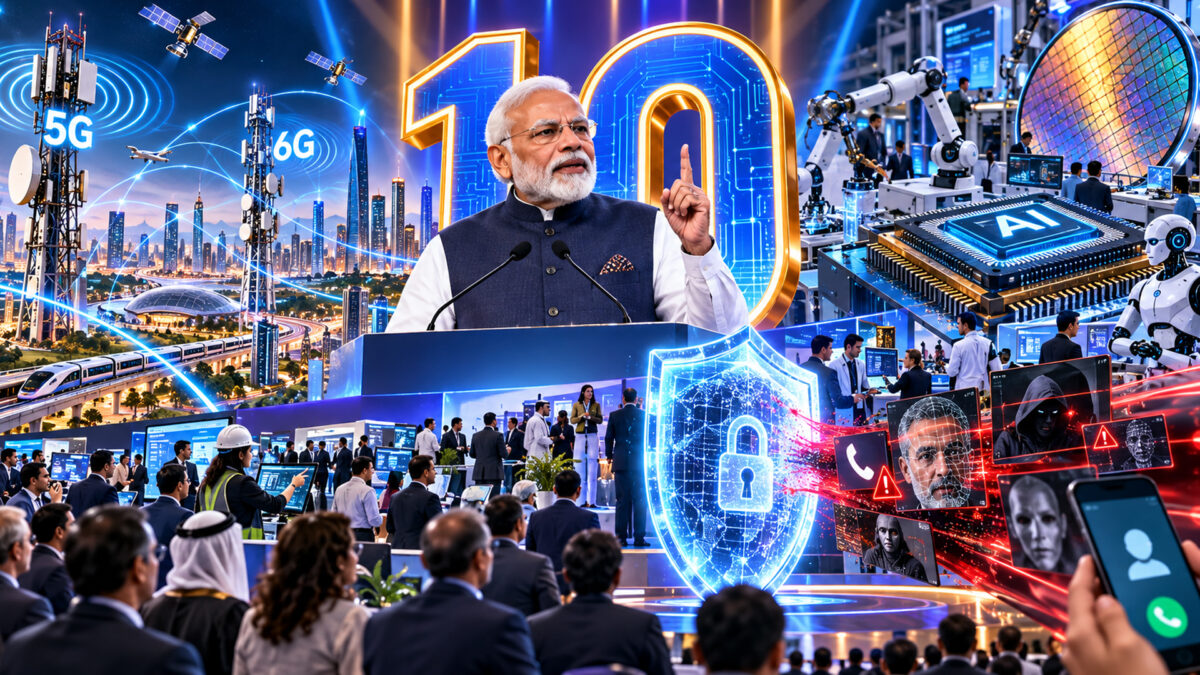
Prime Minister Narendra Modi has called for international cooperation to tackle cyber fraud, deepfakes and other digital threats, stressing that public trust must grow alongside technological progress. Speaking at the 10th edition of the India Mobile Congress (IMC) in New Delhi on October 8, he urged governments, telecom operators, technology companies and financial institutions to work together to make the digital ecosystem safer.
PM Modi said cybercriminals increasingly operate across national borders, making it difficult for individual countries to tackle fraudulent networks on their own. With artificial intelligence making it easier to create convincing fake videos, voices and images, the risks to individuals, businesses and institutions are also growing.
He called on the Global System for Mobile Communications Association (GSMA) and telecom operators around the world to develop a mechanism to identify and prevent digital fraud before it reaches potential victims. India, he said, was willing to share its experience in addressing cybercrime and support efforts to build a coordinated global response.
The Prime Minister’s address highlighted a central challenge for the technology sector: how to expand digital access and encourage innovation while protecting people from increasingly sophisticated online threats.
Digital services have become part of everyday life, from banking and shopping to education, entertainment and government services. However, the same connectivity that makes these services convenient can also expose users to phishing messages, fraudulent calls, identity theft and financial scams.
Deepfakes add another dimension to the problem. By using artificial intelligence to imitate a person’s face or voice, criminals can make fake communications appear genuine. Such material can be used to mislead people, spread misinformation or persuade victims to transfer money.
PM Modi emphasised the need to build confidence in digital communication and transactions. Effective protection, however, cannot depend on users alone. Telecom operators, digital platforms, banks and law enforcement agencies need to work together to identify suspicious activity and respond quickly.
A global framework could help countries coordinate their efforts against criminals who exploit differences in national laws and enforcement systems. It could also encourage closer cooperation between telecom networks and other digital service providers as fraud techniques evolve.
The call comes as governments worldwide face growing pressure to strengthen cybersecurity without slowing the adoption of new technologies. For India, where digital payments and mobile-based services have expanded rapidly, protecting users is increasingly important to sustaining confidence in the digital economy.
PM Modi also highlighted India’s progress in making digital technology more affordable and accessible. He said the country had moved from primarily consuming technology to developing its own products, designs and intellectual property.
The Digital India programme has helped place connectivity and digital services at the centre of the country’s development strategy. Wider mobile coverage and affordable internet access have enabled more people to use online banking, digital payments, educational platforms and government services.
Mobile phones have also evolved into multipurpose tools. Beyond calls and messaging, they now allow users to access entertainment, create videos, attend classes, run businesses and receive public services. For people living in remote areas, these services can reduce the need to travel long distances to access information or complete routine transactions.
The government has also promoted digital systems for delivering welfare benefits. Direct Benefit Transfer, which sends eligible benefits directly to recipients’ bank accounts, was cited as an example of how technology can reduce intermediaries and improve the delivery of public services.
The growth of online platforms has created opportunities for regional-language content creators, small businesses and entrepreneurs. As internet access reaches more communities, digital services are becoming an increasingly important part of economic participation.
India’s expanding 5G network is another part of its digital transformation. The government has reported a rapid rollout of 5G infrastructure since services began in 2022, helping increase network capacity and support new applications.
Communications Minister Jyotiraditya Scindia outlined an ambition to connect one billion 5G users by 2030. Reaching that target will require continued investment in telecom infrastructure, affordable devices and reliable services, alongside efforts to extend coverage to underserved areas.
The next phase of growth is expected to involve more than faster mobile internet. Technologies such as artificial intelligence, connected devices, industrial automation and advanced communications could create opportunities in manufacturing, healthcare, transport and other sectors.
India is also seeking to strengthen its position in electronics and telecom manufacturing. He said the country’s ambitions extended beyond assembling finished products to developing designs, technology and intellectual property. Building domestic capabilities could help Indian companies compete internationally and reduce reliance on imported equipment.
Telecom reforms and efforts to improve the business environment are intended to encourage investment in networks, manufacturing and innovation. Startups and technology firms are expected to play a role in developing new products and services for both Indian and overseas markets.
Held at Yashobhoomi in New Delhi from October 7 to 10, the India Mobile Congress brought together policymakers, telecom companies, technology firms, startups and investors. The event’s theme, Scale Without Boundaries, reflected the industry’s focus on expanding connectivity and developing technologies for a larger global market.
Discussions covered 5G and future 6G networks, artificial intelligence, semiconductors, quantum communication, cybersecurity and electronics manufacturing. Emerging applications in smart mobility, robotics and connected infrastructure also featured in the event’s wider technology agenda.
India’s digital expansion has created significant opportunities, but the next stage will require more than network coverage and faster data speeds. Reliable services, protection against online fraud, affordable access and public confidence will be critical to ensuring that technological progress benefits a wider population.