
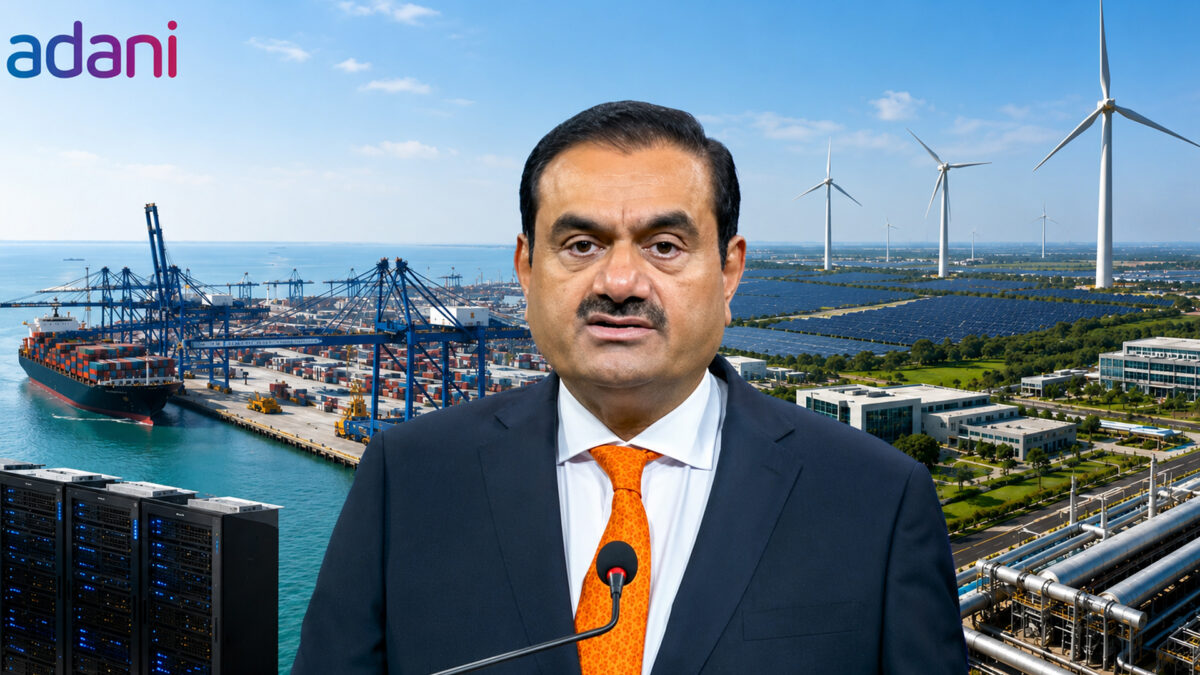
Adani Group chairman Gautam Adani has called on India’s credit-rating agencies to rethink how they assess large infrastructure projects, arguing that traditional rating models may not fully capture the wider economic and strategic value created by modern infrastructure platforms.
Speaking at the CareEdge Ratings Infrastructure Landscape 2026 event in Mumbai on Monday, Adani said India does not need easier credit standards but a broader approach to evaluating infrastructure. He urged rating agencies to look beyond the financial performance of individual projects and consider how interconnected infrastructure can create new businesses, markets, jobs and industrial ecosystems.
“India does not need lower standards. India needs wider lenses,” Adani said, calling on CareEdge to develop what he described as a comprehensive credit framework for what he termed “integrated platform infrastructure”.
The argument comes at a time when India is rapidly expanding its infrastructure network across ports, airports, renewable energy, power transmission, logistics, digital infrastructure and manufacturing. Large projects are increasingly being developed as interconnected platforms rather than as standalone assets.
According to Adani, this changing nature of infrastructure requires credit-rating agencies to update their assessment methods. A project may initially appear risky when judged only on its own cash flows, but its broader contribution to an industrial ecosystem could become significant over time.
He broadly divided infrastructure into three categories. The first is replacement infrastructure, where existing rating methodologies can continue to work reasonably well. The second is growth infrastructure, where the wider economic impact of a project needs greater consideration. The third is platform infrastructure, where a project can create entirely new markets, capabilities and industrial clusters.
Adani argued that the third category is becoming increasingly important as India pushes towards its long-term economic ambitions. Such projects can have effects that go well beyond the asset itself. A large port, for instance, can support logistics companies, manufacturing units, warehouses, transport networks and export-oriented industries around it.
The Adani Group chairman cited large infrastructure developments such as the Mundra and Vizhinjam ports as examples of projects whose impact can extend beyond the immediate revenue generated by the assets. These projects can act as platforms around which wider economic activity develops.
This is where Adani believes the current credit-rating framework may fall short. Conventional infrastructure ratings generally focus on factors such as project cash flows, debt levels, repayment capacity, operating performance and the risks associated with a particular asset.
While these measures remain important, Adani said they may not adequately reflect what he described as ecosystem multipliers, adjacency value and strategic resilience.
The debate is significant for investors and lenders, because credit ratings play an important role in determining how financial institutions assess risk and the cost at which companies and projects can borrow money. A rating that does not capture the full potential of a large infrastructure platform could, according to Adani’s argument, make financing more expensive or restrict access to capital.
India’s infrastructure expansion has also created a growing need for long-term financing. Projects such as renewable power generation, transmission networks, ports and logistics facilities typically require large amounts of capital and take years to generate returns.
A broader credit framework could potentially help lenders and investors distinguish between projects that carry conventional asset-level risks and those that could create wider economic benefits over time.
The call comes against the backdrop of India’s broader infrastructure push. The government has been increasing spending on roads, railways, ports, airports, power systems and digital infrastructure as part of its effort to strengthen connectivity and support economic growth.
Private-sector investment is also becoming increasingly important. Companies are participating in areas ranging from renewable energy and power transmission to logistics, manufacturing and data infrastructure.
The Adani Group itself has a significant presence across several infrastructure segments. Its businesses include ports, airports, energy, renewable power and transmission, giving the group a direct interest in how large infrastructure platforms are evaluated by lenders and rating agencies.
However, a broader rating methodology would not mean lowering standards or ignoring financial risks. The central issue raised by Adani is whether existing models should be expanded to account for benefits that emerge from interconnected infrastructure.
The distinction is important for credit-rating agencies because any new framework would still need to maintain rigorous assessment of debt servicing ability, project execution, cash flows and financial resilience.
The discussion also comes at a time when rating agencies are closely assessing India’s economic prospects and infrastructure investment. S&P Global Ratings recently affirmed India’s sovereign rating while maintaining a stable outlook, citing policy stability and infrastructure investment as positive factors, although it also pointed to fiscal and debt-related constraints.
The challenge for India is to ensure that infrastructure financing keeps pace with the scale and complexity of projects being planned. As infrastructure increasingly connects multiple sectors of the economy, the way risk is measured could become just as important as the amount of capital available.
Adani’s proposal therefore puts the spotlight on a larger question: whether India’s credit-rating framework is evolving quickly enough to assess the infrastructure that could shape the country’s next phase of economic growth.