
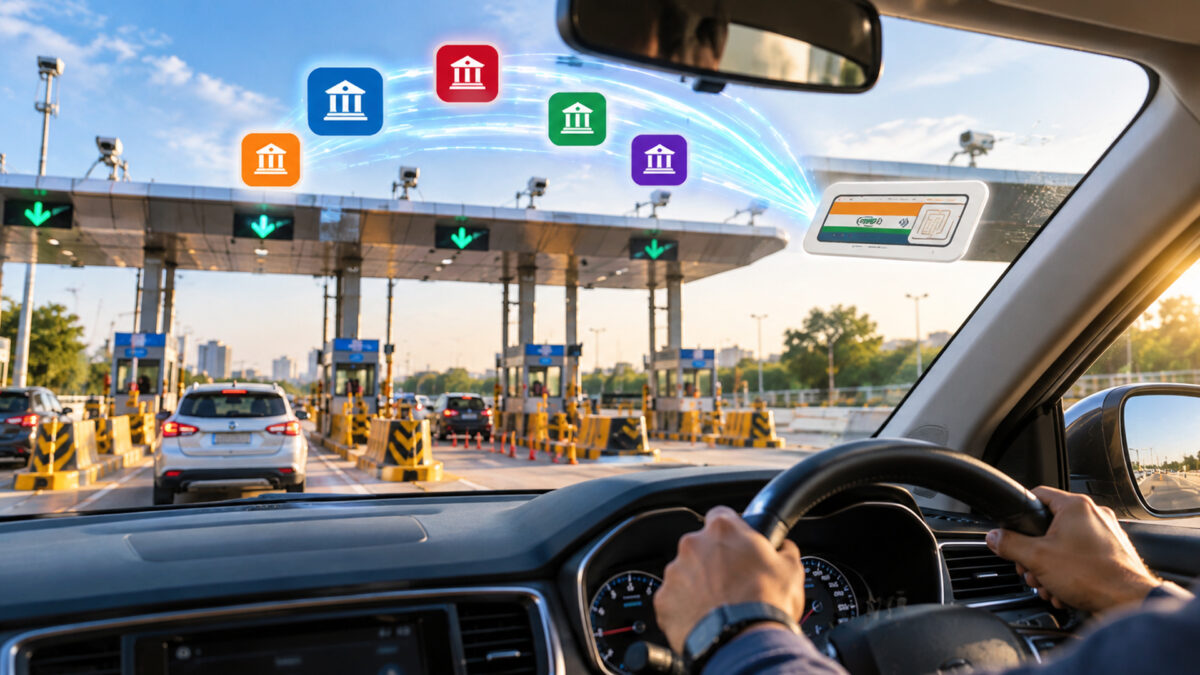
India is moving towards a new generation of highway tolling that could eventually eliminate the need to stop at toll plazas. The government has set a target of implementing barrier-free toll collection nationwide by March 2027, using technologies that can identify vehicles and process payments while they remain in motion.
Union Road Transport and Highways Minister Nitin Gadkari announced the plan on September 11, saying the government is working to expand Multi-Lane Free Flow (MLFF) tolling across the country. The technology is designed to allow vehicles to travel through tolling zones without passing through conventional booths and barriers.
The proposed system will rely on a combination of FASTag and Automatic Number Plate Recognition (ANPR). Cameras will read vehicle number plates, while FASTag technology can be used to link the vehicle to its digital toll account. The approach is intended to make toll collection largely automatic.
The government wants 60-70% of toll plazas to be covered by the new system by December, with nationwide implementation expected by February-March 2027. India currently has around 1,200 toll plazas operated by the National Highways Authority of India (NHAI) and private concessionaires.
The change marks a significant shift from the current FASTag model. Although FASTag has made toll payments cashless, motorists still have to slow down while approaching toll plazas and pass through designated lanes. MLFF aims to remove that bottleneck completely.
FASTag adoption has already created the digital infrastructure needed for the transition. Gadkari said FASTag penetration has reached about 98%, with around 13 crore FASTags issued across the country. Digital toll collections through FASTag have reached approximately ₹82,500 crore.
The next step is to make the technology work without a physical toll barrier.
A barrier-free system could have a major impact on traffic movement, particularly at busy toll points. Vehicles would no longer have to form long lines during weekends, holidays or peak travel periods. Reduced idling could also cut fuel consumption and improve overall highway efficiency.
Government estimates suggest the potential savings could be substantial. Gadkari said reduced waiting at toll plazas could save approximately 71 crore hours and 56 crore litres of fuel every year. The value of the time saved has been estimated at around ₹68,500 crore annually, while fuel savings could amount to approximately ₹5,250 crore.
The technology could also lower the cost of operating toll infrastructure. Toll-plaza operations and maintenance currently account for about 12-15% of costs, according to Gadkari. Under a barrier-free model, this could fall to around 2-4%, potentially saving ₹6,000-7,000 crore every year.
The government has also introduced a new FASTag-related facility called OneTag, aimed at giving motorists greater control over their digital toll accounts.
OneTag allows users to change the bank or issuer linked to their FASTag without replacing the physical tag fitted to their vehicle. This means motorists can switch service providers while retaining the same FASTag.
The facility addresses a common inconvenience faced by FASTag users. Earlier, switching from one issuing bank to another could require the existing FASTag to be closed and a new one obtained. The physical sticker attached to the windscreen would then also have to be replaced.
OneTag is designed to work in a way similar to mobile number portability. A customer can move from one service provider to another without giving up the existing identifier.
The new facility has been developed by Indian Highways Management Company Limited (IHMCL), promoted by NHAI, in association with the National Payments Corporation of India (NPCI).
The introduction of OneTag comes as India’s FASTag network becomes increasingly central to highway toll collection. Giving users the ability to switch issuers could increase competition among banks and service providers while making the system more consumer-friendly.
MLFF and OneTag together point to a broader transformation of India’s highway payment infrastructure. OneTag improves flexibility at the user level, while MLFF changes the way tolls are physically collected on roads.
Digital identification could also strengthen toll monitoring. With ANPR cameras and electronic payment records working together, authorities can track toll transactions more efficiently and reduce dependence on manual collection.
The biggest test will be implementation. India has a vast highway network, and introducing barrier-free tolling will require significant investment in cameras, sensors, payment systems and supporting digital infrastructure.
Accurate number-plate recognition will be particularly important. The system will also need reliable integration between ANPR technology, FASTag accounts and toll databases to ensure that genuine users are charged correctly.
A successful rollout could eventually make the familiar toll booth a thing of the past on major highways. Instead of slowing down, finding the correct lane and waiting for the barrier to lift, motorists could simply continue driving while technology handles the toll transaction in the background.
India has already moved from cash-based toll collection to FASTag. The next phase is aimed at taking that digital shift further — towards zero-stop, technology-driven tolling.
If the March 2027 target is met, the experience of travelling on Indian highways could change significantly, with less waiting, lower fuel wastage and a smoother journey becoming the new standard.