
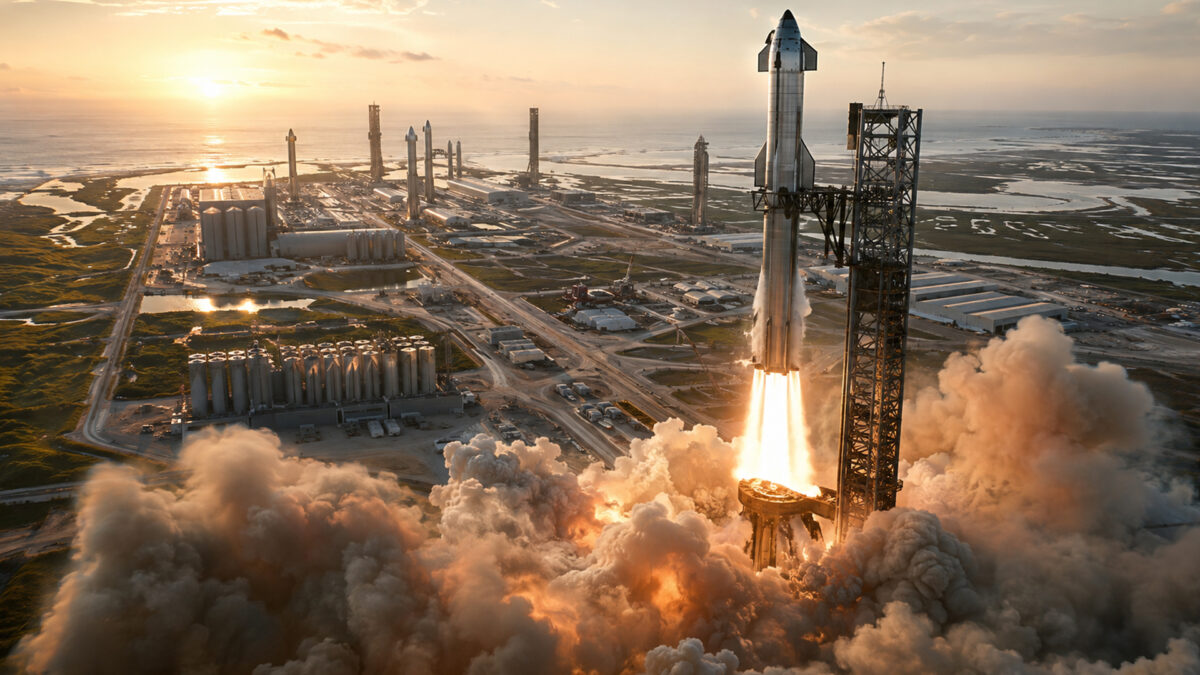
Elon Musk’s SpaceX has unveiled plans for a huge new rocket-launching complex in southern Louisiana, with an estimated investment of $100 billion. Called Starbase Louisiana, the proposed facility is expected to become SpaceX’s largest launch site and one of the biggest commercial spaceports in the world.
The facility will be developed on a vast 125,000-acre site at Pecan Island in Vermilion Parish, along Louisiana’s Gulf Coast. SpaceX plans to begin construction in 2027, with the first Starship launch from the location targeted for 2029.
The project represents a major expansion of SpaceX’s Starship programme. The company currently operates its main Starship development and launch activities from Texas and is also developing launch infrastructure in Florida. Starbase Louisiana would give SpaceX another major base from which to launch its next-generation reusable rocket.
SpaceX says the Louisiana facility will eventually support thousands of Starship flights each year. The site is planned to have more than a dozen launch towers, with the company targeting the ability to conduct more than 30 Starship flights a day once the complex reaches full capacity.
That ambition is closely linked to Musk’s broader goal of making spaceflight far more frequent. SpaceX wants Starship to become a highly reusable transportation system capable of carrying satellites, cargo and eventually people into space. A much higher launch frequency would also help reduce the cost of sending payloads into orbit.
The Louisiana spaceport is expected to function as much more than a collection of rocket launch pads. Plans include facilities for rocket processing, propellant production, power generation and shipping, along with other infrastructure needed to support a large-scale space operation. The site could also eventually include an airport.
One of the project’s important advantages is its location. The Gulf Coast provides SpaceX with access to large quantities of natural gas, which can be used to produce methane fuel for Starship. Its position also offers different launch trajectories over the Gulf of Mexico.
The facility is expected to play a role in SpaceX’s growing satellite business, particularly its Starlink network. Starship is being developed to carry substantially larger payloads than SpaceX’s existing Falcon 9 rocket, potentially allowing the company to deploy satellites on a much larger scale.
SpaceX has also linked Starship to longer-term ambitions beyond Earth orbit. The company sees the vehicle as a key part of future missions to the Moon and Mars, while NASA is counting on Starship technology for elements of its Artemis lunar programme.
The project could bring a significant economic boost. SpaceX expects the development to create more than 3,000 direct jobs over the next decade, with an average salary of around $92,600. State officials are presenting the investment as an opportunity to establish Louisiana as a major centre for the growing commercial space industry.
The project is not without controversy, however. The proposed site includes extensive coastal wetlands, which provide important habitat for wildlife and help protect inland communities from flooding. Environmental groups have raised concerns about the potential impact of construction, rocket launches and industrial activity on the sensitive coastal ecosystem.
SpaceX has sought to address those concerns by promising environmental restoration and protection efforts. Company president and chief operating officer Gwynne Shotwell has said the company intends to preserve and restore parts of the surrounding wetland environment while developing the launch complex.
The Louisiana project also comes at an important stage in Starship’s development. SpaceX has spent years testing the massive reusable rocket, which consists of the Super Heavy booster and Starship spacecraft. The company’s long-term strategy depends on both stages being rapidly reusable, allowing them to fly repeatedly rather than being discarded after each mission.
That technical challenge is critical to the Louisiana plan. Building dozens of launch towers would have little value unless Starship can achieve the reliability and turnaround times required for such a high launch rate. Regulatory approvals, environmental reviews and the construction of supporting infrastructure will also determine how quickly the project can move forward.
Still, SpaceX is betting heavily on the idea that the future of space travel will depend on scale, reusability and frequent launches. Starbase Louisiana is designed around exactly that philosophy.
If the project develops as planned, Louisiana could become a major launch hub for Starship, Starlink satellites, lunar missions and future deep-space exploration. The first launch remains several years away, but SpaceX’s $100 billion commitment signals how seriously the company is preparing for an era in which rockets could fly far more frequently than they do today.