
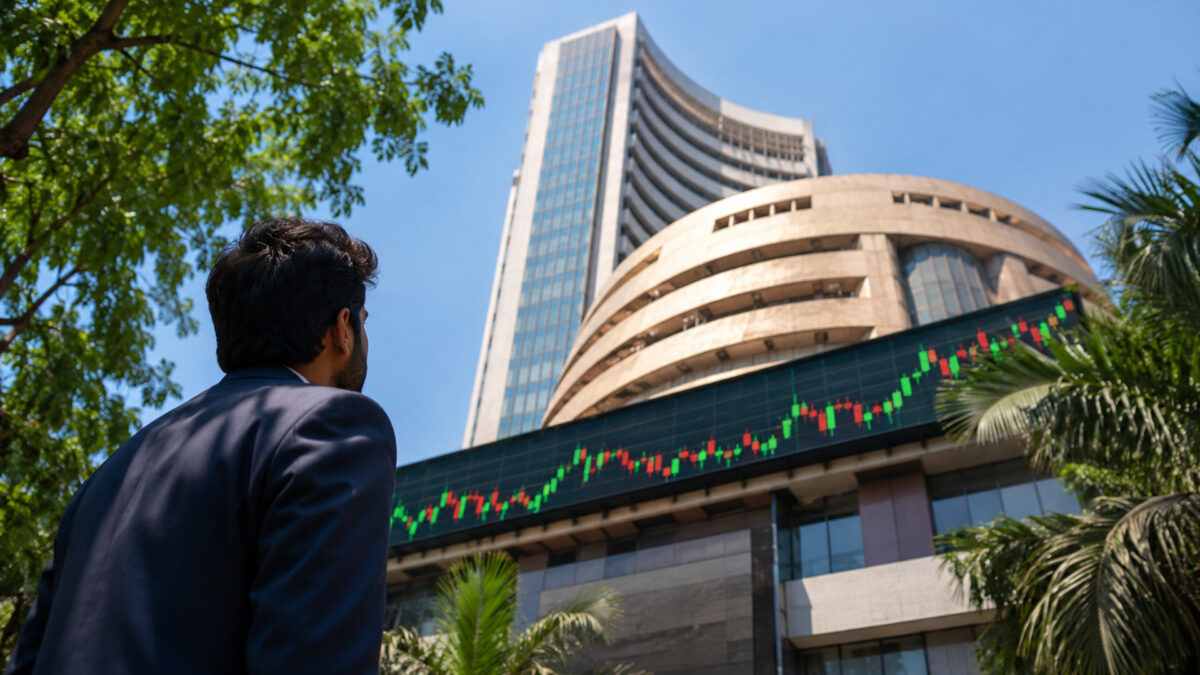
Indian stock markets showed resilience on Friday, November 6, with the Sensex rising nearly 600 points and the Nifty 50 trading above the 24,650 mark, despite a sharp selloff across major global markets. Gains in information technology (IT), pharmaceutical, private banking and healthcare stocks helped domestic benchmark indices recover from a cautious opening.
The recovery came even as Asian markets witnessed heavy losses following a technology-led selloff on Wall Street. Concerns over artificial intelligence (AI) valuations, slowing investments in AI infrastructure and disappointing corporate results triggered widespread selling in global technology stocks.
The BSE Sensex advanced around 600 points during the morning session, while the NSE Nifty 50 crossed 24,650. The market’s performance stood out against the weakness across major Asian indices, highlighting the relative strength of Indian equities.
However, trading remained volatile, with investors closely tracking global developments, foreign institutional investor (FII) activity, crude oil prices and corporate earnings.
The initial signals had pointed towards a weak start. GIFT Nifty was trading around 24,426 in early trade, down approximately 173 points or 0.71%, indicating that domestic markets could open lower. The Sensex and Nifty began the session on a cautious note, with the Nifty initially slipping below 24,500.
Buying interest subsequently returned, helping the benchmark indices move higher. The rebound was supported by selective buying in heavyweight stocks, particularly IT and financial shares.
Information technology stocks emerged among the key performers on Friday as investors reassessed opportunities following the sharp decline in global technology shares.
Shares of Infosys, Tata Consultancy Services (TCS), Wipro and other IT companies attracted buying interest, with several stocks gaining up to 3% during early trading.
The movement reflected a shift in investor sentiment towards Indian technology companies amid concerns surrounding the global AI investment cycle. While US technology companies faced selling pressure, Indian IT stocks benefited from expectations that their business models and relatively lower exposure to the AI investment frenzy could provide some insulation.
The Nifty IT index gained around 1.3% during the session, taking its gains over the previous two trading sessions to nearly 4%.
Pharmaceutical, private banking and healthcare stocks also contributed to the market’s recovery. However, the gains were not widespread across all sectors.
Metal, real estate, chemicals, oil and gas, FMCG and cement stocks witnessed selling pressure. Realty shares were particularly weak, with some stocks declining as much as 5%.
The India VIX, which measures expected market volatility, climbed around 8%, indicating continued nervousness among traders despite the recovery in benchmark indices.
The weakness in Indian markets at the opening was largely influenced by the sharp decline on Wall Street overnight.
The Dow Jones Industrial Average plunged more than 1,800 points on Thursday, November 5, reversing the gains recorded after the US midterm election results. The Nasdaq Composite declined 5.5%, while the S&P 500 dropped 4.4%.
The selloff affected companies across sectors, including technology, artificial intelligence and data centre businesses. Disappointing results from Qualcomm and concerns about slowing spending on AI infrastructure added to investor worries.
The decline also reflected concerns that the Democrats’ gains in the US midterm elections could lead to tighter regulations on the artificial intelligence industry.
The weakness spread across Asian markets on Friday. South Korea’s Kospi plunged more than 8% in early trading, triggering a 20-minute circuit breaker. The index slipped below the 5,000 mark for the first time in nine months.
Japan’s Nikkei 225 declined more than 6%, while Taiwan’s Taiex continued its losing streak. Hong Kong and Chinese markets also traded lower.
The sharp decline in semiconductor and technology shares was a major factor behind the regional selloff.
Despite the global uncertainty, renewed foreign investment has emerged as an important source of support for Indian equities.
Foreign institutional investors purchased Indian stocks worth approximately ₹15,000 crore on Thursday, November 5. The buying marked their strongest single-day net investment in nearly six years and reflected a shift in global investment preferences.
Foreign investors had remained cautious towards Indian equities for much of 2026, partly due to elevated crude oil prices, currency weakness and opportunities in overseas technology markets.
However, recent developments have encouraged some investors to reconsider their exposure to Indian stocks.
The outcome of the US midterm elections, declining crude prices and expectations of a possible easing of geopolitical tensions have contributed to improving market sentiment.
Foreign investors also purchased ₹13,112 crore worth of Indian equities during the second half of October, with IT and telecommunications stocks attracting significant interest.
The decline in crude oil prices has also played an important role in supporting the domestic market.
Lower oil prices are generally positive for India because the country depends heavily on imports to meet its energy requirements. A sustained decline can help reduce inflationary pressure, ease the import bill and improve the financial outlook for oil-consuming industries.
On Thursday, November 5, the Sensex surged 2,008.61 points, or 2.60%, to close at 79,310.01. The Nifty 50 gained 576 points, or 2.40%, to settle at 24,536.60.
The rally followed improving global sentiment, foreign investor buying and optimism surrounding the US political developments.
The combined market capitalisation of BSE-listed companies also crossed the ₹500 lakh crore milestone for the first time, reaching approximately ₹502 lakh crore.
Market experts maintained a broadly positive outlook for Indian equities but cautioned that volatility could continue in the near term.
Technical analysts identified 24,200 as an immediate support level for the Nifty 50, while 24,000 remains an important positional support. On the upside, resistance is placed around 24,800 and 25,000.
For the Sensex, analysts highlighted the importance of sustaining recent gains, while warning that elevated technical indicators could trigger intermittent profit booking.
Investors are also expected to monitor quarterly earnings, foreign fund flows, crude oil movements and developments in global technology stocks.
The contrast between Indian equities and other Asian markets suggests that domestic investors are responding to a different set of factors, including foreign inflows, sector-specific opportunities and relatively lower exposure to the global AI trade.
Nevertheless, the sharp movement in international markets remains a significant risk. Investors are likely to remain cautious as they assess whether the current recovery can continue despite uncertainty surrounding global technology valuations and geopolitical developments.