
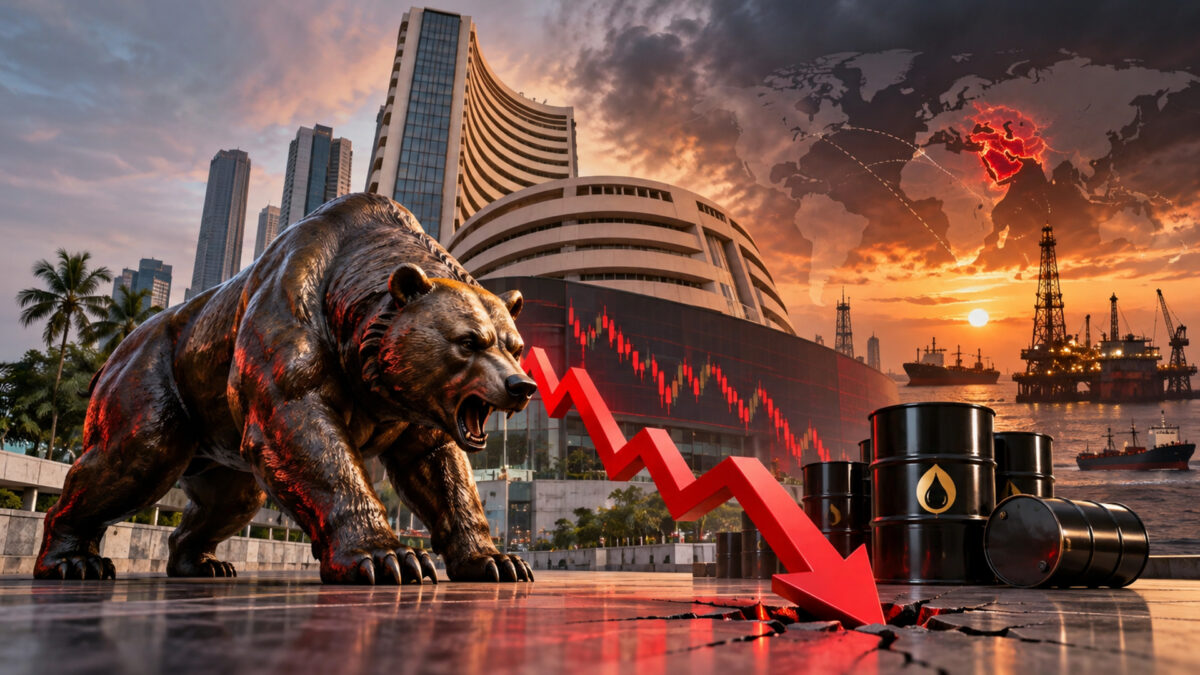
The equity markets ended lower on Friday, November 13, snapping a three-day winning streak as rising crude oil prices, higher retail inflation and cautious global sentiment triggered selling across key sectors. The benchmark indices came under pressure throughout the session, with investors booking profits after the recent rally despite continued foreign institutional buying.
The BSE Sensex declined 318.56 points, or 0.39%, to settle at 81,592.45. The NSE Nifty 50 dropped 155.05 points, or 0.61%, to close at 25,144.30, slipping below the crucial 25,150 mark. The decline followed three consecutive sessions of gains, although both indices managed to retain weekly advances.
The Sensex had fallen more than 600 points during intraday trading before recovering some losses towards the close. The Nifty also touched an intraday low of around 25,054 before staging a partial recovery. The selling pressure reflected growing concerns about inflation, interest rates and the impact of higher energy prices on the Indian economy.
Among Nifty 50 stocks, Shriram Finance emerged as the biggest loser, declining 3.37%. Tata Motors Passenger Vehicles followed with a fall of 3.31%, while Grasim Industries dropped 2.60%. Hindalco Industries declined 2.12%, and Adani Enterprises lost 1.95%.
On the other hand, Eicher Motors was the top gainer, rising 1.34%. Bharti Airtel advanced 1.12%, while Nestle India gained 0.66%. Oil and Natural Gas Corporation (ONGC) added 0.47%, and Asian Paints edged up 0.45%.
The weakness was also visible in the broader market, although mid- and small-cap stocks showed relatively limited declines compared with the frontline indices. Banking, automobile, financial and other heavyweight stocks contributed to the pressure on the benchmarks.
A major factor weighing on investor confidence was India’s latest retail inflation data. Consumer Price Index (CPI)-based inflation increased to 6.09% in October from 5.54% in September, crossing the Reserve Bank of India’s upper tolerance limit of 6% for the first time in two years.
Food inflation was a significant contributor to the increase, rising to 8.94% in October from 7.74% in the previous month. Higher food and beverage prices, along with increases in restaurant services and transport costs, added to household expenses and pushed overall inflation higher.
The latest inflation reading has raised concerns about the Reserve Bank of India’s monetary policy outlook. Investors are assessing whether the central bank may adopt a more cautious approach to interest rate decisions at its December policy meeting.
Higher interest rates can increase borrowing costs for companies and consumers, potentially affecting investment, consumption and corporate profitability. This uncertainty has made investors more selective, particularly towards rate-sensitive sectors such as banking, automobiles and real estate.
Crude oil prices added to the market’s concerns. Brent crude, the global oil benchmark, traded around $95.40 per barrel during the session, remaining significantly higher than the levels seen earlier in the week. Concerns over disruptions to global oil supplies, including tensions surrounding the Strait of Hormuz and attacks on energy infrastructure in Saudi Arabia, contributed to the elevated prices.
Higher crude oil prices are a concern for India because the country depends heavily on imports to meet its energy requirements. An increase in oil prices can raise the import bill, put pressure on the rupee and add to domestic inflation. It can also increase operating expenses for companies in sectors such as aviation, paints, chemicals and transportation.
Despite the market decline, foreign institutional investors (FIIs) continued to show strong interest in Indian equities. Foreign investors purchased shares worth Rs 7,830.60 crore on Thursday, according to provisional exchange data. Their buying streak extended to nine consecutive sessions, with November inflows reaching around $8 billion, the highest monthly inflow since December 2020.
The continued foreign buying has provided some support to domestic equities, particularly after the recent recovery. However, investors remained cautious as rising inflation and crude oil prices threatened to offset the benefits of foreign fund inflows.
Global market movements also influenced domestic trading. US equities ended lower on Thursday following weakness in technology stocks, particularly Nvidia. The Dow Jones Industrial Average, S&P 500 and Nasdaq Composite all closed in negative territory.
Asian markets presented a mixed picture on Friday. South Korea’s Kospi and Hong Kong’s Hang Seng faced pressure, while Japan’s Nikkei and other regional markets showed some resilience. Uncertainty over US interest rates and global economic growth continued to influence investor decisions.
Despite Friday’s decline, the Indian benchmarks ended the week in positive territory. The Sensex gained around 0.7% during the week, while the Nifty advanced approximately 0.5%. This indicated that the latest correction had not completely erased the gains recorded during the previous sessions.
Market participants are now likely to track domestic inflation, crude oil movements, foreign investment flows and developments in global markets for further direction. The RBI’s upcoming monetary policy decision will also remain important as investors assess the possibility of tighter financial conditions.
For the near term, the Nifty’s ability to regain and sustain levels above 25,150 will be important for market sentiment. Persistent inflationary pressure, expensive crude oil and uncertainty over interest rates could encourage further profit-booking. However, continued foreign investor buying, domestic economic activity and corporate earnings could provide support.
Friday’s session therefore marked a pause in the recent market recovery, with investors choosing caution over aggressive buying as economic uncertainties increased.