
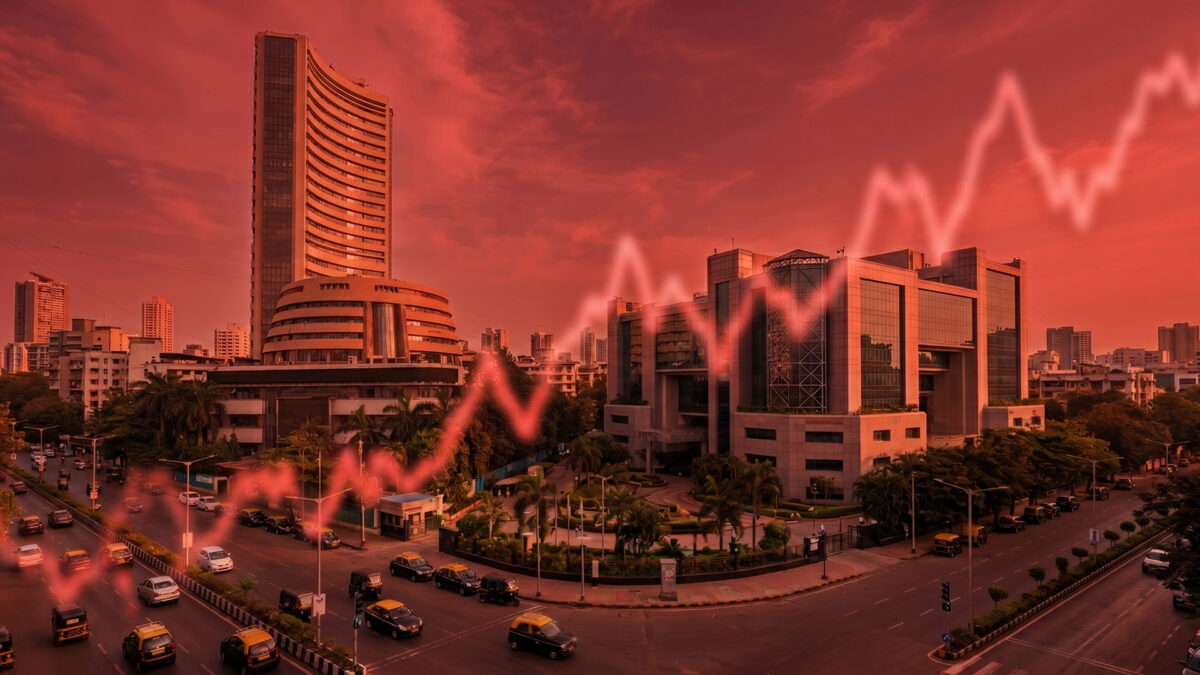
Indian stock markets ended lower on Friday, October 23, as rising crude oil prices, escalating tensions in West Asia and weak global cues weighed on investor sentiment. The BSE Sensex declined 125.56 points, or 0.17%, to close at 73,123.83, while the NSE Nifty 50 fell 87.65 points, or 0.39%, to settle at 22,600.
The benchmark indices opened higher, supported by buying in information technology stocks, but the recovery failed to last. Selling pressure returned as investors assessed the impact of expensive oil on inflation, corporate earnings and India’s economic outlook.
The broader market suffered heavier losses, with the Nifty Midcap 100 declining 2.21% and the Nifty Smallcap 100 plunging 2.94%. The sell-off indicated that investors were reducing exposure to riskier stocks amid rising volatility.
Crude oil prices remained a major concern for Dalal Street. Brent crude traded around $113-$114 per barrel as geopolitical tensions in West Asia raised fears of disruptions to global energy supplies. Reports of escalating hostilities involving Yemen’s Houthis and Saudi Arabia added to uncertainty in the oil market.
India imports a substantial share of its crude oil requirements, making the economy vulnerable to sustained increases in energy prices. Higher oil prices can increase the import bill, put pressure on the rupee and raise costs for businesses in sectors such as aviation, transportation, chemicals and manufacturing.
Expensive energy can also fuel inflation, potentially limiting the scope for interest-rate cuts. Investors therefore remain concerned that prolonged oil price increases could affect consumption, company margins and economic growth.
Weak global cues added to the pressure, with US equities declining in the previous session. Foreign investor selling and concerns about market valuations further contributed to the cautious mood.
The Sensex rose more than 500 points at its intraday high, while the Nifty 50 climbed above 22,750 during early trading. However, the gains faded as selling intensified across sectors.
The indices eventually closed in negative territory, extending their recent losing streak. For the week, the Sensex declined around 2.2%, while the Nifty fell approximately 2.4%.
The broader market recorded steeper weekly losses. Mid-cap stocks fell around 5.6%, while small-cap shares dropped approximately 7.3%, marking their weakest weekly performances in about 20 months, according to market reports.
Analysts attributed the pressure to stretched valuations, the unwinding of leveraged positions and rising volatility. When uncertainty increases, investors often prefer more liquid stocks and reduce exposure to smaller companies, which can experience sharper price movements.
Information technology shares provided some support to the market. Tata Consultancy Services (TCS), Eternal and Infosys were among the notable gainers during the session, while HCL Technologies also traded higher in the midday market snapshot.
TCS rose 2.03% and Eternal gained 1.76% in the snapshot published around noon. Infosys advanced 0.98%, while HCL Technologies edged up 0.41%. These figures reflect intraday movements and may differ from final closing prices.
On the losing side, Tata Steel, Hindalco Industries and Tata Motors Passenger Vehicles faced notable selling pressure. Tata Steel fell 3.74%, Hindalco declined 3.34%, and Tata Motors PV dropped 3.09% in the midday snapshot. Jio Financial Services and NTPC also recorded losses.
Metal stocks were among the weakest performers, with the Nifty Metal index declining 2.71%. Concerns about global demand, commodity price volatility and the economic impact of expensive oil weighed on the sector.
Foreign institutional investors sold Indian equities worth approximately Rs 3,459 crore on Thursday, October 22, while domestic institutional investors purchased shares worth around Rs 2,891 crore, according to exchange data.
Domestic buying offered some support but was insufficient to offset concerns about foreign fund outflows and global uncertainty.
Investors were also monitoring the Jio Platforms initial public offering, which attracted strong demand. Large public issues can temporarily absorb liquidity as investors set aside funds to participate, although this was only one of several factors influencing market sentiment.
The direction of crude oil prices, developments in West Asia and upcoming corporate earnings are likely to remain important triggers for Indian equities. Investors will also monitor foreign fund flows, inflation trends and signals from global central banks.
Friday’s session highlighted the fragile state of market sentiment. While select technology stocks attracted buying interest, sharp losses in metal, mid-cap and small-cap shares showed that investors remained cautious.
A sustained recovery may depend on easing geopolitical tensions, greater stability in oil prices and evidence that companies can protect earnings against rising costs. Until then, market volatility is likely to remain elevated, making stock-specific developments and risk management particularly important for investors.