
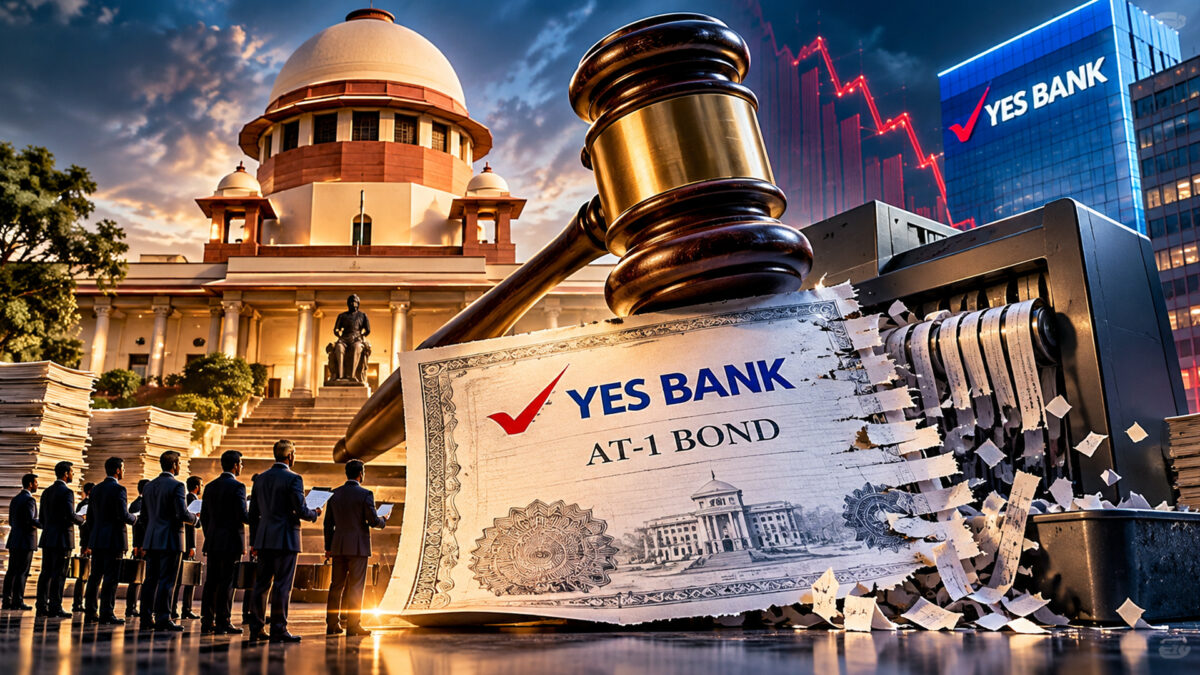
The Supreme Court has dealt a major setback to YES Bank by upholding a ruling that declared its ₹8,415-crore Additional Tier-1 (AT1) bond write-off illegal. The October 15 judgment brings the rights of affected bondholders back into focus and raises fresh questions about the bank’s capital position following its 2020 rescue.
YES Bank has said it is examining the judgment in detail and evaluating the legal options and other steps available to it. The lender has also stated that it has capital-management measures at its disposal and can consider additional action if required.
The decision follows a long legal battle over bonds that were permanently written off when the bank was undergoing a financial crisis in March 2020. The Supreme Court dismissed appeals filed by YES Bank, the Reserve Bank of India (RBI) and the Union government, upholding the Bombay High Court’s January 2023 judgment.
The ruling has significant implications for the bank, investors who held the bonds and the wider banking sector, where AT1 instruments are used to strengthen capital and absorb losses during periods of financial stress.
The immediate market reaction was sharp. YES Bank shares fell 14.43% on October 15 to close at ₹18.15, reflecting investor concerns about the potential financial consequences of the judgment.
The bank’s next steps will depend on its assessment of the court order, the regulatory requirements and the effect on its capital ratios.
The dispute dates back to the bank’s financial troubles in 2020, when authorities stepped in to stabilise the lender. A reconstruction scheme was introduced, and an administrator was appointed to oversee the process. As part of the restructuring, AT1 bonds worth ₹8,415 crore were written off.
The bonds had been issued in two tranches. YES Bank raised ₹3,000 crore through an issue in December 2016 and another ₹5,415 crore in October 2017. Bondholders challenged the decision, arguing that the administrator did not have the authority to permanently cancel the instruments under the approved reconstruction scheme.
Axis Trustee Services, acting on behalf of bondholders, approached the Bombay High Court. In January 2023, the court set aside the write-off, finding that the reconstruction scheme did not authorise the administrator to take that step after the scheme had come into force.
YES Bank and the authorities challenged the decision before the Supreme Court. The top court has now upheld the High Court’s ruling, leaving the bondholders’ legal victory intact.
The judgment centres on the limits of an administrator’s powers under the reconstruction scheme. It does not mean that every AT1 bond issued by a bank is protected from losses. Instead, it underlines the importance of following the applicable rules and the terms of an approved restructuring plan when such instruments are written down.
AT1 bonds are a type of bank capital designed to absorb losses when a lender comes under pressure. They generally carry higher risks than ordinary bank deposits and can have features that allow them to be written off or converted into equity under specified conditions. Investors may receive higher returns for accepting these risks, but they can also lose some or all of their investment.
The YES Bank case has therefore drawn attention to how such bonds are sold, how their risks are explained to investors and what powers banks have during a rescue. It also raises questions about how future bank reconstruction schemes should deal with existing investors and loss-absorbing capital.
The financial impact on YES Bank could be substantial. On October 16, the bank indicated that reinstating the AT1 bonds could reduce its common equity Tier-1 (CET1) capital ratio by 250 basis points, including the impact on profits, based on its position as of June 30, 2026. Its overall Tier-1 capital ratio is expected to remain at 14%, according to the bank’s disclosure.
CET1 capital is a bank’s highest-quality core capital and acts as a buffer against unexpected losses. A lower ratio can reduce the room a lender has to absorb financial shocks or expand its balance sheet without raising additional capital. The precise consequences will depend on how the judgment is implemented and the bank’s subsequent financial disclosures.
YES Bank has said it respects the Supreme Court’s decision and remains focused on serving customers and maintaining its business. It will now need to assess the capital implications while deciding whether any further legal or financial steps are appropriate.
The ruling marks an important moment in the bank’s recovery after its 2020 crisis. It also sends a wider message to lenders and regulators: the use of risk-bearing financial instruments during a rescue must remain within the limits of the law. For bondholders, the decision restores an important legal protection, while for YES Bank, the challenge is to manage the financial consequences without weakening confidence in its future.