
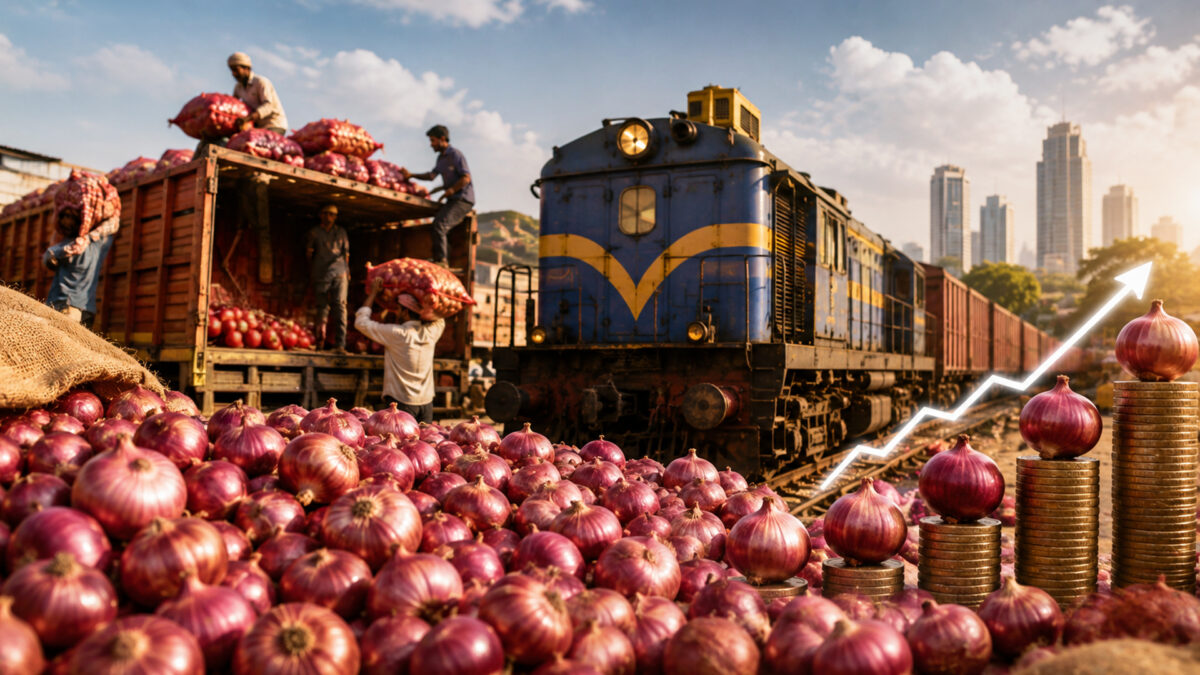
Onion prices have risen sharply across several parts of India, putting fresh pressure on household budgets and prompting the Centre to step in with emergency measures. From Monday, August 24, the government has started operating special trains, called Kanda Express, to move onions from Nashik in Maharashtra to major consumption centres where prices have climbed well above the national average.
The move comes after the average retail price of onions rose to around ₹42 per kg, according to official data. This is nearly 45% higher than the price a year ago and about 19% above the level recorded a month earlier. The sharp increase has become a concern for consumers as onion is a daily kitchen staple and a sustained rise can add to overall food inflation.
The government has identified Delhi, Chennai, Kochi and Guwahati as key destinations for the Kanda Express because onion prices in these markets are significantly higher than the national average. The idea is straightforward: move stocks from regions where supplies are relatively comfortable to markets where consumers are paying more.
Delhi has seen one of the steepest increases. Retail onion prices have reached around ₹65 per kg, compared with about ₹35 per kg a year earlier. In Chennai, prices have climbed to nearly ₹58 per kg, against ₹33 per kg last year. Onion prices have also remained elevated in parts of Kerala and Assam.
For households, the increase is particularly noticeable because onions are used regularly in Indian cooking. A rise of even ₹10-20 per kg can add to monthly grocery bills, especially for families that buy onions in larger quantities. Restaurants, hotels and food businesses are also likely to feel the impact because onions are a basic ingredient in a wide range of dishes.
The current price rise has been linked mainly to lower onion output and tighter supplies. When arrivals fall while demand remains steady, wholesale prices tend to rise, eventually pushing up retail rates. The government is therefore trying to address the immediate supply imbalance rather than allowing prices to rise further.
The Kanda Express is one part of that response. The Centre is also preparing to release onions from its buffer stock into the market. The aim is to increase availability in areas where prices have risen sharply and provide some relief to consumers.
The government’s buffer-stock strategy is not new. Onions are among the essential commodities for which the Centre maintains stocks that can be released when prices rise sharply. By bringing additional supplies into the market, authorities hope to reduce the gap between demand and availability and prevent a further escalation in prices.
The latest intervention also highlights the importance of India’s onion supply chain. Maharashtra is one of the country’s major onion-producing states, with Nashik serving as an important production and trading hub. Moving onions directly from the region to major consuming centres by rail can help transport larger quantities more efficiently and quickly than relying entirely on road movement.
The key question for consumers is how quickly the additional supply will translate into lower onion prices in local markets. The government intervention may take some time to work through the supply chain, particularly if wholesale and retail traders are holding stocks purchased at higher prices.
The Centre is also monitoring the production outlook to assess whether the current shortage is temporary or likely to continue. If arrivals improve in the coming weeks, prices could ease naturally. But if supplies remain tight, further intervention may be required.
The timing is important because rising prices of other food items could add to household expenses. Sugar prices, for instance, have also moved higher in recent weeks. Official data cited in reports showed retail sugar prices at around ₹62.50 per kg on August 22, compared with ₹46 per kg a month earlier. In Delhi and Mumbai, prices were around ₹65 and ₹69 per kg respectively.
The combination of higher onion and sugar prices could add to concerns over food inflation, particularly if the increases persist. Onion prices are closely watched by policymakers because of their importance in household consumption and their potential impact on food-price expectations.
The government will therefore be hoping that the Kanda Express and the release of buffer stocks can improve availability quickly. The special trains are expected to transport onions from Nashik to markets where prices have risen significantly, helping bridge the supply gap.
The initiative also provides a reminder of how quickly agricultural prices can change. Even when overall production appears adequate, differences in regional supply, transportation costs, storage and market arrivals can create sharp price variations between cities.
For consumers in Delhi, Chennai, Kochi, Guwahati and other affected markets, the immediate concern is simple: when will onion prices come down? The answer will depend on how much additional stock reaches the markets and whether fresh arrivals improve.
The Centre’s strategy is focused on increasing supplies and preventing further price escalation. The Kanda Express, alongside the release of buffer-stock onions, is expected to play a key role in that effort.
If the additional supplies reach deficit markets quickly, consumers could see some relief in the coming days. But with production and arrivals still being closely monitored, the government will need to keep a close watch on the market to ensure that the latest onion price surge does not turn into a prolonged food inflation problem.