
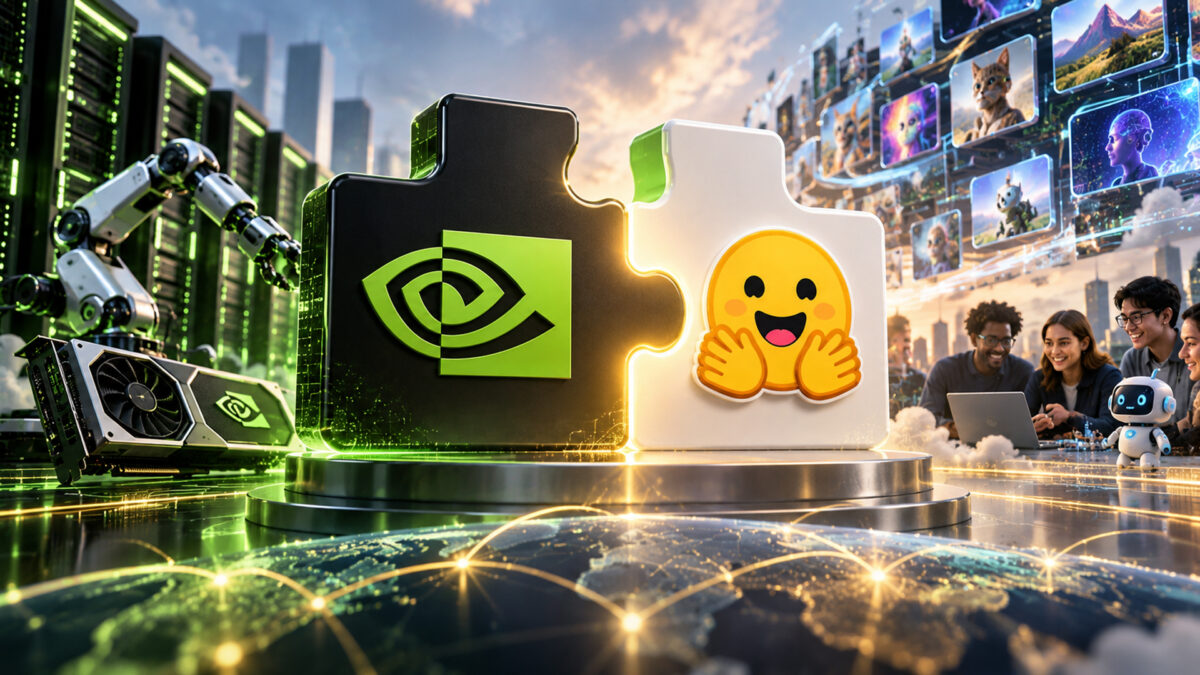
Nvidia is moving beyond the chips that power artificial intelligence and deeper into the software that helps build it.
The company has agreed to acquire Hugging Face for about $12.9 billion, bringing one of the most widely used platforms for artificial intelligence models and developer tools into Nvidia’s growing AI ecosystem.
The deal announced on September 3 is a major bet on the future of open AI. Hugging Face has become a central meeting place for developers, researchers and companies working with machine learning. Its platform allows users to find, share, test and customise AI models and datasets, while also providing tools for building and deploying applications.
For Nvidia, the attraction is clear. The company already dominates the hardware side of the AI boom, supplying the GPUs used in data centres to train and run increasingly powerful models. Hugging Face gives it a stronger presence on the software side and, importantly, closer access to the developers deciding which models and tools will shape the next phase of AI.
Hugging Face has grown rapidly since it was founded in 2016. What started as a chatbot company evolved into an open AI platform used by millions of developers. The platform now hosts more than three million AI models, over 500,000 datasets and about one million applications, according to Nvidia. More than 18 million developers, researchers and creators use its services, while more than 200,000 companies have a presence on the platform.
That makes Hugging Face far more than another AI startup.
Its model repository has become an important part of the global machine-learning community. Developers can use the platform to experiment with different models, adapt them for specific tasks and move them into real-world applications.
This is particularly important as businesses look for alternatives to expensive, closed AI systems.
The AI industry has largely been shaped by powerful proprietary models developed by companies such as OpenAI and Anthropic. At the same time, open and open-weight models have gained momentum because they offer developers greater control over how the technology is used and customised.
Nvidia is clearly positioning itself for that shift.
The company has said Hugging Face will remain an open platform following the acquisition. Developers will continue to have the freedom to work with different models, frameworks and computing platforms rather than being forced to use Nvidia hardware.
That point could become important as regulators and competitors examine the deal.
Nvidia already has enormous influence over the AI computing market. Its GPUs have become the standard hardware for many AI workloads, giving the company a powerful position in the technology supply chain. Owning a major AI developer platform could further increase its influence across the industry.
By promising to preserve Hugging Face’s open approach, Nvidia is attempting to reassure developers that the platform will not become simply another channel for selling its own products.
For Hugging Face, the deal provides something equally valuable: access to Nvidia’s enormous resources.
The company has built a powerful developer community but operates in an increasingly expensive AI market. Training and running sophisticated models requires significant computing power, while demand for AI infrastructure continues to rise.
Joining Nvidia could give Hugging Face greater capacity to expand its platform and develop new services for developers and businesses.
The deal also reflects Nvidia’s changing ambitions.
For years, the company was primarily known for graphics processors used in gaming. The explosion of generative AI transformed that business, turning Nvidia into one of the most important companies in the global technology industry.
But the AI market is no longer standing still.
Technology giants are developing their own processors, while AI startups are competing to build models that require less computing power. Cloud providers are also offering customers a growing range of AI infrastructure options.
Nvidia therefore has an incentive to strengthen its position beyond hardware.
Hugging Face offers one route to do that. By owning a platform used by millions of AI developers, Nvidia can become more closely connected to the software, models and applications being built on top of AI infrastructure.
The financial terms underline the scale of the bet. Nvidia is expected to pay about $11.9 billion to Hugging Face shareholders, with up to another $1 billion in stock-based incentives intended to retain employees.
The price is particularly striking when compared with Hugging Face’s previous valuation. The company was valued at around $4.5 billion during its 2023 funding round, showing how dramatically the perceived value of AI platforms has increased in just a few years.
The acquisition also comes as questions around AI security and governance are becoming more important. Platforms hosting thousands of models and datasets face growing risks as AI systems become more capable and increasingly connected to real-world applications.
For Nvidia CEO Jensen Huang, the acquisition is ultimately about securing a place across the full AI technology stack.
The company already supplies much of the computing muscle. Hugging Face brings a huge community of people developing the applications that put that computing power to work.