
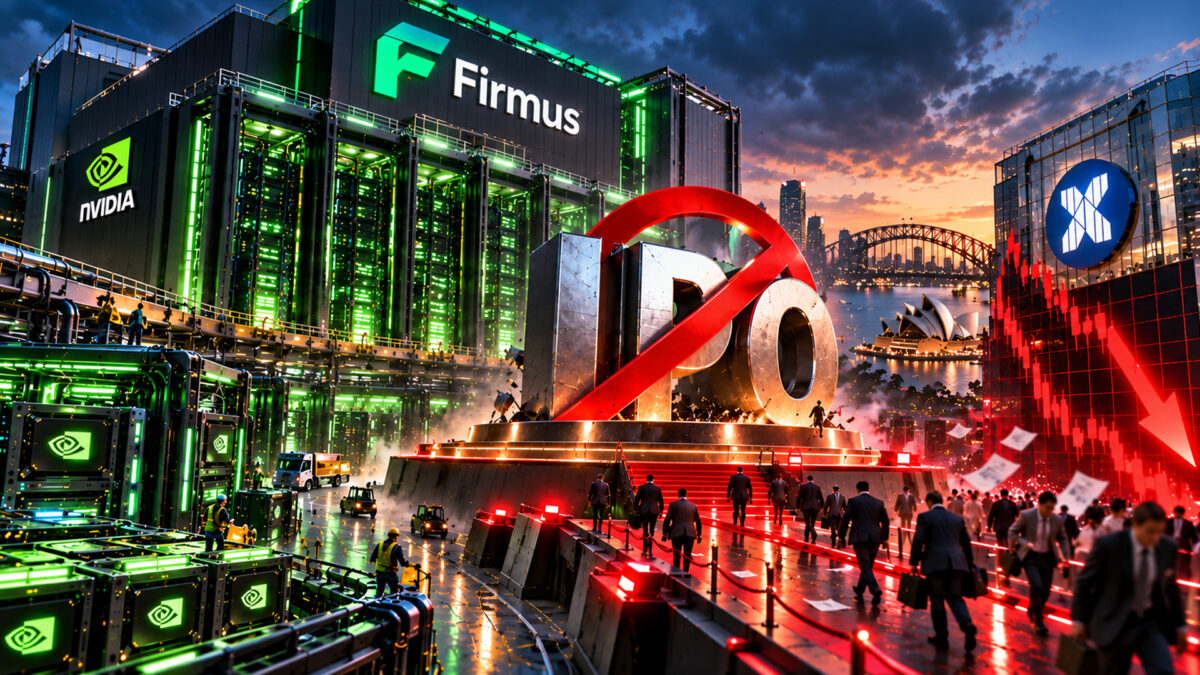
Nvidia-backed Australian data centre company Firmus has withdrawn its proposed $5 billion initial public offering (IPO), highlighting growing investor concerns over valuations, borrowing costs and the financial risks associated with the artificial intelligence boom.
The company abandoned its planned stock market debut on October 9 after market conditions failed to support the terms it was seeking. The decision marks a setback for one of Australia’s most anticipated listings and raises questions about how investors are valuing businesses racing to build infrastructure for AI.
Firmus had planned to list on the Australian Securities Exchange, with trading expected to begin on October 23. The offering was expected to be among the country’s largest share market listings, reflecting the growing appetite for companies linked to artificial intelligence.
The company said the prevailing market environment did not allow it to secure terms that adequately reflected its business strength and long-term growth potential. It will now explore alternative funding options and continue engaging with investors.
Valuation and funding concerns
Firmus had proposed selling shares at A$11 apiece, placing its valuation at approximately A$43.7 billion, or around $30.6 billion. The IPO was expected to raise about $5 billion.
The proposed valuation represented a sharp increase from the company’s August funding round, when it received $2 billion in investment commitments at a valuation exceeding $10.5 billion.
The substantial jump prompted questions about whether Firmus’s existing operations and projected earnings justified the higher price. Although the company has attracted backing from prominent investors, its ambitious expansion plans require significant capital and carry considerable execution risks.
UniSuper, one of Australia’s largest pension funds, was among the investors that reportedly declined to participate. Concerns included the proposed valuation and the possibility that Firmus would need additional borrowing to finance its projects.
Nvidia’s association with the company had strengthened investor interest, alongside support from major investment firms such as Blackstone, Coatue Management and Jane Street. However, the backing of prominent investors was not enough to secure sufficient demand for the IPO on the proposed terms.
The company reportedly considered reducing the offer price to attract buyers but ultimately chose to withdraw the offering.
Limited infrastructure, ambitious targets
Firmus was founded in 2019 and specialises in data centres designed to support the intensive computing requirements of AI systems. Its facilities use advanced cooling technology to manage the heat generated by powerful processors and are intended to serve customers developing and operating large AI models.
The company has established operations in Melbourne and Singapore, with additional facilities planned across the Asia-Pacific region. However, its operational capacity remains small compared with the scale of its proposed expansion.
Reports have highlighted the gap between its current infrastructure and its longer-term targets. Firmus has ambitious plans to build large AI data centres, but completing these projects will require substantial investment, reliable power supplies and the ability to secure customers over extended periods.
The company’s financial projections have also attracted scrutiny. Investors want greater clarity on how quickly planned facilities can become operational and generate sufficient revenue to support the proposed valuation.
A major development that added to the uncertainty was the breakdown of a proposed partnership with established data centre operator CDC Data Centres. The collaboration had been intended to support large-scale infrastructure development in Australia. Its termination raised further questions about Firmus’s ability to deliver projects on its original timetable.
Impact extends beyond Firmus
The withdrawal has implications for Australia’s capital markets, which have struggled to attract large new listings as established companies dominate the stock exchange.
Firmus’s proposed offering was expected to be one of the country’s biggest IPOs in decades. Its cancellation has deprived the market of a major opportunity to attract capital into the fast-growing technology infrastructure sector.
The setback also affected Maas Group, an Australian construction services company with an investment in Firmus. Its shares came under pressure following news of the abandoned listing as investors reassessed the value of its holding and the prospects of a potential exit.
Firmus will now turn to private markets to secure additional capital while keeping alternative public listing options open. Private funding could give the company more time to develop its infrastructure and demonstrate progress without facing the immediate pricing pressures of a stock market debut.
However, raising fresh capital may require investors to reassess the company’s valuation, funding requirements and expansion timetable.
A test for AI infrastructure investment
Firmus’s failed IPO highlights a broader shift in investor sentiment towards AI-related businesses. Demand for computing power remains strong, but investors are becoming more selective about companies seeking large amounts of capital to meet that demand.
Building AI infrastructure involves heavy upfront expenditure on land, buildings, electricity, cooling systems and advanced chips. Returns depend on projects being completed on time, customers committing to long-term contracts and revenue growing enough to cover operating costs and financing.
Higher borrowing costs make these investments more expensive, while rapid advances in chip technology can increase the risk of equipment becoming outdated before its cost has been fully recovered.
The episode does not mean the AI boom is coming to an end. Instead, it underlines the distinction between the industry’s growth prospects and the financial performance of individual companies.
Firmus’s experience sends a clear message to technology businesses seeking public funding: prominent backers and ambitious forecasts may attract attention, but investors also want a credible operating track record, transparent financial projections and a realistic path to profitability.
As AI infrastructure spending accelerates worldwide, the ability to turn investment into sustainable earnings may prove just as important as securing access to capital.