
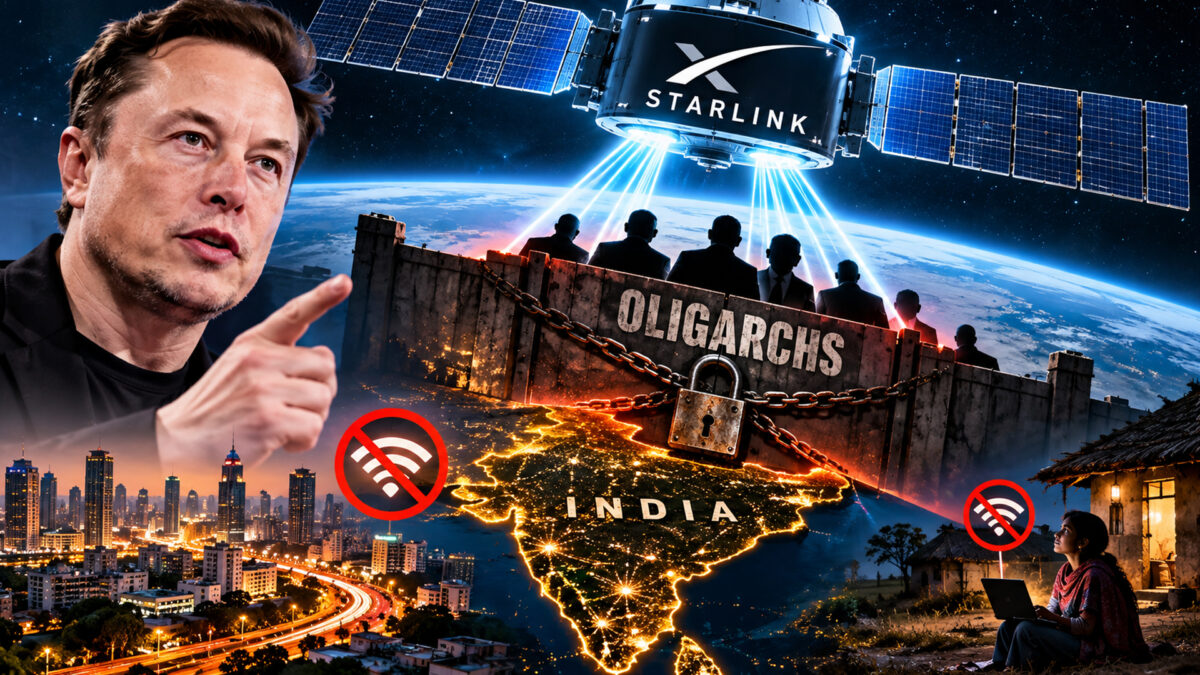
Elon Musk has accused unnamed “oligarchs” of blocking Starlink’s entry into India, escalating a dispute over the satellite internet company’s long-awaited commercial launch.
Musk, the chief executive of SpaceX, said on social media that “certain oligarchs” were trying to prevent Starlink from entering the Indian market to protect what he called a “monopolistic chokehold” over consumers. He did not identify any individual or company, but said the alleged obstruction was a “crime against the people of India”.
The Indian government has rejected the allegation, saying the country’s regulatory framework for satellite communications is fair and non-discriminatory. The Communications Ministry said all three licensed satellite communication operators are currently undergoing security assessments and are broadly at the same stage of the approval process.
The confrontation comes as Starlink remains close to launching its satellite broadband service in India but is still waiting for several regulatory clearances.
Starlink has spent nearly five years preparing for the Indian market. The SpaceX subsidiary has obtained a Global Mobile Personal Communication by Satellite (GMPCS) licence from the Department of Telecommunications and authorisation from the Indian National Space Promotion and Authorisation Centre (IN-SPACe).
The company has also invested in local infrastructure and established 20 gateway sites with hundreds of antennas, according to Lauren Dreyer, Starlink’s vice-president of business operations. Speaking at the India Mobile Congress, Dreyer said Starlink had designed its India operations around the country’s security requirements and had put controls in place to keep Indian user data within the country.
“We stand ready to serve India,” Dreyer said, adding that the company was prepared to work with the government, telecom operators and other industry participants.
Starlink has also signed agreements with Reliance Jio and Bharti Airtel, two of India’s largest telecom companies, to explore bringing its satellite internet service to customers.
The government’s response has shifted the focus from alleged commercial interference to the regulatory process itself.
The Communications Ministry said security assessment is currently underway for all three licensed satellite operators. Once the process is completed for an operator, it can move to the next stage of seeking spectrum assignment.
The three companies include Starlink, Jio Satellite Communications and Eutelsat OneWeb India Communications. The government has maintained that the same regulatory framework applies to all satellite communication providers.
Officials therefore argue that Starlink is not being singled out. The ministry described suggestions that the framework was unfair or discriminatory as “baseless and misconceived”.
Obtaining a satellite communication licence is only one part of the process for Starlink.
The company still faces security-related requirements, foreign investment approval and the final steps involved in spectrum assignment. India has placed particular emphasis on lawful interception, data localisation and the ability of authorities to control satellite services during emergencies or security situations.
These requirements are significant because Starlink operates a global network of low-Earth orbit satellites. Its satellites can transmit data between one another through inter-satellite links before routing traffic to ground stations, raising questions about how Indian authorities can monitor and control traffic originating within the country.