
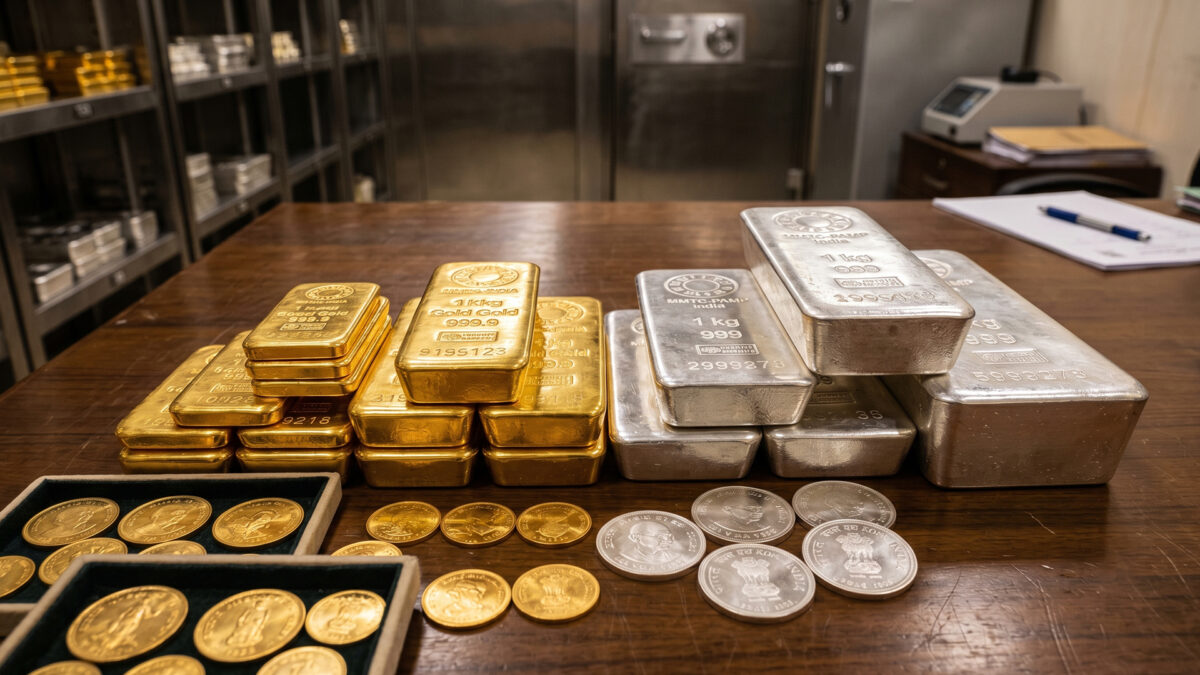
Gold and silver prices slipped on Tuesday, August 18, as investors turned cautious ahead of the US Federal Reserve’s meeting minutes. Higher US Treasury yields and rising crude oil prices also weighed on precious metals, keeping traders focused on the outlook for interest rates.
On the domestic market, MCX gold price moved below the ₹1.55 lakh per 10 grams mark. Gold has remained at elevated levels in recent weeks, but the latest decline reflects a combination of profit-taking, higher bond yields and uncertainty over the Federal Reserve’s next policy move.
Internationally, COMEX gold futures fell 0.51% to $4,450.80 per ounce, while silver futures declined 1.32% to $65.36 an ounce. The LBMA spot gold price stood at $4,405.80 per ounce at the August 17 PM fixing.
For consumers tracking the gold rate today, prices continue to vary across cities and according to purity. The 24-carat gold rate remains higher than 22-carat gold because of the difference in purity. Jewellery prices can also vary from quoted bullion rates because of making charges, GST and other applicable costs.
The silver price today has also softened. Domestic silver prices were around the ₹2.33 lakh per kg level, while international silver prices declined as investors booked profits following strong gains in recent months. Silver generally tends to experience sharper price swings than gold because of its dual role as both an investment asset and an industrial metal.
The pressure on bullion is closely linked to US Treasury yields. Gold does not generate interest income, so higher yields can make bonds more attractive compared with holding a non-yielding asset such as gold. Rising yields can therefore limit demand for the yellow metal.
Crude oil prices have added another layer of uncertainty. Oil prices moved higher amid renewed geopolitical tensions involving the US and Iran. Higher energy prices can increase inflation expectations and complicate the outlook for monetary policy.
For gold investors, this creates competing forces. Persistent inflation concerns can support demand for gold as a hedge, while expectations of higher interest rates can weigh on prices.
The Federal Reserve’s policy outlook remains a key trigger for the bullion market. Investors are waiting for the minutes of the US central bank’s July meeting, which are expected to provide further clues about policymakers’ views on inflation, employment and interest rates.
Recent US economic data have reduced expectations of an immediate rate increase. Markets are now closely assessing whether the Federal Reserve could move towards a more accommodative stance if economic growth and employment show signs of weakening.
A softer tone from the Fed could support gold prices, as lower interest-rate expectations typically reduce bond yields and the opportunity cost of holding bullion. On the other hand, any indication that policymakers remain concerned about inflation could strengthen the case for keeping rates higher for longer and put further pressure on gold and silver.
The US dollar is another important factor for precious metals. Since gold and silver are internationally priced in dollars, currency movements can influence demand from investors holding other currencies. A stronger dollar can make bullion more expensive for overseas buyers, potentially weighing on demand.
Despite the latest decline, the broader outlook for gold remains supported by geopolitical uncertainty and expectations around global monetary policy. The metal continues to attract investors looking for a safe-haven asset during periods of financial and geopolitical stress.
Technical levels are also being monitored by traders. Spot gold could find support around $4,381 an ounce. A sustained break below that level could expose the metal to the $4,320-$4,351 range.
For Indian consumers, the latest decline could offer some relief after gold prices climbed to exceptionally high levels. However, a fall in international bullion or MCX gold price does not necessarily translate into an equivalent reduction in jewellery prices. Retail rates depend on purity, local market conditions, taxes and making charges.
Investors will continue tracking the gold price in India, MCX gold and silver, US Treasury yields, the dollar and crude oil prices for direction. The Federal Reserve minutes could provide the next major trigger for precious metals.
Gold and silver remain caught between safe-haven demand and pressure from higher yields. With bullion prices still near historically high levels, even modest changes in interest-rate expectations, currency movements or geopolitical risks could lead to significant price swings in the coming sessions.