
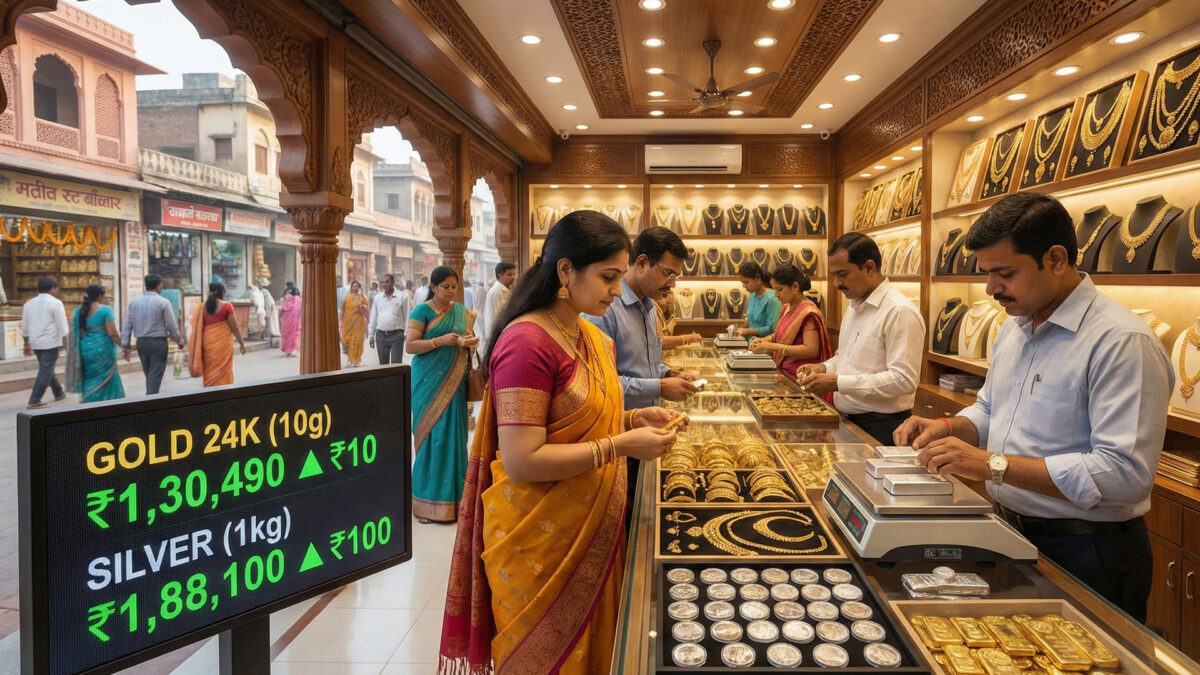
Gold and silver prices witnessed another decline on Thursday, November 12, as investors reacted to stronger-than-expected inflation data from the United States and growing expectations of a possible interest rate hike by the US Federal Reserve in December.
The decline has put the precious metals market under pressure, with domestic bullion prices slipping alongside international rates. A stronger US dollar and rising Treasury yields have also reduced the appeal of gold and silver among investors.
At the time of reporting, gold bullion was trading at approximately ₹1,39,510 per 10 grams, while silver stood at ₹1,83,010 per kilogram, according to the latest bullion market data. In the domestic futures market, December gold contracts on the Multi Commodity Exchange (MCX) were trading near ₹1,38,993 per 10 grams, down ₹723 from the previous close of ₹1,39,716.
Silver futures also remained under pressure. The December silver contract was trading at approximately ₹1,82,632 per kilogram, declining ₹1,893 from its previous closing level of ₹1,84,525.
The latest movement reflects growing concerns that US monetary policy could remain tighter for longer than previously expected. Gold and silver generally benefit from lower interest rates because they do not generate regular income. When interest rates rise, investors often find interest-bearing assets such as government bonds more attractive.
Retail gold prices continued to vary across cities on November 12, depending on local market conditions and applicable charges.
In Mumbai, 24-karat gold was priced at ₹1,39,250 per 10 grams, while 22-karat gold stood at ₹1,27,646. The price of 18-karat gold was ₹1,04,438 per 10 grams. Silver of 999 purity was available at approximately ₹1,82,680 per kilogram.
In Delhi, 24-karat gold was priced at ₹1,39,010 per 10 grams. The 22-karat gold rate stood at ₹1,27,426, while 18-karat gold was priced at ₹1,04,258. Silver was trading at ₹1,82,580 per kilogram.
Bengaluru recorded a 24-karat gold price of ₹1,39,360 per 10 grams. The 22-karat rate was ₹1,27,747, while 18-karat gold was available at ₹1,04,520. Silver prices stood at ₹1,83,040 per kilogram.
In Chennai, 24-karat gold was priced at ₹1,39,650 per 10 grams, while 22-karat gold stood at ₹1,28,013. The 18-karat gold rate was ₹1,04,738 per 10 grams. Silver was priced at ₹1,83,430 per kilogram.
Kolkata recorded a 24-karat gold price of ₹1,39,060 per 10 grams. The 22-karat and 18-karat rates stood at ₹1,27,472 and ₹1,04,295, respectively. Silver was priced at ₹1,82,650 per kilogram.
In Hyderabad, 24-karat gold was available at ₹1,39,450 per 10 grams, while 22-karat gold stood at ₹1,27,829. The 18-karat rate was ₹1,04,588. Silver was priced at ₹1,83,320 per kilogram.
These are indicative retail rates and may differ between jewellers. Making charges, taxes and other applicable costs can increase the final purchase price.
The primary trigger behind the latest decline is the change in expectations surrounding the US Federal Reserve’s interest rate policy.
Recent US inflation figures came in higher than market estimates, raising concerns that price pressures in the world’s largest economy may not be easing quickly enough. October’s headline consumer price index increased 0.4% month-on-month, compared with market expectations of 0.3%. Core inflation also remained firm at 0.3%.
The stronger inflation reading, combined with employment data and hawkish signals from policymakers, has increased expectations of another interest rate hike in December.
According to market assessments cited by commodities analysts, investors have increasingly factored in the possibility of a 25-basis-point rate increase, while expectations of a larger 50-basis-point hike have also gained attention.
The possibility of higher interest rates has supported the US dollar and Treasury yields, creating additional pressure on precious metals.
Vikram Subburaj, chief executive officer of Giottus, said stronger US inflation had reinforced expectations of tighter monetary policy. Higher bond yields tend to make non-interest-bearing investments such as gold less attractive.
Internationally, spot gold slipped to a level last seen on November 4, while silver also recorded losses. The weakness in global bullion markets has influenced domestic prices, although currency movements can affect how much of the international decline is reflected in Indian rates.
Despite the recent correction, analysts believe several factors could prevent a deeper decline in precious metal prices.
Continued purchases by China and sustained demand from central banks are also providing underlying support to the gold market. Such buying can help limit losses even when short-term investor sentiment turns negative.
However, the immediate outlook remains uncertain. Investors are likely to monitor upcoming US inflation and producer price data, along with further comments from Federal Reserve officials, before taking fresh positions.
Currency movements will also remain important for Indian buyers. A weaker rupee can cushion domestic gold and silver prices against international declines, while a stronger rupee can make the impact of falling global prices more pronounced.
For jewellery buyers, the latest correction could offer some relief after a period of elevated bullion prices. However, those planning purchases should remember that retail rates change with market movements and differ across cities.
For investors, analysts recommend avoiding decisions based on short-term price fluctuations. Staggered purchases and disciplined investment allocation may be more suitable while uncertainty surrounding US interest rates, inflation and global market conditions continues.
The direction of gold and silver prices in the coming sessions will largely depend on whether inflation concerns persist and how the Federal Reserve responds. Until there is greater clarity