
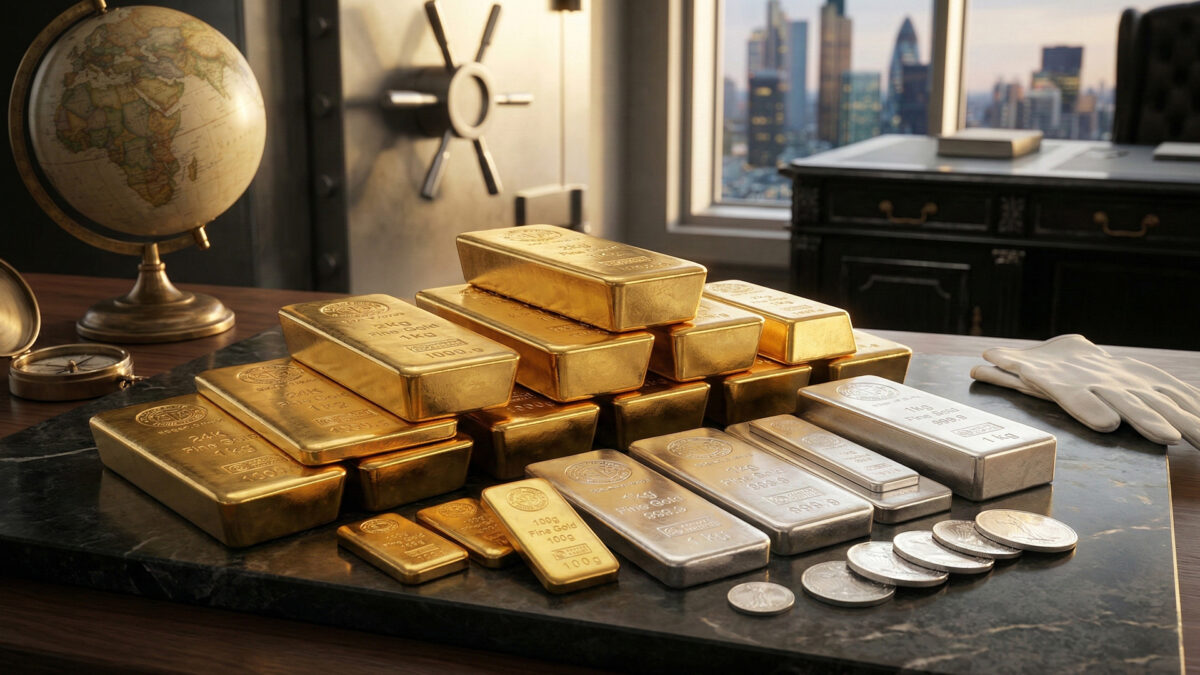
Gold and silver prices declined in domestic futures trading on Tuesday, October 27, as a stronger US dollar and uncertainty over the Federal Reserve’s interest rate decision weighed on precious metals. Gold futures fell by around ₹500 per 10 grams, while silver dropped ₹2,400 per kilogram in the latest market update. Investors remained cautious after a sharp correction in bullion prices over the previous week.
On the Multi Commodity Exchange (MCX), gold futures were reported at around ₹1,42,858 per 10 grams in morning trade, down ₹215, or 0.2%, in one update. Silver futures slipped to approximately ₹1,94,400 per kilogram, falling nearly ₹1,400 during the session. The different reported declines reflect changing prices and update times during a volatile trading day.
Retail gold prices also varied across major Indian cities. According to October 27 rates, 24-carat gold was priced at ₹1,43,270 per 10 grams in Mumbai, while 22-carat gold stood at ₹1,31,331 and 18-carat gold at ₹1,07,453. Silver of 999 purity was quoted at ₹1,96,060 per kilogram in the city.
In Delhi, 24-carat gold was priced at ₹1,43,020 per 10 grams, while 22-carat gold cost ₹1,31,102 and 18-carat gold was quoted at ₹1,07,265. The price of 999-purity silver stood at ₹1,95,720 per kilogram.
Bengaluru recorded a 24-carat gold rate of ₹1,43,380 per 10 grams, with 22-carat gold at ₹1,31,432 and 18-carat gold at ₹1,07,535. Silver was priced at ₹1,96,210 per kilogram. In Kolkata, 24-carat gold cost ₹1,43,080 per 10 grams, while silver was quoted at ₹1,95,800 per kilogram.
In Chennai, 24-carat gold was priced at ₹1,43,680 per 10 grams, while silver stood at ₹1,96,630 per kilogram. Hyderabad recorded a 24-carat gold rate of ₹1,43,490 per 10 grams and a silver price of ₹1,96,370 per kilogram. Ahmedabad’s 24-carat gold rate was ₹1,43,460 per 10 grams, with silver at ₹1,96,320 per kilogram. These figures are indicative retail rates and may differ from jewellers’ final quotations.
The stronger US dollar has been a key factor behind the recent pressure on precious metals. Gold is traded internationally in dollars, making it more expensive for buyers using other currencies when the US currency strengthens. Higher bond yields can also reduce gold’s appeal because the metal does not provide interest income.
Investors are closely watching the Federal Reserve’s policy meeting scheduled for October 27 and 28. Markets are assessing whether US policymakers will signal a more cautious approach to interest rate cuts amid continuing inflation concerns. Any indication that rates could remain elevated for longer may support the dollar and weigh on gold and silver prices.
Oil prices and geopolitical developments are also influencing market sentiment. Higher crude oil prices can raise inflation concerns, potentially limiting the scope for monetary easing. At the same time, reports of renewed diplomatic discussions between the United States and Iran have helped ease some pressure in global markets. These developments have contributed to fluctuations in bullion prices as traders reassess economic and geopolitical risks.
Gold had recently rebounded from a three-month low in international trading, but the recovery remains uncertain. Spot gold slipped 0.2% to around $4,007.66 an ounce in early Asian trading on Tuesday, while spot silver declined 0.1% to $53.90 an ounce. Investors are looking for clearer signals from the US central bank before making fresh decisions.
For jewellery buyers, the daily rate is only one part of the final cost. Twenty-four-carat gold has the highest purity and is commonly used for investment bars and coins, while 22-carat gold is widely used for jewellery. Eighteen-carat gold contains a lower proportion of pure gold and is often used in diamond-studded designs.
Customers should compare rates for the same purity and weight, check hallmark details and ask jewellers to explain making charges and taxes before purchasing. Retail prices can vary between cities and sellers, and the final bill may include additional charges beyond the quoted metal rate.
For investors, the immediate focus remains on the Federal Reserve’s decision, movements in the US dollar and bond yields, and changes in crude oil prices. Gold and silver may remain volatile until the policy outlook becomes clearer. A single day’s decline does not establish a lasting trend, so buyers and investors should assess their financial needs and risk tolerance before making decisions.