
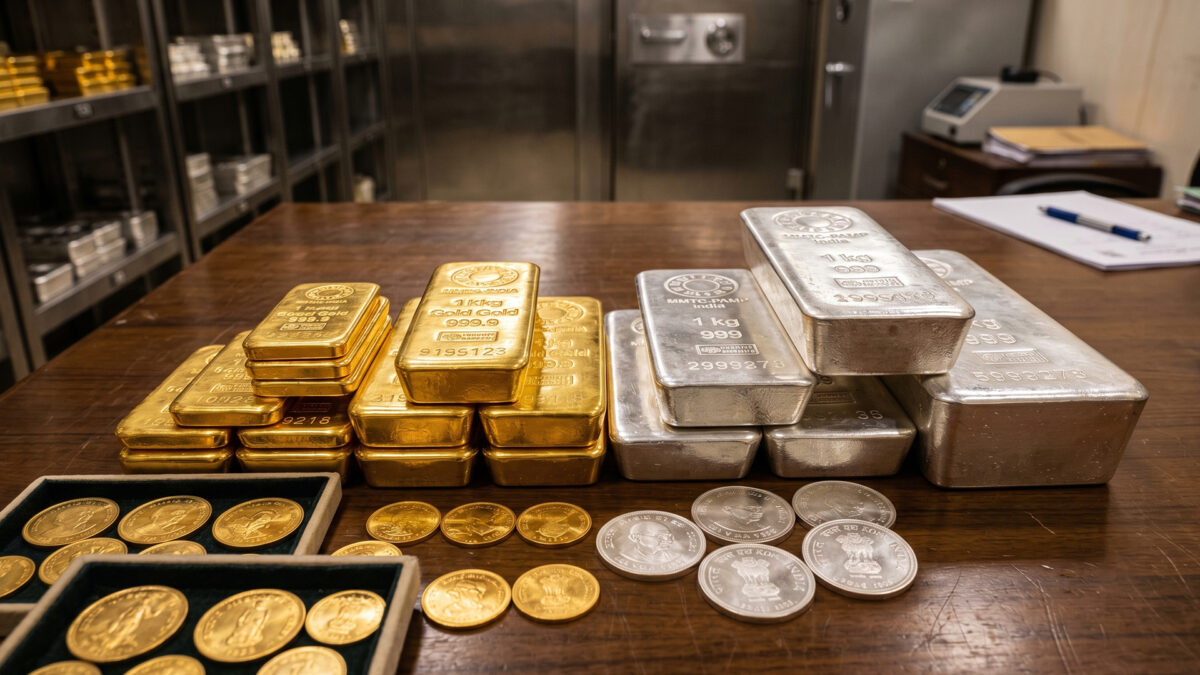
Gold prices remained largely steady in India on Wednesday, October 21, while silver faced fresh selling pressure in domestic and international markets. Investors continued to assess rising crude oil prices, inflation risks and expectations surrounding the US Federal Reserve’s next interest rate decision.
The price of 24-carat gold remained close to ₹1.46 lakh per 10 grams in major Indian cities, while 22-carat gold traded around ₹1.34 lakh. Silver prices were near ₹2.10 lakh per kilogram, with rates varying across cities and jewellery retailers.
The precious metals market has been under pressure in recent sessions, with gold recording its fourth consecutive daily decline in international trading. Higher oil prices have increased concerns about inflation, prompting investors to reconsider their expectations for interest rate cuts.
According to market data reported on Wednesday morning, spot gold fell 0.2% to $4,118.18 per ounce, while US gold futures for December delivery declined 0.2% to $4,136.20. Spot silver dropped 0.9% to $57.44 per ounce.
In the domestic futures market, gold contracts on the Multi Commodity Exchange (MCX) were trading lower at around ₹1,45,939 per 10 grams, down 0.40% in the morning session. MCX silver futures fell around 0.94% to ₹2,09,494 per kilogram at approximately 9.40 am.
The latest movement offers some relief to buyers who have been waiting for gold prices to ease. However, the market remains sensitive to global developments, and further price changes are possible.
Gold rates in major Indian cities
Retail gold prices differ between cities because of local taxes, transportation costs and jewellers’ pricing policies. The rates below were reported on October 21 and are indicative.
In Delhi, 24-carat gold was priced at ₹1,45,740 per 10 grams, while 22-carat gold stood at ₹1,33,595. The price of 999-purity silver was ₹2,09,200 per kilogram.
In Mumbai, 24-carat gold was available at ₹1,46,120 per 10 grams, compared with ₹1,33,943 for 22-carat gold. Silver was priced at ₹2,09,850 per kilogram.
In Kolkata, 24-carat gold stood at ₹1,46,030 per 10 grams, while 22-carat gold was priced at ₹1,33,861. Silver traded at ₹2,09,910 per kilogram.
Chennai recorded one of the higher gold prices among the cities tracked. The rate of 24-carat gold was ₹1,46,660 per 10 grams, while 22-carat gold cost ₹1,34,438. Silver was priced at ₹2,10,550 per kilogram.
In Bengaluru, 24-carat gold stood at ₹1,46,340 per 10 grams and 22-carat gold at ₹1,34,145. Silver was quoted at ₹2,10,360 per kilogram.
These rates may change during the day. Buyers should confirm the final price with their jeweller before making a purchase, as jewellery bills also include applicable taxes and making charges.
Why are gold and silver prices under pressure?
One of the main factors influencing precious metal prices is the outlook for US interest rates. Investors are awaiting the Federal Reserve’s October 27–28 policy meeting for clearer signals on its next move.
Gold does not pay interest, unlike many fixed-income investments. When interest rates remain high or expectations of rate cuts weaken, holding gold becomes relatively less attractive. This can reduce investment demand and put pressure on prices.
Market participants are also monitoring US inflation data, including the Personal Consumption Expenditures price index, which is the Federal Reserve’s preferred inflation measure. The data could influence expectations about the direction of monetary policy.
The US dollar is another important factor. A stronger dollar generally makes gold more expensive for buyers using other currencies, potentially limiting demand. Movements in the rupee against the dollar can also affect domestic gold prices because India imports much of its gold.
Rising crude oil prices have added another layer of uncertainty. Higher energy costs can increase transportation and production expenses, raising inflation concerns. If inflation remains persistent, central banks may have less room to lower interest rates.
Silver is influenced by many of the same factors as gold, but its industrial uses also affect demand. The metal is widely used in electronics, solar panels and other manufacturing applications. As a result, concerns about economic growth and industrial demand can cause silver prices to fluctuate sharply.
What should buyers watch next?
Investors and jewellery buyers will closely follow international bullion prices, the dollar, crude oil movements and the Federal Reserve’s policy signals over the coming days.
Gold may find support if global uncertainty increases or expectations of lower interest rates strengthen. However, persistent inflation and elevated borrowing costs could limit a sustained recovery. Silver may remain volatile as investors weigh both investment demand and its industrial outlook.
For household buyers, a fall in international prices does not always translate immediately into a similar decline in local jewellery rates. City-level differences, taxes and jeweller margins also matter.
Those planning to buy gold or silver should compare current rates across trusted retailers and account for making charges before deciding. Investors, meanwhile, should avoid treating a single day’s price movement as a reliable signal of the market’s longer-term direction.
The immediate focus remains on the US Federal Reserve’s upcoming decision and the economic data preceding it. Until there is greater clarity on inflation and interest rates, gold and silver prices are likely to remain sensitive to global developments.