
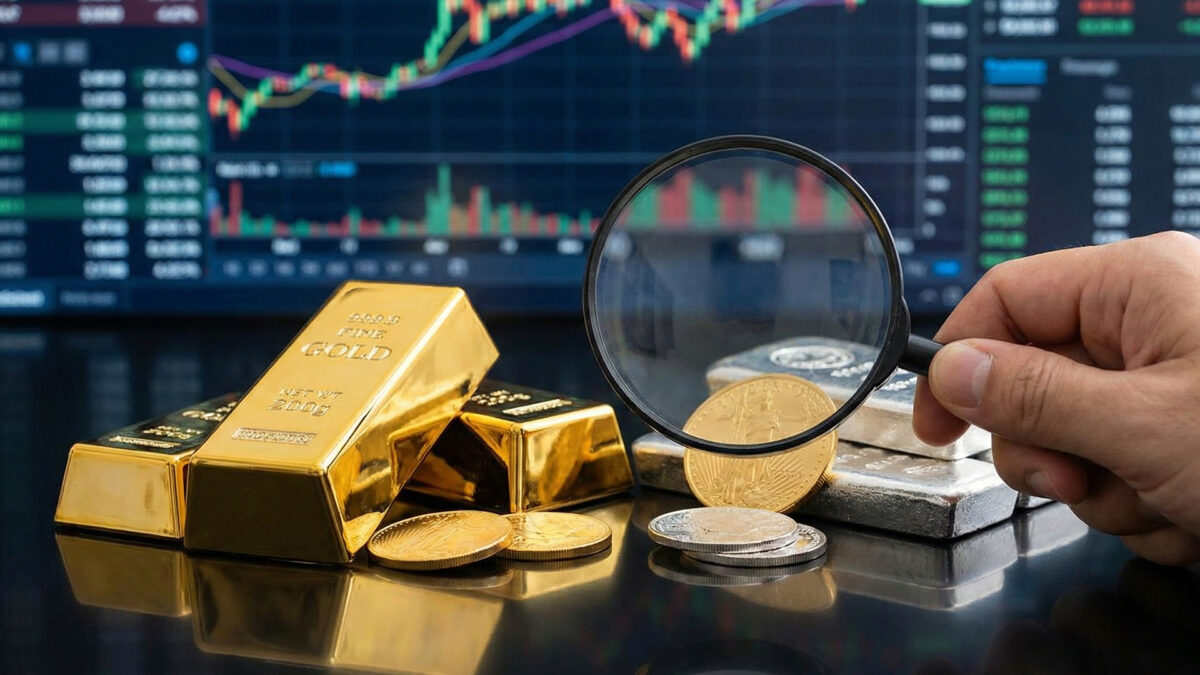
Gold and silver prices witnessed a modest recovery in early trading on Tuesday, November 17, but remained close to their lowest levels in more than a year as a stronger US dollar, elevated bond yields and expectations of another interest rate hike in December continued to weigh on precious metals. The recent decline has kept investors cautious, even as buyers look for opportunities to purchase gold and silver at lower prices.
In Mumbai, 24-carat gold was priced at ₹1,34,540 per 10 grams, while 22-carat gold stood at ₹1,23,240 per 10 grams, according to the latest available city-wise rates. Silver was quoted at ₹1,69,323 per kilogram, or ₹1,690 per 10 grams.
The domestic bullion market has been witnessing considerable volatility over recent sessions. Both precious metals recorded losses on Monday, extending the downward trend in international markets. Gold prices in New Delhi declined by ₹900 to around ₹1.40 lakh per 10 grams, marking the fifth consecutive session of losses. Silver also witnessed a sharp fall of approximately ₹5,000 per kilogram.
According to the India Bullion and Jewellers Association (IBJA), the November 16 evening benchmark rate for 24-carat gold stood at ₹1,34,971 per 10 grams, while 22-carat gold was priced at ₹1,23,633. Silver of 999 purity was quoted at ₹1,70,251 per kilogram. Compared with November 13, 24-carat gold declined by ₹838, 22-carat gold fell by ₹768 and silver dropped by ₹7,749 per kilogram.
International gold prices showed limited movement on Tuesday after touching their lowest level since October 2025 in the previous session. Spot gold was trading around ₹3,856 per ounce in international market quotations, while gold futures registered a modest recovery.
On the Multi Commodity Exchange (MCX), gold futures for December 4 delivery opened 0.44% higher at ₹1,35,137 per 10 grams. The recovery offered some relief after the sharp decline recorded in the previous session. However, the improvement remained limited as traders continued to assess the possibility of tighter monetary policy in the United States.
The strength of the US dollar has been one of the biggest factors affecting gold prices. When the dollar strengthens, gold becomes more expensive for buyers using other currencies, potentially reducing international demand. Higher US Treasury yields have also made interest-bearing investments more attractive compared with gold, which does not provide regular interest income.
Silver prices also moved higher in early domestic trading but continued to remain under pressure following the steep decline witnessed on Monday.
On the MCX, silver futures edged up 0.82% to ₹1,69,239 per kilogram at the opening. International silver prices also recorded a modest recovery, trading around ₹47.39 per ounce in the reported market quotations.
However, the outlook for silver remains uncertain. Unlike gold, silver has substantial industrial applications, particularly in electronics, solar energy and manufacturing. Concerns over weaker jewellery demand and the possibility of reduced silver consumption in solar cells have added to the pressure on prices.
Market estimates suggest that global silver demand could decline by around 5% in 2026. This has raised concerns about the metal’s demand outlook, even as investors continue to monitor its performance as a precious metal and industrial commodity.
Investors are closely following developments surrounding the US Federal Reserve’s monetary policy. Markets have increasingly factored in the possibility of another 25-basis-point interest rate increase in December following persistent inflation concerns and hawkish comments from Federal Reserve officials.
The minutes of the Federal Reserve’s October 27-28 meeting, scheduled for release on Wednesday, are expected to provide further insight into policymakers’ assessment of inflation, economic growth and future interest rate decisions.
A further increase in interest rates could create additional pressure on gold and silver. Higher borrowing costs generally reduce the attractiveness of non-yielding assets, encouraging investors to consider alternatives that offer interest or returns.
For Indian consumers, domestic gold and silver prices depend on several factors, including international bullion movements, the rupee’s value, import-related costs and local market demand. Consequently, retail rates can vary between cities and jewellery retailers.
Wedding purchases and seasonal jewellery demand could provide some support to domestic gold prices despite the weakness in international markets. Central bank purchases are another factor that could influence the longer-term outlook for bullion.
Buyers should also remember that the quoted gold and silver rates are not necessarily the final prices payable at jewellery stores. GST, making charges, wastage and other applicable costs can increase the final bill. Purity is equally important when comparing prices, particularly between 24-carat investment gold and 22-carat jewellery gold.
With gold and silver struggling to recover from recent losses, market participants are likely to remain cautious in the coming sessions. The US Federal Reserve’s policy signals, inflation data, currency movements and global economic developments will determine whether precious metals regain momentum or face further selling pressure.