
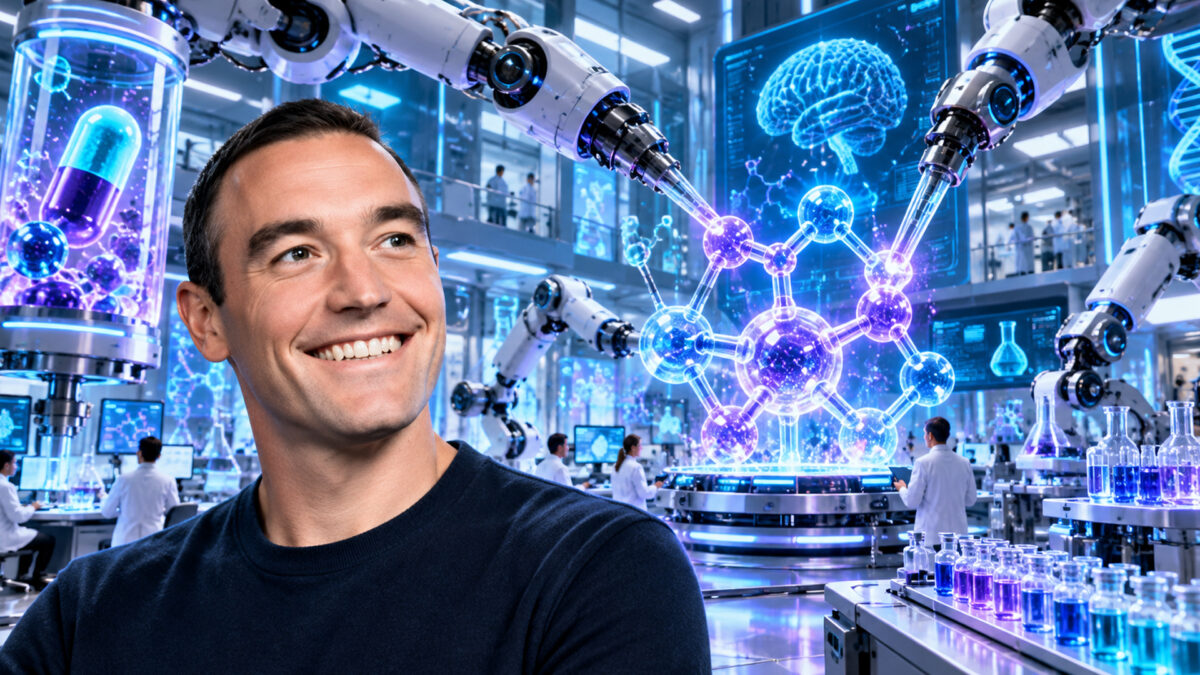
Former OpenAI executive Kevin Weil has launched Warp Sciences, a new artificial intelligence startup that aims to speed up drug discovery by bringing AI and robotics directly into laboratory work. The company has raised $215 million in Series A funding, valuing the startup at $865 million after the investment.
The funding round was led by Lightspeed Venture Partners, with participation from investors including Premji Invest, IVP, Mayfield, Lux Capital, Menlo Ventures, NVIDIA and SignalFire. The startup brings together technology leaders and experienced scientists to address a major challenge in pharmaceutical research: the time and effort required to make and test potential drug compounds.
Weil, who previously served as OpenAI’s chief product officer and led its AI-for-science efforts, is joined by former Meta AI leader Manohar Paluri, former White House chief data scientist DJ Patil and drug discovery specialist Solomon Reisberg as co-founders.
The company’s goal is to help biotechnology and pharmaceutical firms develop medicines faster by automating laboratory experiments that traditionally require substantial manual work.
Warp Sciences is developing an integrated system combining artificial intelligence, robotic equipment and physical laboratories. The idea is to use AI to help scientists design experiments, while robots carry out repetitive laboratory procedures and generate results that can inform the next round of research.
Drug discovery often involves creating and testing numerous variations of a chemical compound to identify candidates with promising properties. This process, particularly during early-stage research, can be slow, expensive and labour-intensive.
Warp Sciences wants to make this work more efficient by building robotic laboratories capable of operating around the clock. The resulting experimental data could also help improve AI models used in scientific research.
The company plans to train robots using the practical knowledge of experienced chemists. Human researchers will wear cameras and sensor-equipped gloves while performing laboratory tasks, allowing the startup to capture how experiments are conducted and use that information to teach robots to perform similar work.
Rather than relying entirely on software simulations, the approach aims to connect AI systems with real-world experiments. This is important because chemistry and biology involve physical processes whose outcomes must be tested in laboratories.
Warp Sciences will initially concentrate on lead optimisation in small-molecule drug discovery. This stage involves improving promising chemical compounds so that they have better properties for further development as potential medicines.
The company is also building a US-based preclinical contract research organisation (CRO). Such organisations provide research services to pharmaceutical and biotechnology companies, allowing them to outsource laboratory work rather than build all the necessary facilities and expertise themselves.
Warp Sciences intends to make and test compounds for its customers, using automation to improve the speed and scale of experimentation. Its business model differs from that of a conventional drug developer: customers will decide which molecules to investigate and retain control of their drug programmes.
DJ Patil, who serves as the startup’s chief operating officer, has said the company is not developing medicines of its own. Instead, it wants to provide the infrastructure that enables other organisations to advance their research.
Manohar Paluri, the company’s chief technology officer, said the initial focus would be on integrating AI and robotics into the experimental process while working closely with chemists. The aim is to develop systems that become more useful as they learn from real laboratory results.
The startup’s launch comes as pharmaceutical companies increasingly explore AI tools to shorten research timelines and improve productivity. While AI has made significant progress in software development, data analysis and mathematical reasoning, translating those capabilities into physical scientific experiments remains a more complex challenge.
Laboratory automation could help researchers run more experiments, compare results and identify promising compounds without requiring a proportional increase in manual work.
The business also addresses concerns about dependence on overseas research providers. Biotechnology companies have outsourced significant amounts of chemical synthesis and preclinical research to specialist contractors, including firms in China.
By developing laboratory capacity in the United States, Warp Sciences hopes to attract customers seeking greater control over research timelines, intellectual property and supply chains. The approach could become particularly relevant as geopolitical tensions influence decisions about where sensitive pharmaceutical research is conducted.
However, the company will need to demonstrate that its automated systems can deliver reliable results at commercial scale. Raising substantial funding provides resources to build the technology and facilities, but it does not yet establish that the approach will shorten drug development timelines or lead to successful medicines.
Warp Sciences enters a rapidly developing market in which major technology companies and startups are investing in AI-powered drug discovery.
OpenAI has expanded its life sciences efforts through its Rosalind platform, while Anthropic has introduced tools aimed at helping researchers with biological research, drug discovery and clinical development. Isomorphic Labs, a Google DeepMind spin-off, is also pursuing AI-driven approaches to medicine development.
Warp Sciences is taking a more hands-on route by combining AI systems with physical laboratory operations rather than focusing only on digital research tools.
Its success will depend on how effectively it integrates software, robotics and scientific expertise into a dependable service for pharmaceutical customers. If the approach works, it could help researchers test more ideas, generate better experimental data and reduce bottlenecks in early drug development.