
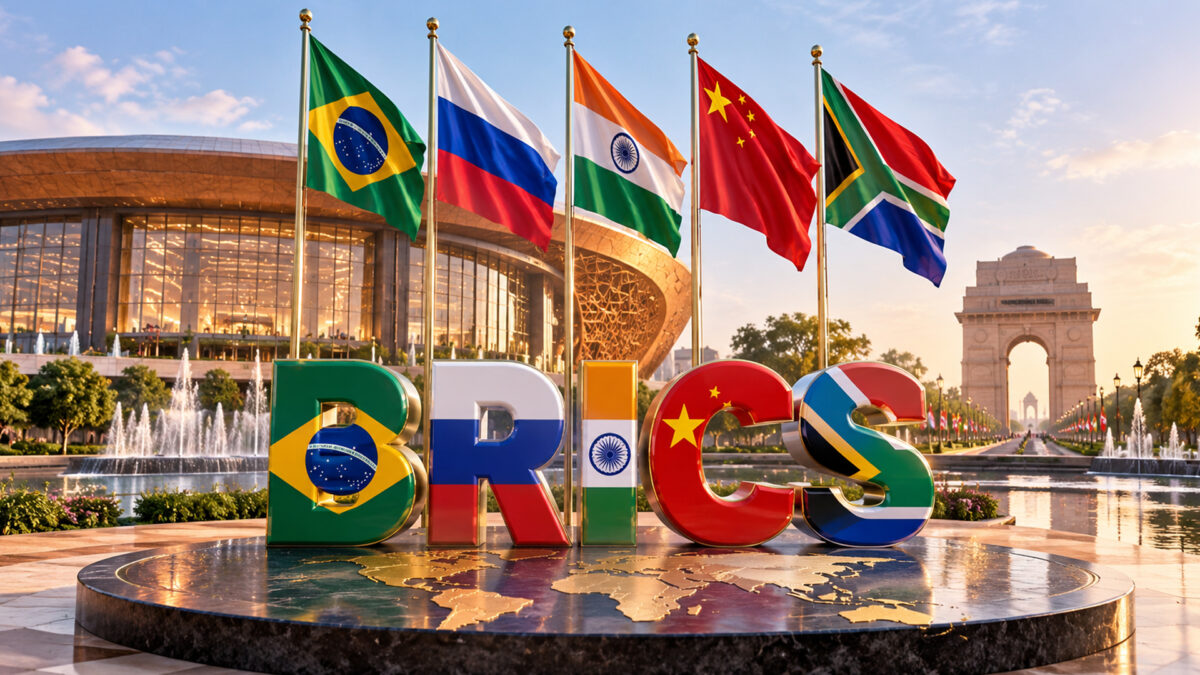
New Delhi is preparing to slow down, tighten its security and put its diplomatic face forward as the capital gets ready to host the 18th BRICS Summit on September 12 and 13.
For two days, Bharat Mandapam at Pragati Maidan will become the centre of attention as leaders and senior representatives from the expanded BRICS grouping gather for talks on the global economy, trade, investment, technology and development.
But the summit’s impact will be felt well beyond the conference venue.
From government offices and roads to hotels, businesses and educational institutions, preparations are already reshaping parts of Delhi. Security arrangements are being stepped up, traffic plans are being drawn up and the city is preparing for the movement of high-profile international delegations.
India is hosting the summit as part of its BRICS chairship in 2026, giving New Delhi an important opportunity to shape the bloc’s priorities at a time when the global economic landscape is undergoing major changes.
India’s presidency has been built around the theme “Building for Resilience, Innovation, Cooperation and Sustainability.” The focus reflects some of the biggest issues facing emerging economies today, including economic uncertainty, technological change, energy security and sustainable development.
More than a leaders’ meeting
While the arrival of political leaders will command the headlines, money and investment are expected to be another major part of the BRICS gathering.
Around 500 investors are expected to converge in Delhi, with global sovereign capital worth an estimated $1 trillion likely to be a key focus of discussions.
The interest is significant. BRICS has evolved from its original five-member format into a much larger grouping, bringing together economies from different parts of Asia, Africa, the Middle East and Latin America.
That expansion has also increased the bloc’s economic weight and its potential as a platform for investment.
The timing could hardly be more important for India. New Delhi is pushing to attract long-term capital into infrastructure, manufacturing, technology, energy and other strategic sectors. The BRICS platform provides an opportunity to connect Indian businesses with sovereign wealth funds and large institutional investors from across the grouping.
The summit’s business dimension could therefore prove just as important as the formal diplomatic discussions.
Delhi changes its pace as now the biggest immediate challenge, however, will be managing the city itself.
International summits involving multiple heads of government require extensive security coordination. Delhi Police and other security agencies are preparing for the movement of foreign leaders, official delegations and motorcades.
That means commuters should expect restrictions and diversions on important routes, particularly around central Delhi and areas connected to the summit venue and hotels where visiting delegations are expected to stay.
Authorities are also encouraging commuters to plan ahead and make greater use of public transport during the summit period.
Hotels are already seeing the effects. Demand for rooms in some of the capital’s major luxury properties has risen as diplomats, officials, business representatives and security personnel begin arriving.
For the hospitality industry, the summit represents a major business opportunity. For ordinary residents, however, it could mean a few days of longer journeys and tighter access to parts of the city.
The preparations will begin even before the leaders’ meetings.
The Centre has declared September 11 a holiday for central government offices in Delhi and New Delhi, along with relevant Delhi government offices, autonomous bodies and public sector undertakings.
The decision is aimed at reducing movement in the capital and making it easier for security and traffic agencies to manage the summit.
With September 12 and 13 falling on Saturday and Sunday, government offices will effectively have a three-day period of reduced activity.
The order has also triggered questions about schools and colleges.
The closure of government offices does not automatically mean that all schools and colleges in Delhi will remain shut on September 11. Educational institutions can take separate decisions based on local security arrangements, traffic restrictions and instructions from authorities.
Students and parents are therefore expected to rely on announcements from their individual institutions rather than assume a citywide educational holiday.
Behind the security plans and traffic advisories lies a much bigger story.
BRICS has become an increasingly important platform for emerging economies seeking a greater voice in global decision-making. Its expanded membership has given the grouping greater reach, but it has also brought together countries with different economic priorities and geopolitical positions.
Finding common ground will therefore be one of the biggest challenges for India.
Issues such as trade, development finance, technology, energy security and reform of international institutions are expected to feature prominently in discussions.
The summit comes against a backdrop of trade tensions, geopolitical conflicts and uncertainty over global investment flows. For developing economies, these shifts can quickly affect energy costs, supply chains, exports and access to capital.
India’s challenge will be to turn the summit from a symbolic gathering into a platform for practical cooperation.
By the time the BRICS leaders arrive, much of Delhi will be operating under a carefully coordinated security and traffic plan.
For residents, the summit may be remembered through road diversions, office closures and crowded hotels. For India, however, the significance is considerably larger.
The BRICS Summit 2026 gives New Delhi a chance to demonstrate its ability to host a major international gathering while also positioning itself as a key voice among emerging economies.
It is a diplomatic event, but also an economic opportunity.