
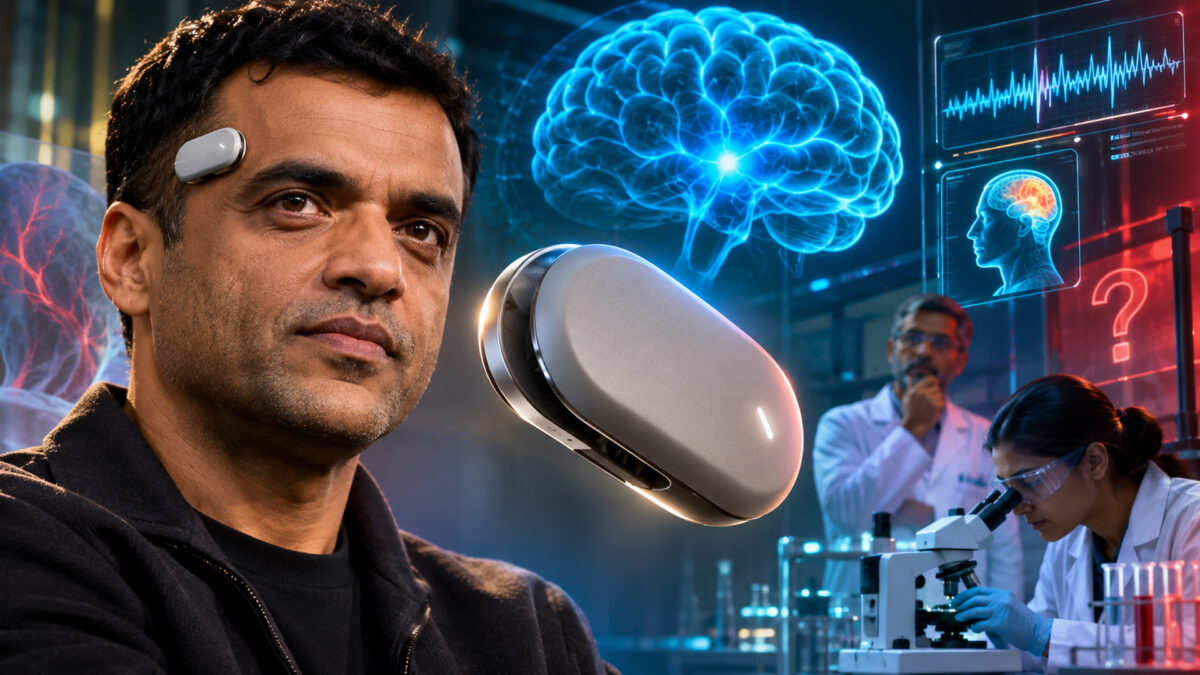
Deepinder Goyal, founder of Zomato and Eternal, has responded to growing criticism surrounding his wearable technology product Temple, saying it was developed for the global market rather than Indian consumers. Defending its premium price tag of ₹85,000 and addressing questions about its scientific claims, Goyal said the company expects India to account for no more than 1% of Temple sales.
In a series of posts on X on November 8, coinciding with Diwali, Goyal addressed concerns raised by consumers, technology enthusiasts and medical professionals over the device’s pricing, purpose and scientific credibility. He said the criticism and feedback received since its launch had helped the company understand which aspects of the product needed further explanation.
“Temple is not made for India. It’s made for the world,” Goyal said, making it clear that the wearable was intended to compete in international markets. His remarks came amid growing discussions online about whether the device justified its relatively high price, particularly for Indian buyers.
Goyal defends Temple’s ₹85,000 price
Temple’s ₹85,000 price has been one of the biggest talking points since the company opened pre-orders on November 1. Many social media users questioned whether the device offered enough value to justify the investment, especially when compared with established fitness trackers and smartwatches.
Responding to the criticism, Goyal said considerable effort had gone into developing Temple and that the company had priced it according to what it believed the product was worth. He acknowledged that some customers might find it expensive but suggested that those uncertain about its value could wait for independent user reviews before making a purchase.
He also rejected the idea that Indian consumers should support Temple simply because it was developed by an Indian startup.
Goyal said the company wanted to compete internationally and did not need support based on national pride. Instead, he said, the startup wanted people to support its work because they believed in early-stage innovation and its potential to improve people’s lives.
Scientific claims face questions
Beyond the pricing debate, Temple has attracted scrutiny over the scientific evidence supporting its features, particularly its Brain Flow measurement. The wearable is designed to collect physiological signals from the area around the forehead and provide information about changes associated with blood circulation.
Several doctors and healthcare professionals have questioned whether the technology can accurately measure blood flow within the brain and whether the available research sufficiently supports the company’s claims.
Hepatologist Dr Cyriac Abby Philips, popularly known as The Liver Doc on social media, has been among the prominent critics. He has questioned the scientific basis of Temple’s brain-monitoring claims and called for closer scrutiny of the research and technology behind the product.
Responding to concerns about scientific validation, Goyal said research develops through different stages, beginning with white papers and preprints before progressing to peer-reviewed publications.
He maintained that consumers were free to wait until stronger scientific evidence became available before purchasing Temple. He also acknowledged that some people might remain unconvinced even after peer-reviewed research is published.
Goyal said the company would continue sharing research and stressed that regulatory authorities, rather than social media discussions, would determine whether the product’s claims met the necessary standards.
Temple is a fitness and AI device, says Goyal
Addressing concerns about whether Temple was being marketed as a medical product, Goyal clarified that it was strictly a fitness and artificial intelligence device.
He said the company had not claimed that Temple could diagnose, prevent or treat any disease. The wearable was also not intended to replace medical consultations or professional healthcare advice.
This distinction is important because some of the questions surrounding Temple relate to its potential applications in monitoring brain health and understanding physiological changes. Goyal maintained that the device should be evaluated as a consumer wellness product rather than a medical diagnostic instrument.
He also said the company would obtain regulatory clearances wherever required before making claims that needed such approvals.
Entropy, not Brain Flow, is Temple’s main focus
Another important clarification concerned the device’s central feature. Goyal said much of the public discussion had focused on Brain Flow, even though it was not the primary proposition behind Temple.
According to him, the main focus of the wearable is a metric called Entropy. He said the initial development work began with Brain Flow, which explains why the first studies released by the company focused on that measurement.
However, Goyal acknowledged that the company had not yet published research explaining Entropy in detail. He said communications sent to people on Temple’s waiting list had largely focused on this feature and promised that more information would be released.
He also addressed questions about Roomdeaf AI, describing it as an expansion of Temple’s capabilities and the company’s broader vision rather than a change in strategy.
Scientific evidence remains central to the debate
Temple’s launch has generated considerable interest because it attempts to move wearable technology beyond conventional measurements such as heart rate, sleep patterns and physical activity.
However, the questions surrounding its Brain Flow measurements and Entropy metric highlight the challenges faced by companies introducing new health and fitness technologies.
Goyal has promised to publish a detailed explanation of how Brain Flow is calculated, its potential applications and, importantly, its limitations on November 9. This explanation is expected to provide further clarity on the technology behind the wearable.
For now, the debate over Temple reflects two competing expectations: the ambition to develop new wearable technology and the need for transparent, independently verifiable scientific evidence.
While Goyal remains confident about the product’s global potential, its long-term acceptance will depend on how effectively the company addresses questions about its performance, scientific validation and practical benefits.