Categories
Corporate

Glenmark Bags Exclusive Global License for HER2-ADC From China’s Hengrui in $1.1B Pact

Glenmark Specialty S.A., a wholly owned subsidiary of Glenmark Pharmaceuticals, on Wednesday clinched an exclusive licensing agreement with China-based Hengrui Pharmaceuticals for the cancer therapy drug Trastuzumab Rezetecan (SHR-A1811). The deal, among the largest in Glenmark’s oncology push, grants the Indian firm rights to develop and commercialise the drug across most global markets, with certain exclusions.

Under the terms, Glenmark will pay an upfront fee of US$18 million, followed by potential regulatory and commercial milestone payments up to US$1.093 billion. In addition, Hengrui will receive royalties based on net sales in the territories covered.

The licence excludes Mainland China, Hong Kong SAR, Macao SAR, Taiwan, the United States, Canada, Europe, Japan, Russia and several Central Asian countries among others. Glenmark will cover the rest of the world under the agreement.

Trastuzumab Rezetecan is a next-generation HER2-targeting antibody drug conjugate (ADC). It was approved in China in May 2025 for adult patients with HER2-activating mutations in unresectable locally advanced or metastatic non-small cell lung cancer who had already undergone at least one prior systemic therapy. Clinical study applications are underway or under review for additional indications such as breast cancer, among others.

With this transaction, Glenmark aims to strengthen its oncology pipeline significantly. Glenn Saldanha, Chairman and Managing Director of Glenmark, said the collaboration aligns with the company’s strategy to bring differentiated, high-value therapies to patients and underscores its commitment to advancing innovation in areas with unmet need. Jo Feng, President of Hengrui, described the deal as a strategic step toward deepening the company’s presence in emerging markets and expanding access to innovative treatments in more countries.

Analysts observe that Glenmark is leveraging this deal to ride the wave of demand for targeted cancer treatments, especially in markets outside the U.S., Europe and other highly regulated territories where regulatory costs and competition are steep. ADCs like Trastuzumab Rezetecan are viewed as high-potential due to their mode of action — delivering anti-cancer agents directly to tumour cells while sparing healthy tissue — which may offer advantages in efficacy and tolerability.

The agreement comes at a time when global pharmaceutical firms are increasingly partnering across borders to accelerate access to novel oncology drugs. For Glenmark, this deal represents a major milestone in establishing itself as a serious player in the high-stakes market of ADCs and biologics, complementing its existing strengths in generics and differentiated therapies.

Also Read: Swiggy Exits Rapido, Hives Off Instamart to Step-Down Arm in Major

Categories
Corporate

Polycab Promoters Poised to Offload ~₹880 Crore Stake via Block Deal

Promoters of Polycab India Ltd are preparing to divest a portion of their holdings in a block deal valued at approximately ₹887–₹888 crore. The planned sale, involving around 1.2 million shares at a floor price of ₹7,300 per share, equates to about 0.81% of the company’s equity. Market participants expect the transaction to attract attention, given its size and implications for promoter shareholding.

According to sources familiar with the matter, the floor price represents a discount of roughly 3.1% relative to Polycab’s most recent trading levels. This discount is intended to entice buyers and ensure liquidity in the block deal. The exact timing of the deal is slated for a Thursday trading session, although confirmation from Polycab’s management or promoter group has yet to be disclosed in official filings.

Polycab shares had seen significant trading interest ahead of the announcement, with analysts noting that promoter stake reductions often trigger volatility in share prices. Investors tend to interpret such moves as either a liquidity play by promoters or a signal that the promoters wish to rebalance holdings.

The company, well known for its leadership in the Indian wires and cables sector, recently posted solid financial results. Its performance has been underpinned by strong demand, expanding operations, and improving margins. Despite this, the decision by the promoters to pare back some ownership is being viewed by many as a routine capital markets manoeuvre rather than a reflection of business stress.

At present, Polycab’s promoter holdings stand at about 63% of the total share capital. The reduction of around 0.81% will still leave the promoter group with a strong controlling interest, though it will slightly dilute their ownership. Stake sales of this nature typically require a lock-in period or other regulatory disclosures, especially when they involve promoter or promoter group entities; however, specific lock-in terms for this transaction are not yet clear.

Analysts suggest that the success of this block deal will depend heavily on investor appetite at that price level. Given the discount and promoter status of the shares, demand could be strong, but execution may still affect the stock’s short-term movement.

Some market watchers caution that these deals may lead to downward pressure on the stock if speculative selling follows. While the deal size is large, the remaining promoter stake remains substantial, and the move appears consistent with standard capital markets activity. Investors will be observing closely both the execution of the sale and any subsequent impact on the stock’s trading behaviour.

Also Read: Infosys Expands Partnership with Sunrise to Accelerate AI-Driven IT

Categories
Corporate

PhonePe Files For IPO via Confidential Route, Aims to Raise ₹12,000 Crore

Walmart-backed fintech firm PhonePe has moved closer to going public, filing its draft red herring prospectus (DRHP) with the Securities and Exchange Board of India via the confidential route. The company is targeting a roughly ₹12,000 crore ($1.35 billion) initial public offering.

Under the confidential filing mechanism, PhonePe has submitted its PDRHP to market and regulatory bodies, including SEBI, BSE, and NSE, although neither the company nor its promoter has disclosed full details of the raise or timing. Sources suggest the IPO may involve a mix of fresh issuance of equity and an offer-for-sale component, with existing shareholders such as Walmart, Tiger Global, and General Atlantic expected to participate. Smaller investors may look to partially monetise holdings, while the promoter is unlikely to dilute its controlling stake significantly.

PhonePe’s financials ahead of the IPO show continued improvement. For the fiscal year ending March 2025, the company recorded revenue of approximately ₹7,115 crore, up about 40% from the prior year. Its losses narrowed year-on-year, falling to around ₹1,720-₹1,727 crore from nearly ₹1,996 crore a year earlier. PhonePe also reported becoming free cash flow positive, generating over ₹1,200 crore in cash flow from operations. Adjusted EBITDA (excluding employee stock option costs) rose sharply, as did adjusted profit after tax (excluding ESOP costs), which more than tripled. For the first time, the company posted a positive adjusted EBIT (excluding ESOP costs), signalling a stronger bottom-line trajectory.

The IPO is being structured under the “pre-filed DRHP” route introduced by SEBI, which allows companies to initiate regulatory review without making all business and financial particulars public immediately. This gives PhonePe flexibility to adapt disclosures and respond to market conditions before finalising the listing. According to sources, the IPO size is being finalised in the range of ₹10,000 to ₹13,000 crore, with about 10% of the company’s equity likely to be offered.

PhonePe has in recent months taken several preparatory steps for a listing. It converted into a public company earlier this year, introduced statutory independent directors and board committees, and effected a stock split of its shares in a 10:1 ratio. The firm has also expanded its services beyond payments: its operations now include lending, insurance distribution, wealth management, and stock broking, along with newer consumer tech businesses.

Despite strong growth, challenges remain. The fintech market is intensely competitive, regulatory oversight is tightening, and macroeconomic conditions could affect investor sentiment. For PhonePe, balancing growth, profitability, and market expectations will be critical in ensuring the IPO succeeds. Analysts suggest that how much stake existing backers sell, and how the fresh capital is deployed, will be closely watched by both markets and regulators.

PhonePe has not publicly confirmed the final IPO size, allocation of fresh issue versus offer for sale, or a listing date. The confidential filing begins the formal regulatory process, but a public launch remains subject to final approvals and disclosures.

Also Read: Surat Startup DhiWise Rebrands as Rocket AI, Raises $15 Million Seed Round

Categories
Corporate

Indian Hotels Company Signs 310-Room Taj Hotel in Visakhapatnam

Indian Hotels Company Limited (IHCL) has announced the signing of a new 310-room Taj hotel in Visakhapatnam, Andhra Pradesh. This marks the debut of the Taj brand in the coastal city, reflecting IHCL’s strategy to expand its presence in key leisure and commercial markets.

The hotel, named Taj Varun Beach, will be located within the Varun Bay Sands complex. It is set to offer panoramic views of the Bay of Bengal, providing a luxurious experience for both leisure and business travelers. The property will feature an all-day dining restaurant, specialty restaurants, a bar, a well-equipped gym, a swimming pool, and the signature J Wellness Circle spa. Additionally, expansive banqueting and meeting facilities will cater to corporate events and social gatherings.

Puneet Chhatwal, Managing Director and CEO of IHCL, expressed enthusiasm about the partnership with Varun Hospitality Private Limited for this greenfield project. He highlighted the company’s commitment to introducing the iconic Taj brand to Visakhapatnam, aiming to set new benchmarks for luxury hospitality in the region.

The Varun Bay Sands complex, which will house Taj Varun Beach, is a multi-use development that also includes Varun Hub, offering commercial office spaces, and Varun Nest, featuring service apartments. This integration of hospitality with commercial and residential spaces is expected to enhance the overall appeal of the location.

Prabhu Kishore, Founder and Chairman of Varun Group, emphasized the significance of this collaboration, stating that Taj Varun Beach will elevate the hospitality landscape in Visakhapatnam and contribute to the city’s growing prominence as a tourist and business destination.

This development aligns with IHCL’s broader expansion plans, which include a significant capital expenditure over the next five years to double its hotel count and consolidate revenue. The company aims to reach 150 billion rupees in revenue by fiscal 2030, expanding from 350 to over 700 hotels, primarily focusing on the Indian subcontinent.

The introduction of Taj Varun Beach is anticipated to bolster tourism in Visakhapatnam, attracting both domestic and international visitors. As the city continues to develop its infrastructure and connectivity, the new hotel is poised to become a landmark destination for travelers seeking luxury and comfort along the eastern coast of India.

Also Read: Apple Enters India’s Top 5 as Smartphone Market Grows 2% in H1 2025

Categories
Corporate

Infosys Expands Partnership with Sunrise to Accelerate AI-Driven IT Transformation

Infosys has announced an expansion of its strategic collaboration with Sunrise, Switzerland’s second-largest telecommunications provider, to accelerate the latter’s IT transformation and enhance its artificial intelligence (AI) capabilities.

This move underscores Infosys’s commitment to supporting global enterprises in their digital evolution through advanced technology solutions.

Under the expanded partnership, Infosys will leverage its AI-first platform, Infosys Topaz, along with its expertise in analytics and data, to assist Sunrise in becoming an AI-driven organization.

The collaboration aims to improve operational agility, enhance data security, and streamline IT operations, thereby enabling Sunrise to deliver more personalized and efficient services to its customers.

The partnership builds upon Infosys’s previous work with Sunrise, where it consolidated multiple IT vendors and transitioned various applications to create a unified, scalable, and secure technology environment. This foundational work has set the stage for deeper AI integration, allowing Sunrise to unlock new business value through data-driven insights and intelligent automation.

Anna Maria Blengino, Chief Information Officer at Sunrise, emphasized the importance of this collaboration, stating, “Through our strategic collaboration with Infosys, we are consolidating our technology landscape and infusing it with AI, putting enhanced customer experience at the heart of this transition.”

Infosys’s role in this partnership extends beyond providing technological solutions; it also involves fostering a culture of innovation and agility within Sunrise. By embedding AI into Sunrise’s core operations, Infosys aims to help the telecom company respond more swiftly to market changes, optimize resource utilization, and offer differentiated services that meet the evolving needs of its customers.

The expanded collaboration aligns with the broader trend in the telecommunications industry, where operators are increasingly adopting AI and automation to stay competitive. As customer expectations rise and technological advancements accelerate, telecom companies like Sunrise are recognizing the necessity of modernizing their IT infrastructures to remain relevant and efficient.

This partnership also highlights Infosys’s growing influence in the European telecom sector, where it continues to establish itself as a key player in driving digital transformation. By combining its technological expertise with a deep understanding of the telecom industry’s challenges, Infosys is well-positioned to support Sunrise and other operators in navigating the complexities of the digital age.

As the collaboration progresses, stakeholders will be keen to observe the tangible outcomes of this expanded partnership, particularly in areas such as service reliability, time-to-market for new offerings, and overall customer satisfaction. The success of this initiative could serve as a model for similar transformations in the telecom industry, showcasing the potential of AI and IT modernization in driving business growth and innovation.

Also Read: Apple Enters India’s Top 5 as Smartphone Market Grows 2% in H1 2025

Categories
Corporate

Dilip Buildcon JV Emerges as L-1 Bidder For ₹1,115.37 Crore Kerala Project

In a major order win in Kerala, a joint venture involving Dilip Buildcon Ltd (DBL) has been declared the lowest bidder (L-1) for a ₹1,115.37 crore Engineering, Procurement & Construction (EPC) contract under the Kerala Industrial Corridor Development Corporation (KICDC).

The project, located in the Palakkad Node, is seen as a key component of the state’s broader effort to accelerate infrastructure development and attract industrial investment.

The contract has been awarded to the DBL-PSP joint venture, in which Dilip Buildcon holds approximately 74 per cent stake. Under the tender floated by KICDC, the JV submitted the most competitive bid, outpacing other contenders to secure the EPC project at the stipulated cost.

Details of the project location indicate it pertains to the Palakkad Node under the Kerala Industrial Corridor, which is being developed as part of the state’s strategy to improve connectivity and industrial infrastructure.

The scope of the project is expected to include civil construction, site preparation, internal roads, utility infrastructure, drainage, and other public works typically involved in readying an industrial node for investment.

Although the precise technical specifications have not been fully disclosed in reports, the size of the project indicates substantial scale and significance for regional growth.

The awarding of this order had immediate impact on market sentiment. Shares of Dilip Buildcon surged nearly 6 per cent following the announcement, reflecting investor optimism about the company’s future earnings potential and its ability to clinch large infrastructure contracts.

For KICDC, the selection of DBL-PSP as the L-1 bidder represents a step forward in the execution of the state’s industrial corridor ambitions.

Kerala Industrial Corridor Development Corporation has been tasked with developing industrial nodes equipped with modern infrastructure to attract industrial enterprises, facilitate job creation, and boost the local economy. Projects of this magnitude are integral to fulfilling those strategic objectives.

While the financial cost of ₹1,115.37 crore is significant, it excludes GST, and the contract is likely to involve multiple stakeholders including state authorities, contractors and possibly sub-contractors handling various utilities or service components.

Timelines for completion, funding arrangements, and the precise division of responsibilities within the joint venture have not yet been publicly disclosed.

Analysts observing the order book of DBL note that this win helps reinforce its positioning in large-scale infrastructure projects, particularly within state industrial corridor programmes.

The company’s ability to deliver EPC solutions at competitive costs, while navigating regulatory, environmental, and land acquisition challenges, is likely to be closely watched in similar tenders in future.

In summary, the DBL-PSP JV’s selection as L-1 bidder for the Palakkad Node project underscores both the growing momentum of industrial corridor development in Kerala and Dilip Buildcon’s growing footprint in delivering large infrastructure contracts.

As the project moves toward execution, stakeholders will monitor progress on implementation, quality of infrastructure, and ability to meet deadlines—all of which will be critical for the long-term credibility of both KICDC and its partners in the private sector.

Also Read: Apple Enters India’s Top 5 as Smartphone Market Grows 2% in H1 2025

Categories
Corporate

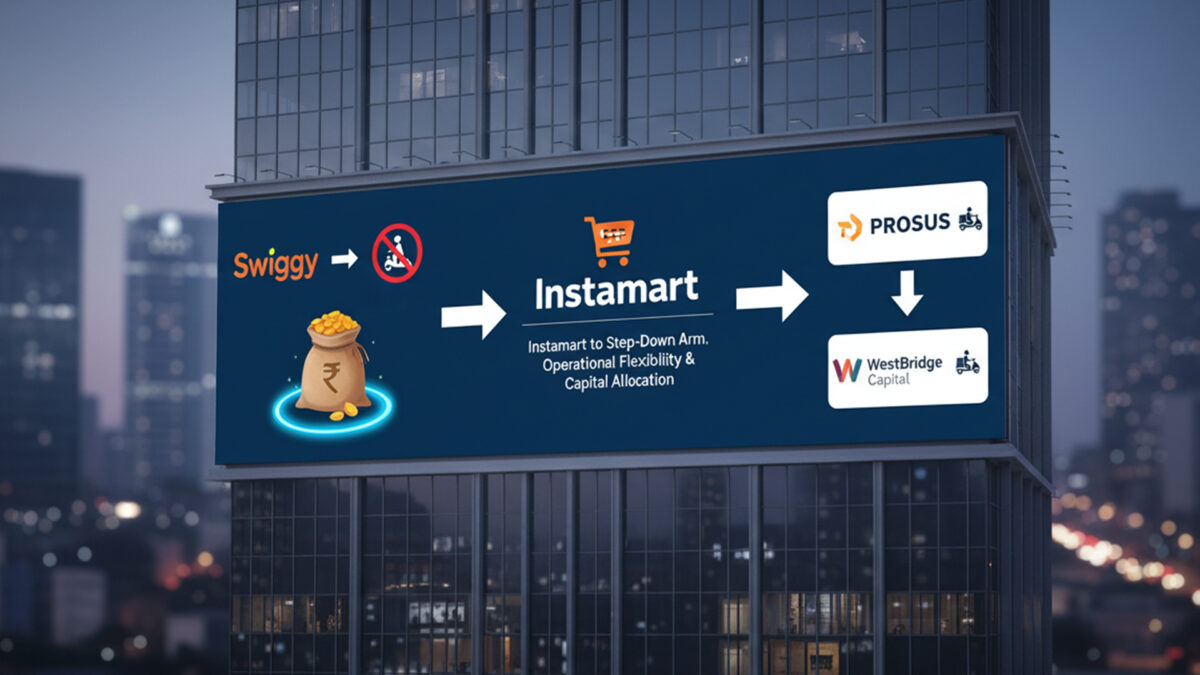
Swiggy Exits Rapido, Hives Off Instamart to Step-Down Arm in Major Restructuring

Foodtech major Swiggy on Tuesday moved to streamline its portfolio, with the board approving the sale of its entire stake in bike-taxi aggregator Rapido and a slump sale to transfer its quick-commerce arm Instamart into an indirect wholly-owned subsidiary.

The twin decisions, disclosed in regulatory filings, mark a notable reshuffle of Swiggy’s non-core investments and operating structure as the company sharpens focus on its primary food delivery and grocery marketplaces.

Swiggy will divest the Rapido shares it holds through Roppen Transportation Services in two tranches, selling a majority portion to MIH Investments One B.V., a Prosus group entity, and the remainder to an affiliate of WestBridge Capital, the filings show.

The combined consideration for the stake sale is reported at about ₹2,399–2,400 crore (roughly $270 million), representing a more than two-fold return on Swiggy’s original investment. Company filings cited by multiple outlets indicate the deals will be executed through transfers of equity and preference shares.

The board also approved a slump sale to move Instamart — Swiggy’s quick commerce business that promises groceries and essentials within minutes — into a newly incorporated step-down subsidiary.

Under the transaction, Instamart’s assets, liabilities and operations will be transferred at book value to the indirect arm, a move Swiggy said is intended to provide the unit with greater operational flexibility and to better align capital allocation across group businesses.

The company has indicated the slump sale is expected to complete after necessary shareholder and regulatory approvals.

Market reaction to the announcements was muted but positive in early trade, with Swiggy’s shares rising modestly before stabilizing, as investors parsed the implications of cash inflows from the Rapido exit alongside the strategic refocusing implied by the Instamart restructuring.

Analysts note that while the Rapido sale monetises a non-strategic holding, the Instamart reorganisation could be preparatory — enabling distinct governance, potential third-party investment or future strategic partnerships for the fast-growing but capital-intensive quick-commerce vertical.

For Rapido, the infusion from Prosus and WestBridge is expected to support an aggressive expansion and fundraise planned by the Bengaluru-based mobility player; several reports suggest the company is pursuing a broader financing round that would further bolster its valuation and product expansion into adjacent categories.

Swiggy’s exit removes a potential conflict after Rapido began venturing into food delivery and commercial services that could overlap with Swiggy’s core offerings.

Swiggy declined to comment beyond its exchange filings. The transactions reflect a broader trend among large Indian digital platforms to rebalance portfolios, monetise matured bets and ring-fence newer, capital-heavy verticals for targeted governance — a pattern likely to shape sector deals and investor interest in the coming quarters.

Also Read: Surat Startup DhiWise Rebrands as Rocket AI, Raises $15 Million Seed Round

Categories
Corporate

JLR Extends Production Shutdown to October 1 After Cyberattack

Jaguar Land Rover (JLR), the luxury carmaker owned by Tata Motors, said on Tuesday that its production lines in the U.K. will remain shut until at least October 1 after suffering a cyberattack that struck earlier in September, further compounding losses and rippling through its extensive supplier network.

The company had initially halted operations on August 31 following the cybersecurity breach. Factories in central and northwest England were shut, and more than 30,000 direct employees were told to stay home. In making this latest extension, JLR said it wished to provide “clarity for the coming week as we build the timeline for the phased restart of our operations and continue our investigation.”

JLR has stated that its technical teams are working around the clock with cybersecurity specialists, the U.K. National Cyber Security Centre and law enforcement agencies to ensure that production resumes in a safe, secure and controlled manner. The automaker’s retail operations and dealerships remain open, and it said it is supporting suppliers, colleagues and customers through the disruption.

The decision to prolong the shutdown places mounting pressure on both the company and its supply chain. JLR estimates its three U.K. plants, collectively producing roughly 1,000 vehicles a day, are losing tens of millions of pounds per week in foregone output. Moreover, JLR’s supply chain—which supports over 100,000 jobs in Britain—is already under severe strain. Many smaller suppliers, which depend heavily on just-in-time deliveries to meet production schedules, have reportedly scaled back operations or laid off workers.

Labour unions, particularly Unite, have raised concerns that longer shutdowns may lead to permanent job losses among suppliers if financial relief or support is not forthcoming. UK ministers, including Business Secretary Peter Kyle and Industry Minister Chris McDonald, are due to visit affected sites and meet with supply chain firms to assess damage and explore possible support measures.

Despite the severity of the operational disruption, JLR has said that no customer data was compromised in the incident. The company’s global operations, retail channels, and post-sales support have all been impacted, but only internal production systems were fully disabled. The precise nature of the attack remains under investigation.

In India, the announcement also caught market attention: Tata Motors shares dropped nearly two per cent from their intraday highs following the update, reflecting investor concerns over lost production, revenue disruption, and implications for future profitability.

The extension to October 1 represents a second postponement; earlier, production was expected to resume by September 24. The delay underscores the complexity of recovering from cyberattacks in an industry increasingly dependent on digitised operations and interconnected supply chains.

JLR said that the pause is needed not only to restore technical systems but to validate new controls, test security postures, and assure both suppliers and regulators of safety. It also emphasised that when operations resume, it will be in a phased manner.

The incident adds to the growing narrative of cybersecurity as a critical risk for automotive manufacturers. In an era when modern vehicle production, parts ordering, diagnostics, and even vehicle licensing are embedded in digital systems, disruptions of this kind bring not only financial consequences but reputational risk.

As JLR works toward a safe restart, the broader industry is watching closely. The stakes are high: failure to resume smoothly or to support suppliers effectively could have long-term implications for jobs, competitiveness, and the resilience of the U.K. automotive sector.

Also Read: Surat Startup DhiWise Rebrands as Rocket AI, Raises $15 Million Seed Round

Categories
Corporate

Cochin Shipyard Inks Strategic Deal With South Korea’s HD KSOE

In a landmark move designed to propel India towards global shipbuilding leadership, Cochin Shipyard Limited (CSL) has signed a strategic agreement with HD Korea Shipbuilding & Offshore Engineering (HD KSOE).

The partnership, announced on the sidelines of the “Samudra se Samriddhi” event in Gujarat, aims to blend CSL’s domestic infrastructure and expertise with HD KSOE’s advanced technology and global market access.

The collaboration is a key pillar in India’s ambitious Maritime India Vision (MIV) 2030 and Maritime Amrit Kaal Vision (MAKV) 2047, which seek to position the country as a major global shipbuilding and repair hub.

The agreement outlines the joint construction of large and next-generation vessels, including Suezmax tankers and Capesize bulk carriers, leveraging CSL’s new 310-metre dry dock in Kochi.

This facility, inaugurated in January 2024, can build up to six such vessels annually. The partnership also involves knowledge sharing, workforce upskilling, and exploring new business areas.

CSL is supporting this expansion with investments, including approximately ₹3,700 crore for a new Block Fabrication Facility in Kochi. This facility is expected to create around 2,000 direct jobs. CSL is also considering a significant greenfield investment in Tamil Nadu, potentially with HD KSOE, to establish a new shipyard.

This collaboration aligns with India’s Atmanirbhar Bharat initiative. Partnering with HD KSOE, a subsidiary of HD Hyundai, provides access to advanced technology, enhancing efficiency and competitiveness.

For HD KSOE, it offers entry into India’s growing maritime market, supported by government policies.

Analysts believe the deal will help CSL enter the higher-value segment of commercial vessel construction.

The combination of technological expertise and increased production capacity is expected to strengthen CSL’s global standing and boost India’s share in the global shipbuilding market.

The partnership represents a significant step for Indian shipbuilding, aiming for global competitiveness and technological advancement in line with national maritime goals.

Also Read: Apple Enters India’s Top 5 as Smartphone Market Grows 2% in H1 2025

Categories
Corporate

Bajaj Electricals snaps up Morphy Richards brand rights for ₹146 crore

Bajaj Electricals Ltd has won board approval to acquire the rights to the Morphy Richards brand and associated intellectual property from Ireland-based Glen Electric Ltd, a unit of the Glen Dimplex Group, paying ₹146 crore. The deal, which covers India and five neighbouring South Asian markets, marks a strategic move by Bajaj Electricals to assert greater control over a premium home appliance brand it has long partnered with.

Under the agreement, Bajaj Electricals will assume exclusive ownership of the Morphy Richards brand and related IP in India, Nepal, Bhutan, Bangladesh, the Maldives, and Sri Lanka. The consideration excludes applicable taxes and duties, and the acquisition remains subject to definitive agreements between the parties and to obtaining the required regulatory and statutory approvals.

The announcement of the acquisition sent Bajaj Electricals’ shares sharply higher. On the day the board approved the deal, the stock rallied more than 10 per cent, ending a four-day losing streak. Early trading saw volumes surge as investors reacted to the strategic implications of owning the Morphy Richards brand in the region.

Morphy Richards is a well-established name in consumer appliances, known for categories such as hand blenders, steam irons, ovens, coffee makers, juicers, and mixers. Bajaj Electricals has over the years operated under licensing and distribution ties with Morphy Richards; with this acquisition, the company aims to deepen its foothold in the premium appliance segment.

Analysts view the acquisition as an opportunity for Bajaj Electricals to reduce dependency on royalty/licensing costs and to better integrate innovation, design, and brand positioning under its own umbrella. The control over intellectual property is expected to give more flexibility over pricing, marketing, and product development. However, it will also confront Bajaj Electricals with the need to invest further in maintaining the brand’s premium perception, ensuring product quality, and keeping pace with competitive pressures from both local and global appliance makers.

Street observers added that the deal’s relatively moderate price tag suggests a lowgoing acquisition cost given the brand’s reach and reputation in the region. The markets have largely reacted positively, factoring in the potential upside from higher margins and reduced royalty outflows. Bajaj Electricals will need to ensure efficient supply chain, product innovation, and strong post-sales support to fully lever the brand acquisition.

In its recent first quarter results, Bajaj Electricals posted a steep fall in profits, with revenue from operations slipping compared to the same period last year, and margins under pressure. The Morphy Richards acquisition could help the company diversify its revenue streams and contribute to growth in higher-margin premium products.

Bajaj Electricals’ history with Morphy Richards dates back years through licensing agreements and co-marketing under the brand in India. This move to acquire full rights in the region places the company in a position to control the product roadmap, design, and pricing more directly. It may enable faster launches, tighter quality control, and more coherent marketing.

The company noted in its regulatory filings that consummation of the deal will require negotiation of definitive agreements and receipt of required approvals. Bajaj Electricals must also manage the brand transition—including IP registrations, possible adjustments in supply relationships, and adaptation to market dynamics across differing South Asian territories.

As Bajaj Electricals sets out to integrate the Morphy Richards brand, the broader home appliance sector will be watching whether the move translates into stronger growth, improved profitability, and enhanced brand resonance among consumers seeking premium offerings. The acquisition represents a clear bet on brand ownership at a time when product differentiation and IP control are becoming increasingly important in India’s consumer durables market.

Also Read: Surat Startup DhiWise Rebrands as Rocket AI, Raises $15 Million Seed Round