Categories
Beyond

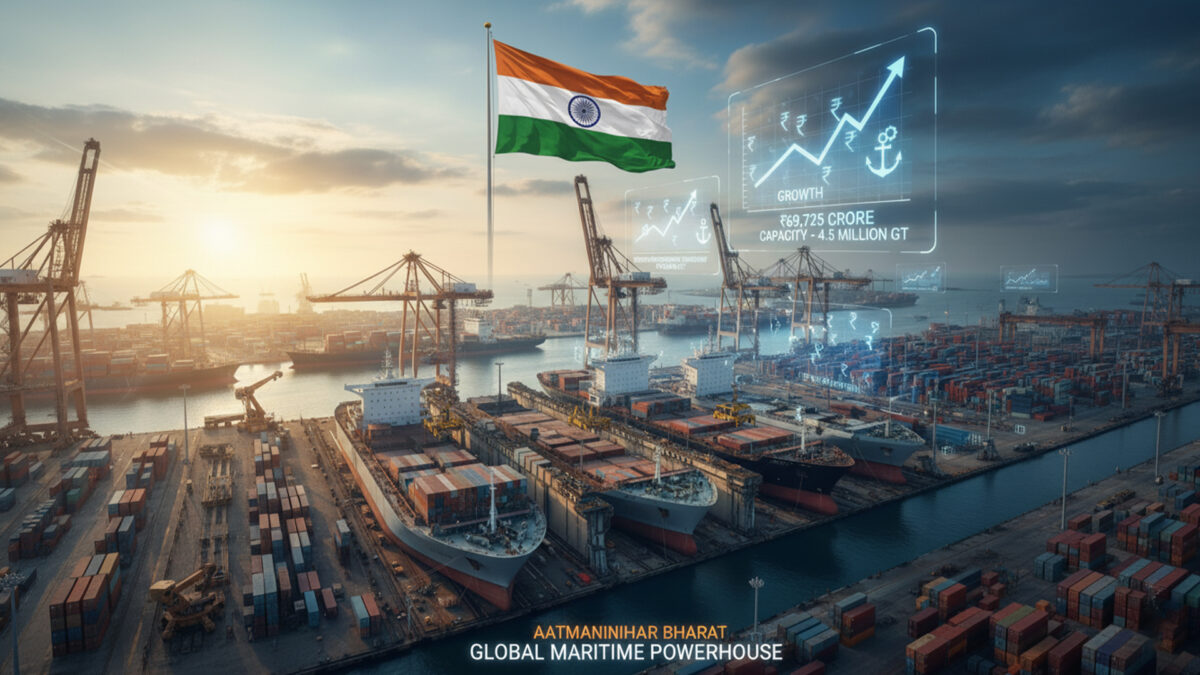
Union Cabinet Approves ₹69,725 Crore Package to Boost India’s Shipbuilding and Maritime Sector

The Union Cabinet, chaired by Prime Minister Narendra Modi, on Tuesday approved a comprehensive package of ₹69,725 crore aimed at revitalizing India’s shipbuilding and maritime ecosystem. The initiative introduces a four-pillar strategy to strengthen domestic capacity, improve long-term financing, promote shipyard development, enhance technical capabilities, and implement legal, taxation, and policy reforms.

Under the plan, the Shipbuilding Financial Assistance Scheme (SBFAS) has been extended until March 31, 2036, with a total corpus of ₹24,736 crore. This includes a Shipbreaking Credit Note of ₹4,001 crore and the creation of a National Shipbuilding Mission to oversee implementation. The scheme seeks to incentivize domestic shipbuilding, reduce project costs, and encourage technological adoption in shipyards across the country.

The package also introduces the Maritime Development Fund (MDF) with a total corpus of ₹25,000 crore, which will provide long-term financing for the sector. A Maritime Investment Fund of ₹20,000 crore will see 49% participation from the government, complemented by an Interest Incentivization Fund of ₹5,000 crore aimed at lowering the effective cost of debt and improving project bankability.

Further, the Shipbuilding Development Scheme (SbDS), with an outlay of ₹19,989 crore, is designed to expand domestic shipbuilding capacity to 4.5 million Gross Tonnage annually. The scheme will support the development of mega shipbuilding clusters, upgrade infrastructure, establish the India Ship Technology Centre under the Indian Maritime University, and provide risk coverage including insurance for shipbuilding projects.

The government expects the overall package to unlock 4.5 million Gross Tonnage of shipbuilding capacity, generate nearly 30 lakh jobs, and attract investments of around ₹4.5 lakh crore into India’s maritime sector. Officials noted that the measures will not only bolster economic growth but also enhance national, energy, and food security by strengthening supply chains and maritime routes.

Experts said the initiative will reinforce India’s geopolitical resilience and strategic self-reliance, advancing the government’s vision of Aatmanirbhar Bharat and positioning the country as a competitive player in global shipping and shipbuilding.

India’s maritime sector has historically been central to trade, supporting nearly 95% of the country’s trade by volume and 70% by value. Shipbuilding, often called the “mother of heavy engineering,” remains critical for employment, investment, national security, and the resilience of trade and energy supply chains.

The Cabinet’s approval marks a major step in modernizing India’s maritime infrastructure and promoting long-term competitiveness in shipbuilding, aligning with the government’s broader industrial and strategic priorities.

Also Read: Swiggy Exits Rapido, Hives Off Instamart to Step-Down Arm in Major

Categories
Beyond

Rupee Hits Record Low Amid US Visa Fee Hike and FII Outflows

The Indian rupee has fallen to a historic low, trading at ₹88.75 against the US dollar as of 10:30 AM IST today. This marks a significant depreciation from yesterday’s close of ₹88.73, continuing a downward trend that has seen the currency weaken over the past week.

Several factors are contributing to the rupee’s decline. A primary concern is the recent increase in US H-1B visa fees, which is expected to negatively impact Indian IT services exports and reduce remittance inflows as fewer professionals may take up US assignments. Analysts warn that export growth could fall below 4% in fiscal year 2026, down from earlier estimates of 5%. Additionally, sustained foreign institutional investor (FII) outflows have put pressure on the rupee, as capital exits from emerging markets amid global economic uncertainties.

The rupee’s depreciation is also influenced by broader regional market trends. Weakening sentiment across Asia, with regional currencies and equity markets also showing declines, reflects ongoing concerns over US Federal Reserve rate decisions. Fed Chair Jerome Powell’s recent comments about balancing inflation risks with a softening labor market have kept market participants cautious, leading to a flight to safety and a stronger US dollar.

For importers, the rupee’s decline means higher costs for goods priced in foreign currencies, potentially leading to increased inflationary pressures. Conversely, exporters may benefit from the weaker rupee, as their goods become more competitively priced in international markets.

The Reserve Bank of India (RBI) has yet to announce any intervention measures. Market participants are closely watching for any signs of RBI action to stabilize the rupee. In the meantime, the currency’s performance will continue to be influenced by global economic developments, domestic policy responses, and investor sentiment.

Also Read: Apple Enters India’s Top 5 as Smartphone Market Grows 2% in H1 2025

Categories
Beyond

Sensex and Nifty Dip as Visa Policy Concerns and FII Outflows Weigh on Markets

Indian equity markets slipped on Wednesday, with the benchmark Sensex falling as much 380.48 points to 81,721.62 in early trade and the Nifty shedding 106.45 points to 25,063.05. Investor sentiment was dampened by sustained foreign fund outflows and concerns over potential changes in the US H-1B visa system.

Tech and banking stocks were among the key laggards, with Tech Mahindra, Wipro, Tata Motors, HDFC Bank, and ICICI Bank declining up to 2 percent intraday. Analysts attributed the decline to multiple factors, including proposed modifications to the US visa framework. The US Department of Homeland Security has suggested a shift to a wage-based system for H-1B visa allocations, prioritising higher-paid candidates. Market observers note that this could adversely affect Indian IT services exporters, which traditionally rely on cost-effective H-1B staffing for overseas projects.

The broader market sentiment was also pressured by continuing foreign institutional investor (FII) selling, with equities worth ₹3,551.19 crore offloaded on Tuesday. Experts point out that persistent FII outflows have heightened volatility, particularly in mid-cap and large-cap segments.

Global cues contributed to the bearish mood, with South Korea’s Kospi and Japan’s Nikkei 225 trading lower, reflecting overnight losses on Wall Street. Higher Brent crude prices, which rose 0.28 percent to $67.82 a barrel, added to concerns for India, given its heavy dependence on oil imports. The Indian rupee weakened seven paise to 88.80 against the US dollar in early trade, hovering near record lows, as analysts highlighted the combined effect of capital outflows, tariff-related uncertainties, and the proposed US visa fee hike.

Further weighing on markets were comments from US Federal Reserve Chair Jerome Powell, who emphasized the need for caution in easing interest rates. Powell’s remarks suggested that premature monetary easing could entrench inflation, while overly restrictive policies could harm employment prospects. Market strategists noted that the Fed’s cautious stance typically keeps foreign investors cautious about emerging markets, including India.

Technical analysts observed that while the Nifty managed to hold the 25,000 support level, upside momentum remained capped. Geojit Financial Services’ Chief Market Strategist indicated that without a decisive move above 25,330, the index was likely to oscillate in a 24,880–25,080 range, reflecting both domestic and global headwinds.

Overall, Wednesday’s trading highlighted the vulnerability of Indian markets to global macroeconomic shifts and domestic liquidity pressures. Analysts suggest that investor focus will remain on developments related to US visa policies, FII flows, crude price fluctuations, and the trajectory of the rupee in the near term, with market participants closely monitoring both technical levels and fundamental drivers for signs of stability.

Also Read: Trump’s India Strategy Could Backfire on US Giants: Here’s how

Categories
Beyond

Auto stocks zoom as Navratri demand and GST reforms power up vehicle sales

Strong signs of demand in both the two‑wheeler and four‑wheeler segments have lifted shares of automotive companies, with the Nifty Auto index gaining nearly 1.8 percent on September 23. Trimmed by weakness elsewhere in the market, the auto rally was led by names like Maruti, Tata Motors, Mahindra & Mahindra, Hero MotoCorp, Eicher, along with Ashok Leyland, Bajaj Auto, TVS Motor, and Bharat Forge. The popular NBFC Bajaj Finance also got buoyed as auto financing looks set to gain from the surge in vehicle purchases.

Channel checks and early festive‑season data indicate that the first day of Navratri has seen healthy customer activity. Maruti reported close to 30,000 bookings and around 80,000 enquiries on Day 1, while enquiries for small cars have surged nearly 50 percent over normal levels. Hyundai Motor India recorded around 11,000 dealer billings on September 22, marking its best single‑day performance in the past five years. Analysts believe that the combination of reduced GST rates (under GST 2.0 reforms), festival sentiment, and better price affordability have unlocked pent‑up demand that was held back during the Shraddh period.

Brokerages have turned quite optimistic. Goldman Sachs upgraded Maruti Suzuki’s rating from Neutral to Buy, setting a target price of Rs 18,900 per share. The upgrade helped push Maruti shares to a 52‑week high. Other firms, such as Nuvama, expect the demand upcycle for passenger vehicles (PVs) to continue through FY29, supported by favorable tax policies, upcoming government pay‑commission recommendations, new model launches, and expectations of further rate cuts by the RBI. Experts at Nuvama note that historically the upcycle in autos lasts about six to eight years, suggesting there is room for the current momentum to extend further.

Despite the positives, some challenges persist. Supply constraints for certain popular variants could test the ability of manufacturers to meet demand. Price sagas in electric two‑wheelers have narrowed, yet consumers are showing willingness to pay more for differentiated or premium features. Heavy vehicles are seeing stronger value growth rather than volume growth, as fleet operators prefer shifting to higher tonnage trucks to improve margins and utilization.

From a policy perspective, the recent GST reforms (GST 2.0) appear to be delivering early results. The downward reconstructions in tax rates on passenger vehicles and two‑wheelers have made entry‑level models more affordable. Analysts suggest these reforms may be key in sustaining demand through the festival season and beyond.

Looking forward, industry experts believe that if domestic demand remains strong, OEMs that manage costs effectively and maintain supply will benefit most. Dealers anticipate volume growth of over 20 percent during the core festive period from October to December. Auto companies are adjusting strategy to ensure small car and affordable EV segments are well stocked, as growth in those areas could define winners in the near term.

Also Read: Government refuses to extend Vedanta’s contract for Cambay basin oil & gas block

Categories
Beyond

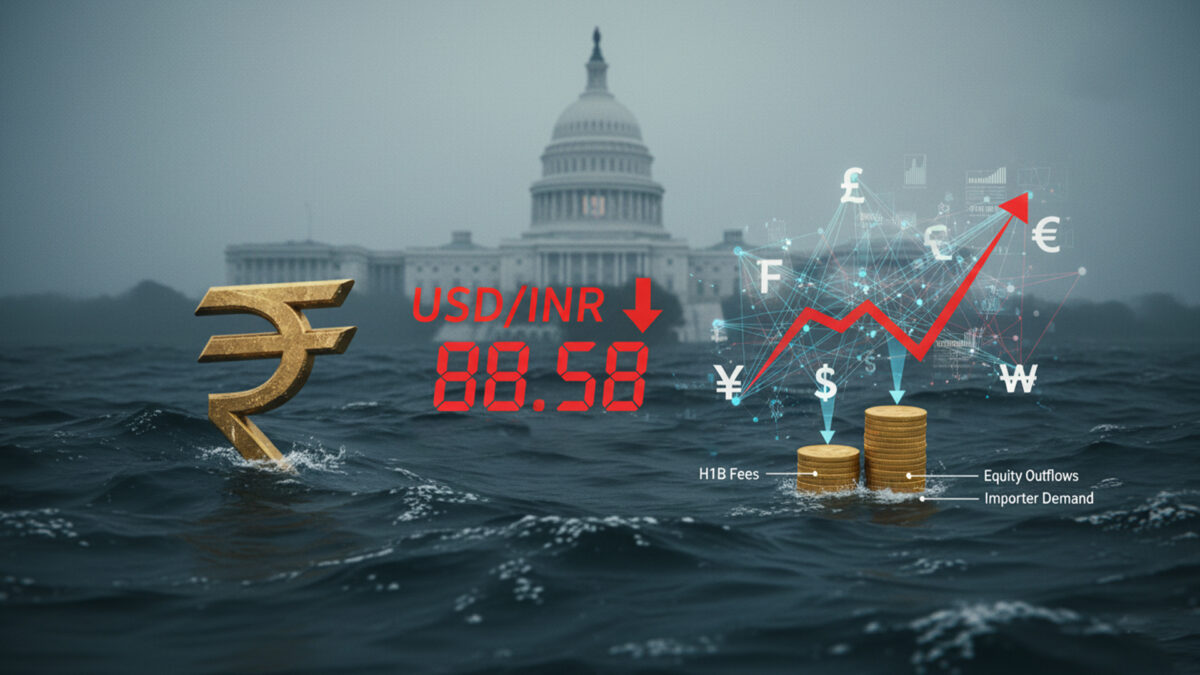
Rupee dips to fresh all-time low amid US policy headwinds and weak capital flows

The Indian rupee hit a record low of ₹88.58 against the US dollar in early trade on September 23, following a weak opening and pressure from both domestic and international fronts. The currency had opened at ₹88.4137 against the greenback, compared with ₹88.3163 at the previous close.

Asian currencies broadly were under strain, with the South Korean won down about 0.22 percent, the Thai baht 0.16 percent, the Indonesian rupiah 0.08 percent and the Singapore dollar, Japanese yen and Hong Kong dollar each about 0.05 percent weaker. Analysts say these wider currency trends have exacerbated the rupee’s fall.

Experts point out multiple factors weighing on the rupee, including enhanced US tariffs on Indian goods and a steep hike in H1B visa fees. The move on visa fees—raised to US$100,000 for certain categories—has stirred anxiety among India’s IT and outsourcing sectors. Concerns are rising about reduced remittances and the risk of equity outflows as foreign investors reassess exposure in view of these policy changes. Foreign inflows into Indian equities have already been weak this year.

In commentary on the outlook, currency specialists suggest that despite current pressure, there may be limited room for further sharp depreciation if certain support levels hold. One such expert believes that “the rupee is likely to appreciate from current levels, with support around ₹87.90–88.00,” arguing that if these zones are maintained, the currency could avoid sliding further in the near term.

In addition to policy-induced risks, importers’ demand for the dollar to hedge against rising costs has added to demand pressure. Weak domestic equity markets, and subdued foreign portfolio inflows, further reduce support for the rupee. Traders and analysts are also watching US interest-rate policy closely: higher US yields tend to strengthen the dollar, making it costlier for other currencies, including the rupee.

While the drop to the all-time low underscores the intensity of current pressure, there are signals of possible intervention from the Reserve Bank of India if the rupee weakens significantly further. Such intervention has in past episodes helped stem sharp slides. Ultimately, whether the rupee stabilizes will depend on whether external pressures ease, foreign capital revives, and trade-policy frictions are addressed.

Also Read: Internal Strife Erupts at Tata Trusts Over Nominee Director Appointment

Categories
Beyond

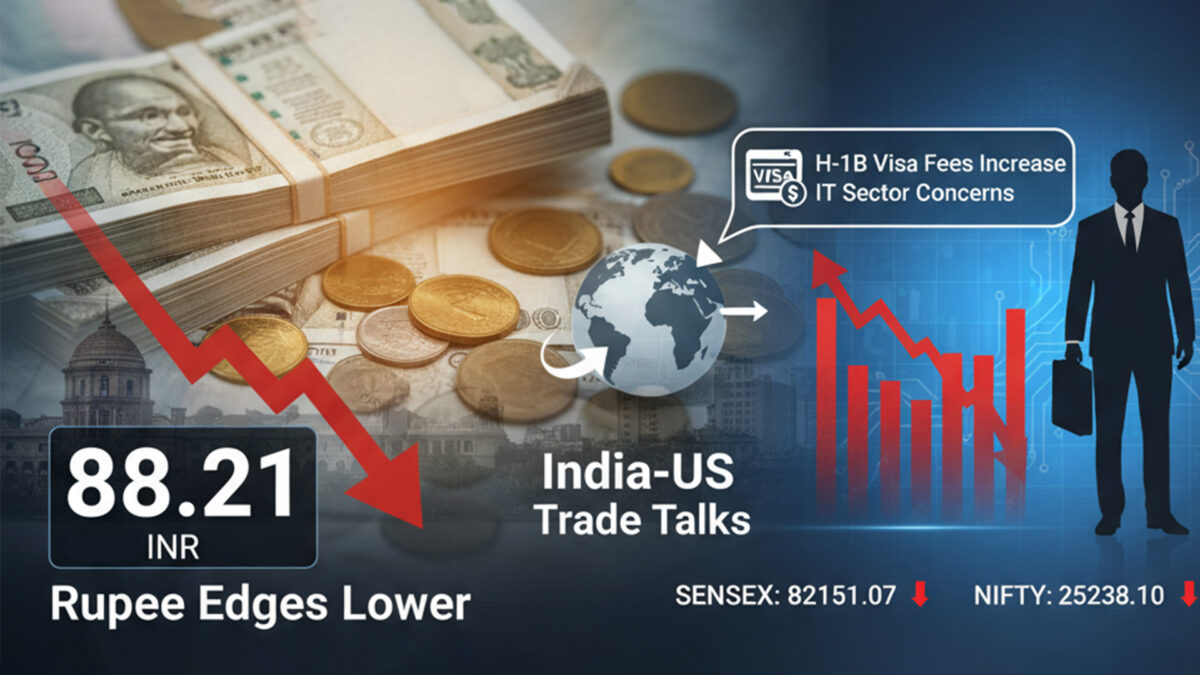
Rupee Edges Lower to 88.21 Amid Strong Dollar, IT Sector Concerns

Mumbai: The Indian rupee traded in a narrow range on Monday, September 22, 2025, and depreciated by 5 paise to 88.21 against the U.S. dollar. Strength in the American currency in overseas markets, coupled with a negative trend in domestic equities, weighed on investor sentiment.

Forex market participants noted that the recent increase in H-1B visa fees in the U.S. could impact the IT sector, potentially affecting company margins and reducing remittances due to slower employee deployments.

At the interbank foreign exchange market, the rupee opened at 88.20 before easing to 88.21. In the previous session on Friday, September 19, the currency had strengthened by 4 paise to close at 88.16.

The dollar index, which measures the greenback against a basket of six major currencies, gained 0.13% to 97.77. Global oil benchmark Brent crude was trading 0.66% higher at $67.12 per barrel in futures trade.

Domestic equities opened lower on Monday, with the Sensex down 475.16 points to 82,151.07 and the Nifty slipping 88.95 points to 25,238.10. Despite the early weakness, foreign institutional investors had net purchases worth ₹390.74 crore on Friday.

India’s foreign exchange reserves rose by $4.698 billion to $702.966 billion for the week ended September 12, following a $4.038 billion increase in the prior week, according to Reserve Bank of India data.

Meanwhile, Commerce and Industry Minister Piyush Goyal is scheduled to lead an official delegation to the U.S. on Monday for trade talks aimed at advancing negotiations for a mutually beneficial agreement. The delegation will visit New York and engage with U.S. officials to push for an early conclusion of the trade discussions.

Also Read: GRSE Secures $62.44 Million Contract with German Firm for Hybrid Vessels

Categories
Beyond

GST Cuts Make Dairy Products Cheaper Across India from September 22

Starting today, prices of key dairy products across India have dropped following a major overhaul in the Goods and Services Tax (GST) structure. The revised rates, effective from September 22, have resulted in a price reduction for ghee, butter, cheese, paneer, UHT milk, and other packaged dairy items, offering relief to consumers nationwide.

The GST Council, under its “GST 2.0” reform initiative, has slashed tax rates on several dairy items. UHT milk and packaged paneer have been moved to the nil GST category (0%), while other processed dairy products like butter, ghee, cheese, and ice cream now attract just 5% GST, down from the earlier 12%.

Leading cooperatives, including Mother Dairy, Amul, Nandini (Karnataka Milk Federation), and Milma (Kerala Cooperative Milk Marketing Federation) have all announced price cuts in line with the new rates.

Mother Dairy has reduced the price of its one-litre UHT milk tetra pack from ₹77 to ₹75. Its 200g paneer now costs ₹92, while a 100g pack of butter has dropped from ₹62 to ₹58. Ghee (1-litre carton) has been cut from ₹675 to ₹645.

Amul has revised prices across over 700 product variants. Ghee (1 litre) is now ₹610, down by ₹40, while processed cheese (1 kg) has been reduced to ₹545. A 200g pack of frozen paneer is now priced at ₹95, down from ₹99.

Nandini and Milma have also announced reductions on ghee, butter, paneer, flavored milk, and curd, with new rates effective from today.

However, the price of regular pouch milk remains unchanged as it has always been exempt from GST.

The move is expected to increase the affordability of dairy products and boost demand, particularly for value-added items that were previously costlier due to higher tax rates. Dairy brands have confirmed they will pass on the full benefit to consumers.

As the festive season demand approaches, the tax cut is seen as timely support for both consumers and the dairy industry.

Also Read: Apple Enters India’s Top 5 as Smartphone Market Grows 2% in H1 2025

Categories
Beyond

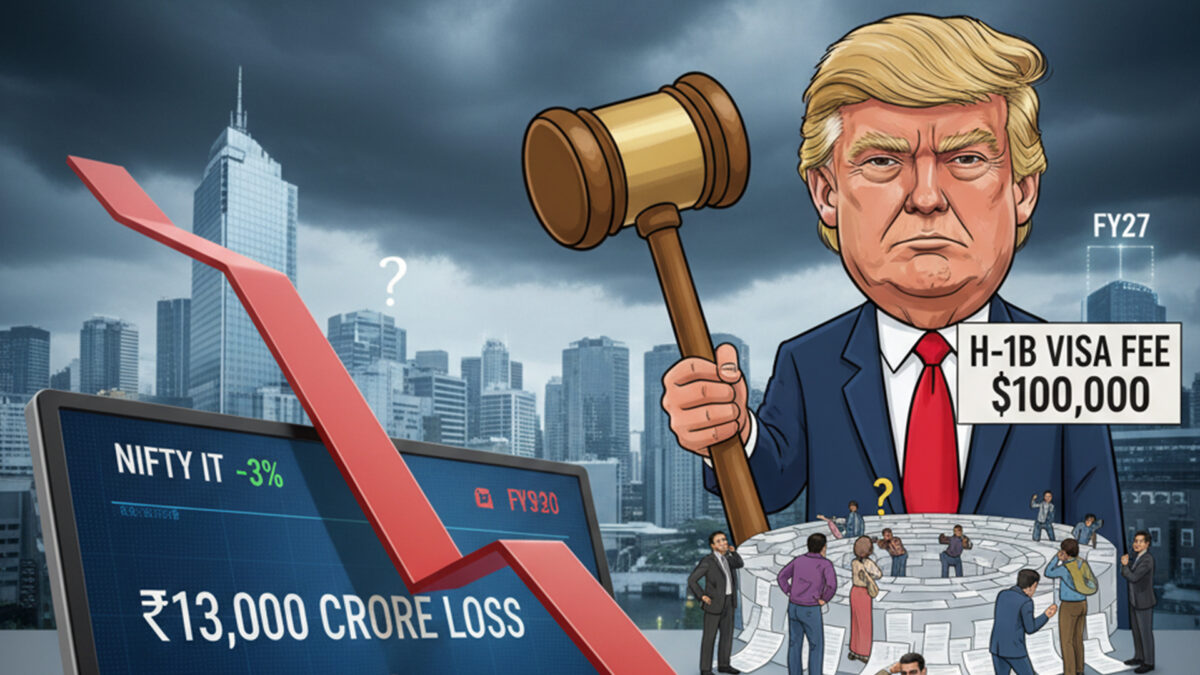
H-1B Effect: ₹13,000 Crore Wiped Out Fom Indian Mutual Funds

Indian mutual funds saw nearly ₹13,000 crore wiped out from their holdings in the country’s top ten IT companies after a sharp sell-off triggered by the U.S. government’s sudden move to increase H-1B visa application fees.

The executive order, signed by President Donald Trump, has unsettled investors who fear a direct hit on profitability and future hiring strategies of the sector.

As of September 19, mutual funds held shares worth ₹3.41 lakh crore across the ten biggest IT companies by market value. By market opening on September 22, this had slipped to ₹3.28 lakh crore.

Infosys accounted for the largest exposure at ₹1.27 lakh crore, followed by Tata Consultancy Services at ₹62,000 crore and HCL Tech at ₹35,850 crore. Other significant holdings included Coforge at ₹21,720 crore, Persistent Systems at ₹18,900 crore, Mphasis at ₹13,240 crore, Wipro at ₹11,600 crore, LTIMindtree at ₹8,189 crore and Oracle Financial Services at ₹4,348 crore.

The policy change, which raises the H-1B visa fee from about $1,000 to a staggering $100,000 per new application, represents a hundred-fold jump. While the process of sponsoring skilled workers remains intact, the costs are expected to reshape hiring economics and alter business models.

The immediate impact on margins is expected to be limited, but analysts caution that second-order effects, such as wage inflation in the domestic talent pool, could pressure profitability by up to 50 basis points.

On the other hand, companies are likely to counterbalance the hike through increased offshoring and price renegotiations, which could neutralise the effect over time.

Industry experts point out that top Indian IT players currently have only 1.2 to 4.1 percent of their workforce on H-1B visas, reducing the scale of disruption compared with earlier fears.

The consensus emerging among brokerages is that while the news rattled markets and pulled the Nifty IT index down by 3 percent, the long-term impact may not be as damaging.

Many believe that with this regulatory overhang now addressed, the sector could actually benefit from greater clarity, enabling firms to recalibrate their models with certainty.

The full financial implications of the new fee structure are expected to show up only in FY27, when petitions filed under the revised regime begin to affect cost structures in a material way.

Until then, investors are expected to closely track how IT majors adjust their strategies, whether through deeper reliance on offshore talent pools, higher local hiring in the United States or renegotiated client contracts to pass on a share of the additional costs.

Also Read: Apple Enters India’s Top 5 as Smartphone Market Grows 2% in H1 2025

Categories
Beyond

Adani Stocks Rises ₹66,000 Crore After SEBI Clears Charges

Shares of the Adani Group witnessed a strong rise on Friday, September 19, 2025, collectively adding around ₹66,000 crore to their market capitalization. This surge came in response to the Securities and Exchange Board of India (SEBI) dismissing significant allegations leveled by the U.S.-based short-seller Hindenburg Research against the conglomerate.

Leading the gains was Adani Power, which jumped 12.4% to close at its highest level since August 2024, buoyed further by the announcement of a forthcoming stock split. Other major group companies, including Adani Total Gas, Adani Enterprises, and Adani Green Energy, also saw notable increases, pushing the group’s total market value to roughly ₹13.96 lakh crore.

SEBI’s order cleared the group of key charges related to stock manipulation and questionable related-party transactions, restoring some investor confidence that had been shaken by the Hindenburg report. Analysts now believe the ruling may pave the way for a re-rating of Adani stocks, particularly encouraging foreign investors who had been cautious.

Gautam Adani welcomed the SEBI decision, urging an apology from those who propagated what he called “false narratives” based on Hindenburg’s “fraudulent and motivated” report. He reiterated the group’s commitment to transparency and integrity.

However, SEBI’s investigations are ongoing, with over a dozen other allegations still under review. These include potential violations of securities laws and shareholder misclassification, meaning further regulatory scrutiny remains possible.

Despite the positive momentum, some group firms are still recovering from the Hindenburg-triggered selloff. Adani Enterprises, for example, remains 28% below its pre-Hindenburg levels, while other companies continue to trade 20-80% lower. In contrast, Adani Power, Adani Ports, and Ambuja Cement have already surpassed previous losses, showing substantial rebounds.

The market’s favorable response to SEBI’s ruling signals a possible turning point for the Adani Group, as it seeks to rebuild investor trust and navigate ongoing regulatory challenges.

Also Read: SEBI Clears Adani of Hindenburg Allegations; Group Stocks Jump

Categories
Beyond

GST 2.0 Reforms to Put ₹2 Lakh Crore Back in People’s Hands: Sitharaman

Union Finance Minister Nirmala Sitharaman has said that the sweeping Goods and Services Tax reforms that come into effect from September 22, 2025 will leave about ₹2 lakh crore more in the hands of Indian households, boosting domestic consumption significantly. Speaking at the 80th anniversary of the Tamil Nadu Foodgrains Merchants Association in Madurai, she emphasized that the simplification from the earlier four tax slabs to two—5% and 18%—is meant to ensure that the poor, middle-class families, and MSMEs benefit most from the changes.

Sitharaman explained that the new “GST 2.0” structure will move almost all items taxed at 12% into the 5% category, and a large portion of those taxed at 28% into the 18% slab. Essential items such as everyday household goods, certain foods, and agricultural inputs will see sharp reductions in tax rates, while the higher slab will apply to standard goods. There will also be a 40% rate reserved for luxury and “sin” goods—such as tobacco, pan masala and aerated drinks—but the implementation of that higher rate for some of these items will be phased.

She said that because of the two-slab structure, many goods consumers buy regularly will become cheaper, encouraging greater spending. Industries are expected to respond by increasing production, thereby creating more jobs and expanding the tax base. Sitharaman pointed out that entrepreneur registrations under GST have risen sharply since 2017: from about 65 lakh to 1.51 crore, which she says reflects growing participation in the formal economy.

The government is also easing procedural burdens: registration and return filing processes will be simplified, refunds sped up, and compliance for MSMEs reduced. These reforms follow decisions taken at the 56th GST Council meeting, and official notifications have been issued to operationalize the changes.

Critics, however, have questioned why the rate-cuts have taken eight years to implement and whether the benefits will reach all categories of consumers equally. Some business analysts warn that while the tax burden will fall on many products, certain goods still in higher slabs or under the luxury/sin category may not see relief, and the timing of adjustments will matter for low income households.

Overall, the government’s claim is that GST 2.0 will stimulate demand, improve affordability, and ensure that taxation is simpler, fairer, and more inclusive, especially for those who were previously bearing heavier indirect tax burdens.

Also Read: Vodafone Idea Shares Surge 9% as Supreme Court Defers Hearing on Rs 9,450-Crore AGR Demand