Categories
Beyond

Indian Markets Surge Amid Optimism Over Fed Rate Cut, Banking Performance

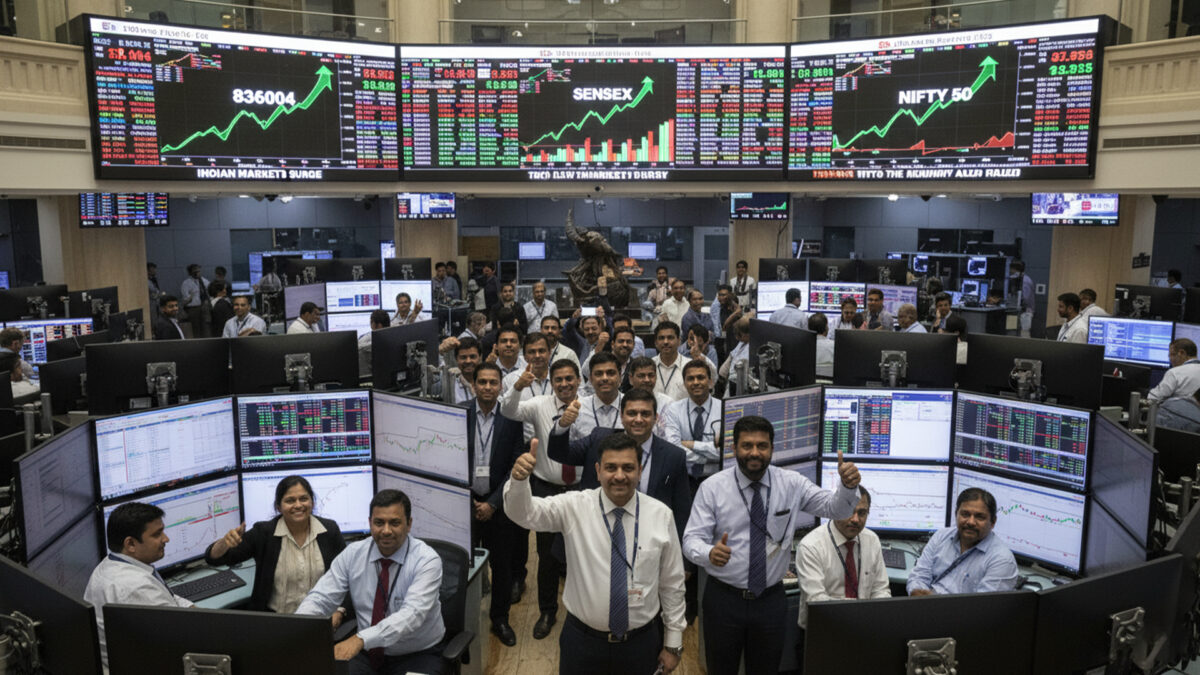
Indian equity indices experienced a robust rally on Thursday, October 16, 2025, with the Sensex and Nifty both climbing over 1% during intraday trade.

At 2:55 PM IST, the Sensex stood at 83,604, up 998.83 points or 1.21%, while the Nifty 50 reached 25,621.65, gaining 298.10 points or 1.18%.

The rally was driven by strong performances in banking shares, positive global cues, expectations of a U.S. Federal Reserve rate cut, and continued foreign institutional inflows. Titan Company, Adani Ports, Tata Motors, Axis Bank, and Mahindra & Mahindra were among the top gainers in the Nifty pack, rising up to 3% intraday.

Banking Sector and Domestic Drivers

The banking sector was a key catalyst for the market uptrend, with stocks like Axis Bank, Kotak Mahindra Bank, and HDFC Bank showing strong gains. Axis Bank advanced after reporting healthy loan growth in the September quarter, and brokerage analysts continued to maintain positive ratings on the stock.

Reports of a possible consolidation among public sector banks also buoyed investor sentiment, with the government considering a mega merger plan that could see smaller lenders combined with larger banks by FY27.

Domestic institutional investors (DIIs) further supported the rally, purchasing shares worth ₹4,650.08 crore on Wednesday, strengthening market liquidity.

Additionally, the rupee appreciated by 40 paise to 87.68 against the U.S. dollar in early trade, aided by central bank intervention, a softer dollar index, lower crude prices, and positive domestic equities, which helped sustain investor confidence.

Global Cues and Technical Outlook

Positive global market cues reinforced domestic optimism, with Asian indices such as South Korea’s Kospi, Japan’s Nikkei 225, and Shanghai’s SSE Composite trading higher.

The prospect of a U.S. Federal Reserve rate cut contributed to bullish sentiment, while expectations of a U.S.-India trade deal further lifted investor confidence. Trade discussions were set to focus on energy commerce, with U.S. officials indicating reduced trade tensions and a potential agreement in the coming weeks.

From a technical standpoint, the Nifty’s close near the 25,330 level, previously acting as resistance, signals market strength. Analysts noted that a sustained move above this region could open the possibility of testing 25,460 in the near term, with immediate support seen near 25,260.

The combination of robust banking sector performance, foreign capital inflows, improving trade prospects, and positive global cues has created a conducive environment for continued market gains in the short term.

Also Read: Microsoft, AWS, and Google to Shift Production Out of China?

Categories
Beyond

SEBI Orders ₹173 Crore Disgorgement in IEX Insider-Trading Case

The Securities and Exchange Board of India (SEBI) has ordered the disgorgement of ₹173 crore from eight individuals in connection with an insider trading case involving Indian Energy Exchange Ltd (IEX).

The regulator has also barred the individuals from trading in securities as part of interim action against alleged misuse of unpublished price-sensitive information.

According to SEBI’s interim order, the eight individuals traded in IEX shares and derivatives ahead of a regulatory announcement by the Central Electricity Regulatory Commission (CERC) regarding the implementation of “market coupling.”

The announcement, made on July 23, 2025, was deemed price-sensitive and was followed by a sharp decline in IEX’s share price the next day.

SEBI’s investigation found that several of the accused had made substantial trades in IEX put options before the announcement, despite having little to no prior history of such activity. The trading behavior was described by SEBI as inconsistent with their usual patterns and suggestive of prior access to confidential information.

The eight individuals named in the order include Bhoovan Singh, Amar Jit Singh Soran, Amita Soran, Anita, Narender Kumar, Virender Singh, Bindu Sharma, and Sanjeev Kumar.

SEBI’s whole-time member Kamlesh Chandra Varshney, in his 45-page interim order, stated that there is prima facie evidence indicating that the noticees were in possession of unpublished price-sensitive information (UPSI) before the regulatory decision was made public.

The regulator directed that ₹173 crore in alleged unlawful gains be impounded and deposited in interest-bearing fixed deposits with a lien in favor of SEBI.

The individuals’ bank and demat accounts have been frozen, allowing withdrawals only to facilitate transfer of the impounded funds.

Until full disgorgement is completed, the accused are prohibited from buying, selling, or dealing in any securities. After the amount is credited, they will remain barred from dealing in IEX securities specifically.

The probe was initiated after IEX’s stock price dropped nearly 30 percent on July 24, 2025, immediately following the CERC announcement.

SEBI correlated the sharp decline with prior unusual trading activity and flagged the pattern as indicative of insider trading.

Investigations included search and seizure operations conducted between September 18 and 20, 2025, across multiple locations associated with the accused. Digital records and communications were collected as evidence.

SEBI’s order also noted that part of the gains may have been transferred to other related parties, and further inquiry is ongoing.

The regulator has shared its findings with CERC for any action the power regulator may deem appropriate. SEBI also indicated that additional entities could be named as the investigation progresses.

The interim order represents one of SEBI’s more substantial enforcement actions in recent months and underscores its continued focus on curbing insider trading and strengthening governance standards across India’s capital markets.

Also Read: Amazon Plans to Cut 15% of HR Staff Amid AI-Driven Restructuring

Categories
Beyond

Rupee Surges Nearly 1% on RBI Intervention and Trade Optimism

The Indian rupee rebounded sharply on Wednesday, posting its largest intraday gain in nearly four months after approaching a record low, driven by heavy support from the Reserve Bank of India (RBI) and renewed optimism over trade negotiations with the United States.

The currency rose as much as 0.9% to 87.9987 per dollar before paring some gains, after having weakened to 88.8025 on Tuesday.

Market sources indicated that the RBI likely sold dollars in both offshore and onshore trades to stabilize the rupee, echoing a similar intervention earlier this year in February when the central bank sold billions of dollars to curb speculative pressure on the currency.

Analysts observed that the rupee has remained relatively flat over the past three weeks, suggesting that the RBI has been quietly acting to prevent it from slipping past the 89-per-dollar level.

Experts noted that the central bank’s active presence, combined with expectations of India fast-tracking trade negotiations with the US, contributed to the currency’s sharp recovery.

Reports suggest that New Delhi aims to conclude trade discussions by next month, a development that, along with a softer dollar influenced by anticipated US Federal Reserve rate cuts, provided additional support to the rupee.

Market strategists highlighted that the RBI’s interventions around the 88.80 mark indicate a deliberate effort to prevent excessive and rapid depreciation of the currency.

Analysts further noted that if the rupee sustains gains above 88.10 per dollar, it could potentially strengthen toward the 87 level.

The combination of central bank action, trade optimism, and a broadly weaker dollar environment helped lift the rupee alongside other Asian currencies, signaling renewed confidence in the domestic currency and a cautious but steady stabilization of the foreign exchange market.

Also Read: Adani Group Seeks Court Approval to Acquire 87 Sahara Properties

Categories
Beyond

India, United States Set to Resume Trade Talks Amid Energy Import Discussions

India and the United States have resumed high-level trade negotiations this week, with energy imports and bilateral trade expansion taking center stage.

The discussions come amid efforts to resolve longstanding trade disputes and strengthen economic ties between the two nations.

The talks follow a temporary suspension in August 2025, when the United States imposed tariffs of up to 50% on a range of Indian goods.

Washington cited concerns that India’s continued imports of Russian oil were indirectly supporting Russia’s military actions in Ukraine, despite ongoing international sanctions.

Diplomatic engagement between Prime Minister Narendra Modi and U.S. President Donald Trump helped ease tensions, leading to the current round of negotiations in Washington.

India is seeking to increase its imports of U.S. energy, including crude oil and liquefied natural gas (LNG), as part of a broader strategy to diversify its energy sources.

Commerce Minister Piyush Goyal confirmed that New Delhi is keen on expanding its purchases of American energy products to address U.S. concerns and to ensure a more balanced trade relationship.

Indian officials view increased U.S. energy imports as critical not only for geopolitical reasons but also for supporting India’s domestic energy security and growing industrial needs.

The Indian delegation is being led by Commerce Secretary Rajesh Agrawal and includes senior officials from the Ministry of Commerce and Industry.

Their agenda covers tariffs, energy imports, and measures to encourage U.S. investment in India’s renewable and nuclear energy sectors. New Delhi has emphasized that energy cooperation with the United States could help accelerate its transition to cleaner energy sources while meeting rising domestic demand.

Bilateral trade between India and the United States has been growing steadily, and both sides have expressed a shared goal of doubling trade to $500 billion by 2030.

This ambitious target was first outlined during Prime Minister Modi’s visit to Washington earlier this year and underscores the strategic importance of the U.S.-India economic partnership. The current talks are seen as a key step toward realizing this goal, as both nations explore opportunities to expand collaboration in technology, manufacturing, and energy.

Experts note that U.S. energy companies stand to benefit from increased exports to India, particularly in the LNG sector, while India gains access to stable and diversified energy supplies.

In addition to fossil fuels, the negotiations also cover participation of American firms in India’s renewable energy projects, including solar and wind power, which are central to India’s long-term climate and energy policy objectives.

Analysts say the resumption of trade talks reflects a broader warming in U.S.-India economic relations and signals a willingness on both sides to address contentious trade issues.

With energy imports at the forefront of discussions, India and the United States are aiming to create a framework for sustainable trade and investment that strengthens energy security and supports industrial growth.

The talks are expected to continue over the coming days, with both governments indicating optimism about reaching a mutually beneficial agreement.

Officials from both sides have emphasized that the discussions are part of a long-term strategy to deepen economic engagement, resolve outstanding trade disputes, and support broader bilateral cooperation.

Also Read: OpenAI and Broadcom to Deploy 10 Gigawatts of Custom AI Accelerators

Categories
Beyond

Mumbai’s First Underground Metro Connects South–North in 45 Minutes

Mumbai has stepped into a new age of commuting this week as its first fully underground metro line, the Colaba–Bandra–SEEPZ corridor or Aqua Line, began full operations. Stretching 33.5 kilometres with 27 stations, the high-capacity line now carries passengers from Cuffe Parade in South Mumbai to Aarey in the North in just 45 minutes, transforming the way the city moves.

The final link, from Acharya Atre Chowk to Cuffe Parade, was flagged off on October 8 by Prime Minister Narendra Modi in the presence of Japan’s Ambassador to India, Maharashtra’s Governor and Chief Minister, and senior union ministers. The metro’s construction, years in the making, tested engineering limits by tunnelling through Mumbai’s dense, heritage-rich core without disturbing life above ground.

Funded in partnership with the Japan International Cooperation Agency (JICA), which covered over half of the JPY 680,692 million project cost through concessional loans, the line reflects decades of Indo-Japan infrastructure collaboration. PM Modi saluted the engineers and workers for taking on one of India’s toughest projects, calling the metro “a living symbol of a developing Bharat.”

Connecting commercial powerhouses like Bandra-Kurla Complex, Dharavi, Mumbai International Airport, and SEEPZ, the Aqua Line is designed for inclusivity with women-only coaches, disabled-friendly access, and advanced safety systems. Maharashtra Chief Minister Devendra Fadnavis called the metro a pride of the state and a testament to Mumbai’s resilience.

Fast, safe, and deeply rooted beneath the city it serves, the Aqua Line stands as a reminder that Mumbai’s spirit knows no limits, even when the path forward lies deep below the surface.

Also Read: Indian Households’ Gold Holdings Surge to $3.8 Trillion Amid Record Prices

Categories
Beyond

Draft Bill Seeks to Open Retail Power Sector to Private Companies

The Government of India has unveiled a draft amendment to the Electricity Act, 2003, aiming to transform the electricity distribution sector by introducing competition and enhancing efficiency.

The proposed reforms are designed to address long-standing challenges in the power sector and align with the nation’s vision of a developed economy by 2047.

The amendment seeks to allow multiple private companies to supply electricity within the same geographical area, utilizing existing infrastructure.

This move is intended to foster competition, reduce infrastructure duplication, and potentially lower costs for consumers.

Under the current law, multiple licensees in the same area can operate only if they establish their own distribution networks, a requirement that has led to unnecessary duplication and increased costs.

The proposed changes also advocate for the separation of the distribution network (carriage) from the retail supply of electricity (content).

This would enable different companies to operate within the same area, promoting competition and improving service quality.

Another key proposal is to empower State Electricity Regulatory Commissions (SERCs) to set electricity tariffs independently, without waiting for proposals from power generation utilities.

This is aimed at ensuring that revised tariffs take effect from April 1 each financial year, enhancing financial discipline in the sector.

The draft bill emphasizes the acceleration of renewable energy adoption, aiming to reduce cross-subsidies and lower industrial tariffs. It also proposes exemptions from cross-subsidy charges for manufacturing enterprises, railways, and metro railways within five years.

Consumer rights are also a focus, with measures to streamline dispute resolution mechanisms and improve the accountability of distribution companies.

Industry reactions to the proposed amendments have been largely supportive. Experts and private companies view the reforms as a step towards modernizing the power sector and encouraging private investment. Companies such as Adani Power, Tata Power, Torrent Power, and CESC are expected to benefit from increased competition and market opportunities.

However, employee unions have raised concerns. The All India Power Engineers Federation (AIPEF) warned that allowing private companies to operate in the same area could undermine the public sector’s role and potentially lead to higher tariffs for consumers.

The Ministry of Power has opened the draft bill for public consultation, inviting feedback from stakeholders over a 30-day period.

The finalization and implementation of the proposed amendments will depend on the concurrence of state governments and regulatory bodies.

Also Read: Natco Pharma Secures Legal Victory to Launch Generic Risdiplam in India

Categories
Beyond

Indian Households’ Gold Holdings Surge to $3.8 Trillion Amid Record Prices

Indian households’ gold holdings have reached an estimated $3.8 trillion, equivalent to approximately 88.8% of the country’s Gross Domestic Product (GDP), according to a recent report by Morgan Stanley.

This surge is attributed to a significant rally in gold prices, which have increased by 61.8% in 2025, reaching a record high of $4,056 per ounce. As of June 2025, Indian households collectively held about 34,600 tonnes of gold, underscoring the metal’s deep-rooted cultural and financial significance in the country.

The substantial rise in gold holdings has created a positive wealth effect on household balance sheets, enhancing consumer confidence and spending power. However, experts point out that a significant portion of this gold remains idle, not contributing to the broader economy.

Zerodha CEO Nithin Kamath highlighted this paradox, noting that while Indian households possess approximately $3 trillion worth of gold, much of it is stored and not utilized for investment or economic activities.

Kamath emphasized the potential benefits of mobilizing even a fraction of this idle gold to stimulate economic growth and investment.

Equity Investments Reach Record Share of Household Financial Savings

In a notable shift, equities now constitute a record 15.1% of Indian households’ financial savings, surpassing traditional bank deposits.

This change reflects a growing trend towards financialization of savings, driven by factors such as low interest rates on deposits and increased investor awareness.

The movement towards equities is further supported by favorable demographics and a burgeoning middle class, which is increasingly seeking higher returns through stock market investments.

Despite this progress, participation in the securities market remains limited. A recent survey by the Securities and Exchange Board of India (SEBI) revealed that only about 9.5% of Indian households invest in securities like equities and mutual funds.

The survey also indicated that 80% of families prioritize capital preservation over potentially higher returns from riskier assets, highlighting a cautious approach to investing.

However, the survey also noted improving awareness and growing participation in urban areas, suggesting a potential for increased engagement in the securities market in the future.

The combined trends of rising gold holdings and increasing equity investments signify a significant transformation in India’s household financial landscape.

While gold continues to serve as a traditional store of wealth, the growing inclination towards equities indicates a shift towards more diversified and potentially higher-return investment strategies.

This evolution reflects broader economic changes and the increasing financial sophistication of Indian households.

Also Read: LG Electronics India IPO: Grey Market Premium Climbs to 35% Ahead of Allotment

Categories
Beyond

RBI Announces Comprehensive Regulatory Overhaul: Here’s What It Means

On October 9, 2025, the Reserve Bank of India (RBI) unveiled a significant regulatory overhaul aimed at enhancing the resilience and competitiveness of India’s banking sector.

This initiative encompasses a wide range of reforms, including the consolidation of existing regulations, the introduction of new credit risk frameworks, and the expansion of grievance redressal mechanisms.

Consolidation of Regulatory Framework

The RBI has undertaken a major consolidation of its regulatory instructions, aiming to streamline and simplify the existing framework.

Approximately 9,000 circulars, including Master Circulars, will be repealed and absorbed into 238 Master Directions applicable across 11 types of regulated entities. This move is expected to improve clarity and compliance for regulated institutions, reducing the complexity of the regulatory environment.

Overhaul of Credit Risk Regulations

In an effort to align domestic practices with international standards, the RBI has proposed significant changes to credit risk regulations.

Key proposals include adjusting risk weightage for corporate, MSME, and real estate loans, which could reduce the capital banks are required to hold against these exposures. Additionally, the RBI is introducing an Expected Credit Loss (ECL) framework to improve provisioning for bad loans.

This model classifies loans into stages based on credit risk and is expected to increase initial provisions but have minimal overall capital impact, thanks to a five-year transition period. The new ECL rules will be implemented from April 1, 2027.

Expansion of Grievance Redressal Mechanisms

The RBI has extended the Banking Ombudsman scheme to cover state cooperative banks and district central cooperative banks, offering these banks’ customers the same grievance redressal mechanism previously available only to customers of nationalised and scheduled banks.

Under the expanded scheme, customers can lodge complaints against financial fraud or losses directly with the RBI ombudsman if not resolved by the bank within 30 days.

The ombudsman is required to deliver a resolution within 45 days, with options for appeal to the Deputy Governor of RBI. This move aims to enhance accountability, transparency, and public trust in cooperative banking institutions, particularly benefiting rural account holders.

Restructuring of Leadership and Oversight

In a parallel move, the RBI has implemented a significant reshuffle involving its four deputy governors, resulting in a redistribution of oversight across the central bank’s 32 departments.

This realignment of portfolios is part of the RBI’s administrative strategy to enhance operational efficiency and optimize leadership roles within the institution. The reshuffle aims to support the central bank’s evolving objectives and manage the diverse and critical functions under its purview.

Implications for the Banking Sector

These comprehensive reforms are expected to bring about a more streamlined and efficient regulatory environment, fostering greater stability and resilience within the banking sector.

By aligning domestic practices with international standards, the RBI aims to enhance the competitiveness of Indian banks and improve their ability to manage credit risk effectively. The expansion of grievance redressal mechanisms is also anticipated to bolster customer confidence and trust in the banking system.

Overall, the RBI’s regulatory overhaul represents a proactive approach to modernising the financial sector, addressing emerging challenges, and positioning Indian banks for sustainable growth in an increasingly complex global financial landscape.

Also Read: LG Electronics India IPO: Grey Market Premium Climbs to 35% Ahead of Allotment

Categories
Beyond

U.S. to Impose 100% Tariffs on Chinese Imports; Markets React Sharply

The United States has announced plans to impose 100 percent tariffs on Chinese imports beginning November 1, intensifying tensions between the world’s two largest economies.

President Donald Trump said the move responds to China’s recent restrictions on rare earth exports, materials vital for semiconductor, defense, and green technology industries.

He described Beijing’s actions as “hostile” and accused China of unfair trade practices, adding that there was “no reason” to meet with Chinese President Xi Jinping at this stage.

The new tariffs effectively double the current import duties, placing greater pressure on American importers and global supply chains.

Analysts have warned that the sweeping levies could raise prices for U.S. consumers and complicate business planning for industries dependent on Chinese components.

Trump also signaled forthcoming export controls on “critical software,” expanding the confrontation beyond goods trade into the technology sector.

The announcement marks a sharp escalation after months of relative calm in U.S.-China economic relations. Financial observers note that the administration’s stance could be aimed at securing leverage ahead of any future negotiations.

However, experts caution that such moves risk triggering a full-scale trade war, potentially undermining global growth and investor confidence.

Wall Street Suffers Worst Day Since April

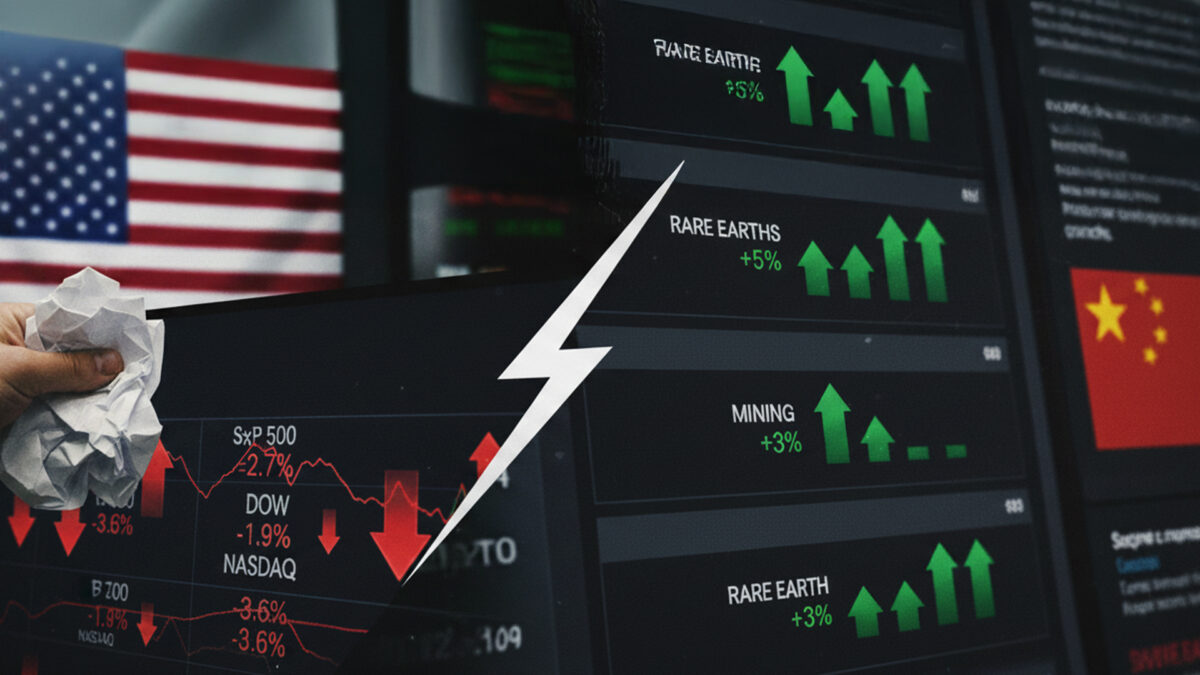
The tariff announcement sent shockwaves through global financial markets. Wall Street experienced its steepest single-day decline in six months, with the S&P 500 falling 2.7 percent, the Dow Jones Industrial Average dropping nearly 1.9 percent—or about 878 points—and the Nasdaq Composite sliding 3.6 percent.

The Philadelphia Semiconductor Index, which tracks chipmakers heavily exposed to China, tumbled more than 6 percent. Shares of major technology firms such as Nvidia, AMD, and Tesla led the downturn.

Investors fled to safer assets as market volatility spiked. The CBOE Volatility Index (VIX), often referred to as Wall Street’s “fear gauge,” surged sharply.

Energy stocks also weakened amid declining oil prices and fresh concerns about global demand. The sell-off was broad-based, with decliners far outnumbering gainers on the New York Stock Exchange.

Meanwhile, rare-earth and U.S. mining companies gained modestly, buoyed by expectations of domestic supply expansion.

For the week, all major indexes closed lower, reversing earlier gains. Analysts attributed the drop to renewed uncertainty over trade and the potential inflationary effects of new tariffs. The timing of the escalation added to market jitters, coming amid a partial government shutdown that has delayed key economic data releases.

Economists warn that higher import duties could worsen inflation pressures, disrupt manufacturing supply chains, and dampen consumer spending in the months ahead.

China has already begun retaliatory steps, including antitrust investigations targeting U.S. tech firms and expanded export restrictions. Observers fear the confrontation may extend into broader areas such as finance, energy, and national security.

The renewed tariff threat underscores the fragility of global markets and the interconnected nature of U.S.-China trade.

With both nations adopting hardline stances, investors and businesses are bracing for a period of heightened volatility and uncertainty across major economies.

Also Read: Natco Pharma Secures Legal Victory to Launch Generic Risdiplam in India

Categories
Beyond

India’s Telecom Sector Set to Boost GDP Share, BSNL 4G Rollout Marks Milestone

India’s telecommunications sector is expected to expand its contribution to the national GDP from the current 12-14 percent to around 20 percent over the next decade, Communications Minister Jyotiraditya Scindia said on October 9.

Speaking at a press conference on the second day of India Mobile Congress 2025, Scindia emphasized that the government’s role in the sector is more about facilitation than regulation, highlighting the highly competitive and largely deregulated nature of the industry.

A significant achievement in India’s telecom journey, Scindia noted, is the development of an indigenous 4G technology stack.

Collaborating with multiple ministries and private-sector partners, India became the fifth country globally to achieve a fully functional 4G stack, completing the feat in just 20 months from concept to deployment.

The minister stated that BSNL will scale up its 4G infrastructure and eventually transition to 5G as the network expands.

Prime Minister Narendra Modi, in his address at the congress a day earlier, called BSNL’s 4G stack a “major milestone” capable of providing seamless connectivity in remote regions and noted that the technology is now “export ready.”

Addressing questions on the Centre’s stake in struggling telecom companies, Scindia said the government currently holds a 49 percent stake in Vodafone Idea and has no immediate plans to increase its share.

Regarding MTNL, he clarified that BSNL has already taken over the operations in Delhi and Mumbai since January 1, though the transfer of assets has not yet occurred.

BSNL reported an operating profit of Rs 2,300 crore in FY24, which rose to Rs 5,100 crore in FY25. Despite this, the state-owned operator has not yet turned net profitable, primarily due to a record capital expenditure of Rs 25,000 crore last year.

The investment supported the installation of 100,000 towers to facilitate BSNL’s 4G rollout.

Scindia also spoke on the Production-Linked Incentive (PLI) scheme for telecom manufacturing, acknowledging that only half of the eligible companies have received benefits so far.

However, he maintained an optimistic outlook, noting that 21 out of 42 manufacturers exceeded their incentive targets.

He stressed that the scheme remains inclusive and that support would be extended to those who have not yet met their goals.

The minister’s remarks underline the government’s continued focus on strengthening India’s digital infrastructure, promoting domestic technology development, and expanding connectivity across urban and rural areas.

With indigenous technology development and large-scale network rollouts, the sector is poised to become a more significant contributor to the country’s economic growth in the coming years.

Also Read: MakeMyTrip Partners with Google Cloud to Enhance AI Travel Assistant