
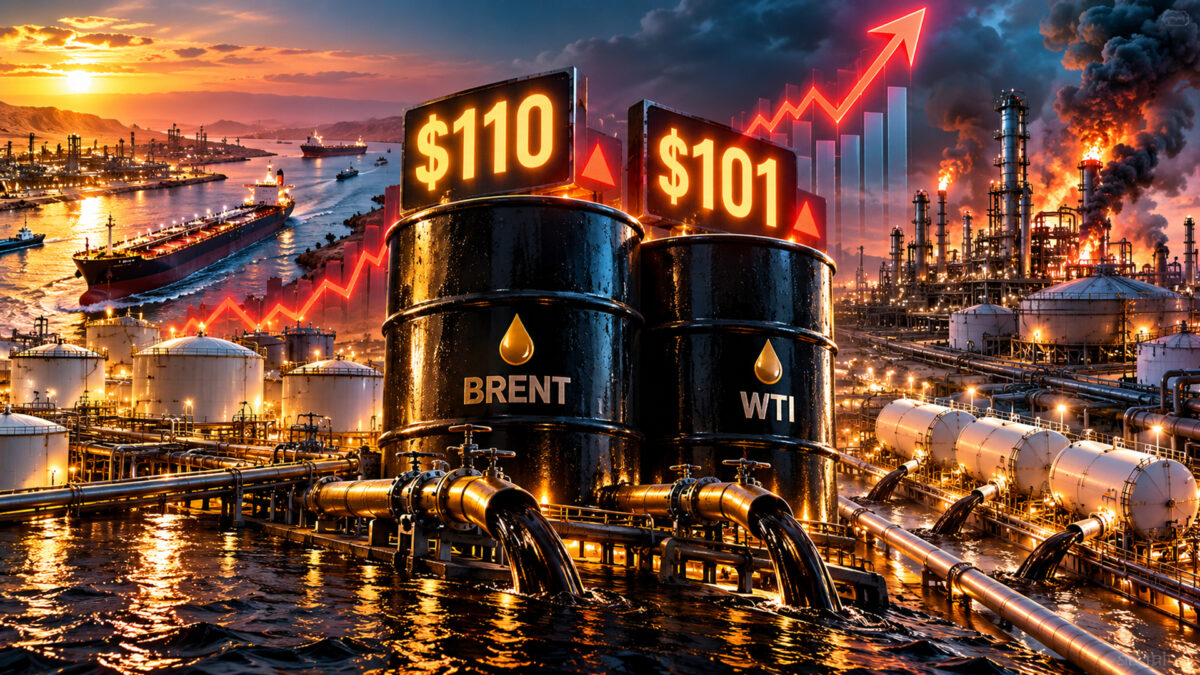
Global oil prices climbed sharply on Friday, October 16, as escalating tensions in the Middle East and fresh attacks on Russian energy infrastructure heightened concerns about global supplies. Brent crude touched $110 a barrel for the first time since May, while the US benchmark West Texas Intermediate (WTI) crossed $100, reflecting growing fears that oil shipments could face further disruption.
Brent crude futures settled at $109.86 a barrel, gaining $3.94, or 3.7%. US WTI crude futures rose $3.44, or 3.5%, to close at $101.41 a barrel. Brent recorded its highest settlement since May 19, while WTI reached its highest level since September 17. Both benchmarks recovered from earlier losses as traders reassessed the risks to global energy supplies.
For the week, Brent gained around 4.9%, while WTI rose 10.4%. The sharp increase highlights how geopolitical developments continue to outweigh efforts to ease supply concerns. Investors are closely monitoring the conflict involving Iran, the safety of shipping routes in the Gulf and the availability of Russian oil and refined products.
The latest rally also comes at a time when governments and energy agencies are trying to limit the impact of higher fuel costs on consumers and businesses.
The Strait of Hormuz remains one of the biggest concerns for the oil market. The narrow waterway connects the Persian Gulf with international shipping routes and is a key passage for crude oil and petroleum products exported by Gulf producers.
Recent attacks on commercial vessels have raised concerns about the security of oil shipments. Any prolonged disruption in the strait could delay deliveries, increase transport costs and reduce the amount of crude reaching international markets.
Market concerns intensified on Friday following reports of possible attacks on Saudi energy infrastructure and fears that Iran could take further military action. Saudi Arabia intercepted a ballistic missile aimed at the strategically important port city of Yanbu, although no damage was reported, according to reports cited by Reuters. These developments added to uncertainty over regional energy infrastructure and export routes.
Oil prices often rise when traders believe supplies could become harder to obtain. Even without a confirmed loss of production, the possibility of shipping delays or damage to energy facilities can lead buyers to secure supplies in advance, pushing futures prices higher.
Developments in Russia have also contributed to the increase. Ukraine renewed attacks on Russian energy facilities, damaging the Ryazan oil refinery, raising questions about the country’s ability to maintain supplies of refined petroleum products.
Russia is an important supplier of crude oil and diesel to international markets. Any disruption to its refining operations could tighten the availability of diesel, which is widely used in road transport, agriculture, construction and industrial activity.
Traders are also assessing how much Russian diesel can reach global markets following recent changes in US sanctions policy. The Trump administration has temporarily eased some restrictions on Russian diesel supplies in an effort to improve availability and contain fuel costs.
Washington is separately considering whether to relax restrictions on certain tankers associated with the so-called shadow fleet. These vessels have been used to transport oil from countries facing Western sanctions. Allowing more ships to operate commercially could increase shipping capacity and potentially reduce freight costs, although no such measure can fully offset supply disruptions caused by conflict.
Efforts to increase available supplies have so far failed to remove market uncertainty. The International Energy Agency has agreed to accelerate the release of additional emergency oil stocks, including more than 20 million barrels of diesel, as part of a wider effort to ease pressure on energy markets. This follows an earlier coordinated release by member countries intended to cushion the impact of supply disruptions.
The United States is also seeking to make additional crude available through its Strategic Petroleum Reserve. On October 16, the US Department of Energy invited proposals to exchange up to 17 million barrels from the reserve. The move forms part of a broader international effort to stabilise fuel markets following the conflict involving Iran. <Cite refs={[“turn583428news21”]}/>
However, emergency stock releases are temporary measures. They can help bridge short-term supply gaps, but they cannot fully replace regular production and exports if major shipping routes remain disrupted or refineries suffer prolonged damage.
The rise in crude prices is important for India, which imports most of the oil it consumes. A sustained increase in international benchmarks can raise the country’s import bill and put pressure on the rupee. It can also add to costs for transport companies, manufacturers, airlines and other fuel-intensive businesses.
Higher crude prices may increase inflationary pressure by making the movement of goods and the production of essential items more expensive. However, a rise in international oil prices does not automatically mean petrol and diesel prices at Indian fuel stations will increase immediately. Domestic prices also depend on currency movements, taxes, refining margins and government decisions.
The outlook for oil will largely depend on developments in the Middle East, the security of the Strait of Hormuz and the extent of disruption to Russian energy supplies. Emergency stock releases and possible changes to tanker sanctions could offer some relief, but traders remain cautious.
With Brent near $110 and WTI above $100, the market is signalling that supply risks remain serious. Until shipping routes and energy infrastructure become more secure, crude oil prices are likely to remain volatile, keeping pressure on governments, businesses and consumers worldwide.