Major U.S. technology companies — Microsoft, Amazon Web Services (AWS), and Google — are planning to relocate significant parts of their production and component manufacturing out of China by 2026, as they look to reduce reliance on Chinese supply chains amid escalating U.S.-China trade and geopolitical tensions, according to a report by Nikkei Asia.
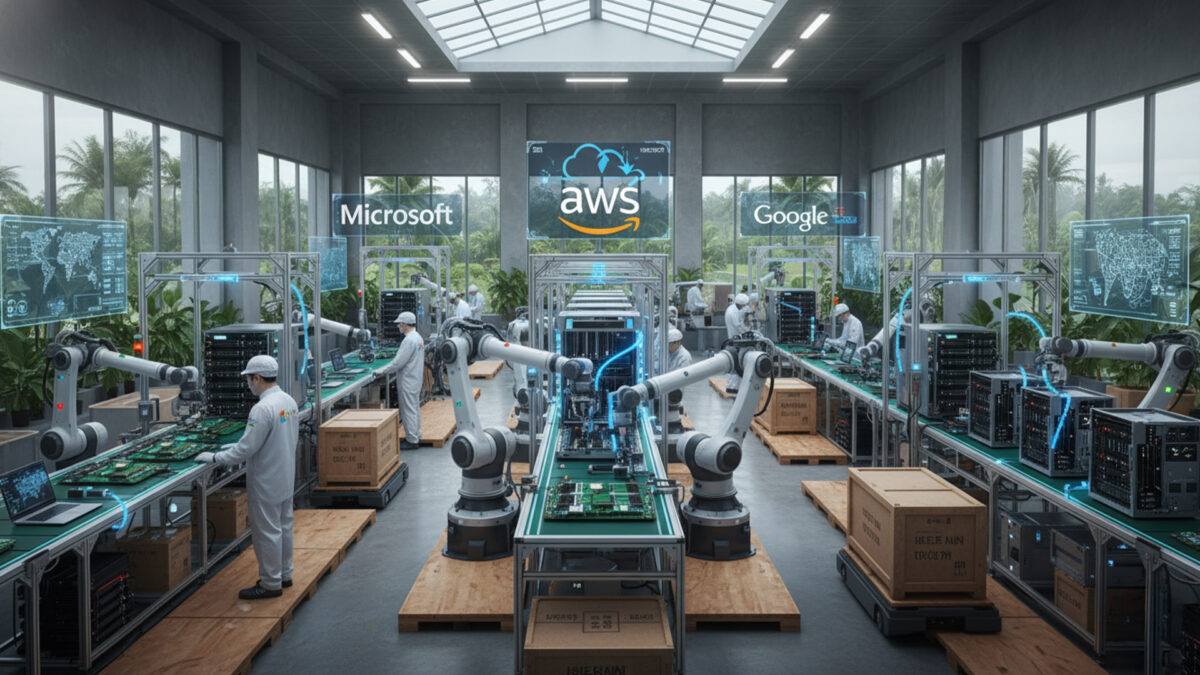
Microsoft has reportedly asked several suppliers to explore moving production of new products, including Surface laptops and data-center servers, outside China beginning in 2026.
The company is also targeting a shift in sourcing, with as much as 80 percent of materials for certain server components expected to come from non-Chinese suppliers.
AWS, the cloud computing arm of Amazon, is also accelerating efforts to diversify its supply base away from China.
The company is said to be focusing particularly on relocating production of components used in artificial intelligence (AI) servers, a key growth area that has been affected by export controls and supply-chain pressures.
Industry executives familiar with the matter have acknowledged that this shift poses challenges, given China’s long-established expertise in the manufacture of printed circuit boards and other critical parts.
Google, meanwhile, has begun expanding its server production capacity in Thailand. The company has reportedly instructed suppliers to carry out full-scale manufacturing — from component sourcing to assembly — in the Southeast Asian nation, in order to build greater resilience into its global hardware operations.
The move by these three U.S. tech giants comes amid rising strategic competition between Washington and Beijing, which has led to export restrictions, technology bans, and heightened scrutiny of supply-chain dependencies.
For multinational corporations, particularly those in the technology sector, the effort to “de-risk” and diversify supply chains has become a central strategy in response to these geopolitical uncertainties.
Analysts note that while shifting final assembly out of China can be done relatively quickly, relocating production of core components is far more complex.
Many of these parts rely on specialized supply networks, deep technical know-how, and cost structures that have developed in China over decades. Nonetheless, Microsoft, AWS, and Google appear committed to a gradual but significant reconfiguration of their manufacturing footprints.
If fully implemented, the moves could signal one of the most extensive supply-chain realignments by major U.S. technology firms in recent years.
Industry experts expect this to spur new investment across Southeast Asia, particularly in Thailand, Vietnam, and Malaysia, as companies seek alternatives to China while maintaining access to skilled labor and manufacturing infrastructure.
The transition marks a strategic turning point for the global tech industry, as firms balance cost efficiency with geopolitical risk management in an increasingly fragmented world economy.
Also Read: Air India in Fresh Talks to Acquire up to 300 Aircraft Amid Global Expansion Drive