
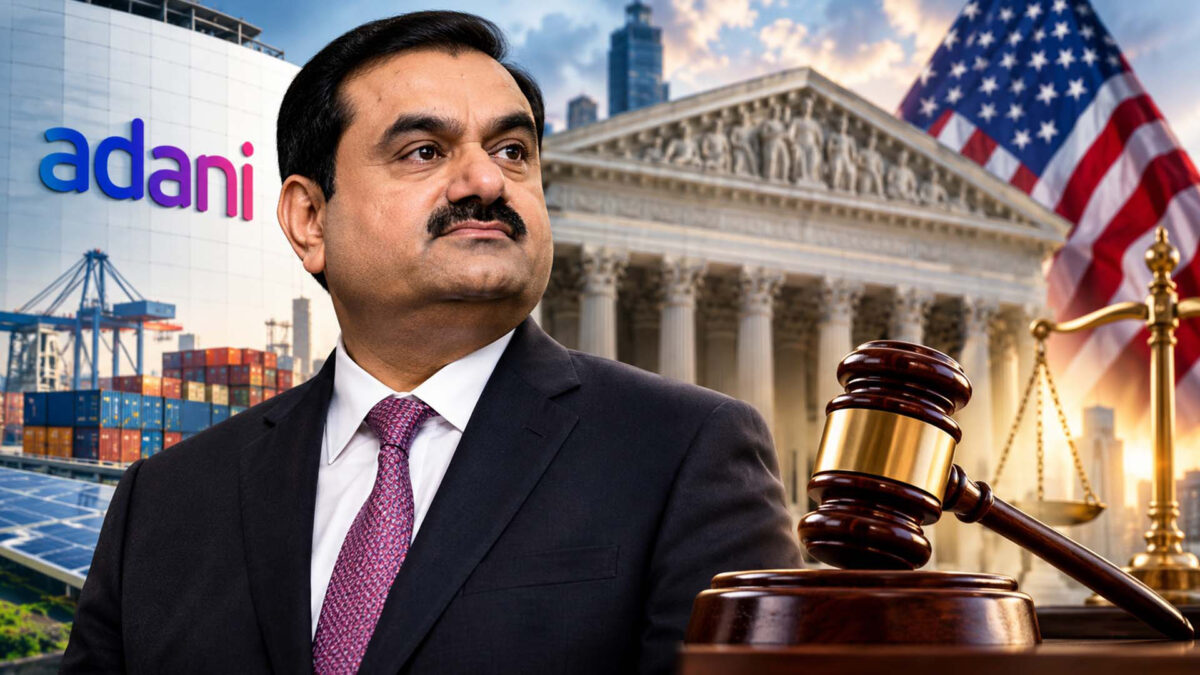
Indian billionaire Gautam Adani, one of the world’s leaders in energy, transport and logistics, has won the judicial outcome that matters most to him: the US criminal and civil cases, filed against him by US Department of Justice and the US Securities and Exchange Commission, are over. Yet the US court’s 47-page order is less a clean bill of health than a clear rebuke about how the case was dismantled and what could still follow. Adani’s reaction was immediate and public.
On August 10, Judge Nicholas Garaufis of the Eastern District of New York dismissed with prejudice the securities-fraud and wire-fraud counts against Adani — and also against his nephew Sagar Adani and Adani Green Energy director Vneet Jaain. The US DOJ cannot simply refile those counts. For a conglomerate whose access to global capital and overseas projects has been clouded by governance controversies, the US judicial orders provide both substantial relief and clear corporate vindication. In 2024, the Adani Group had immediately termed the DOJ and SEC allegations “baseless”.
But this is where the easy headline ends. The judge did not acquit the three men. He did not find the 2024 allegations to be false. He did not endorse the DOJ’s decision to retreat. In fact, he went out of his way to say precisely that.
Also, on the same day, Gautam Adani and Sagar Adani resolved the US SEC’s parallel civil case by accepting permanent antifraud injunctions and agreeing to pay $18 million in penalties — without admitting the allegations in the complaint. This is certainly a legal victory. However, it is not a judicial vindication.
What the court actually dismissed
The original indictment covered eight defendants and three alleged schemes. US prosecutors claimed that executives connected to Adani Green Energy and Azure Power had participated in a plan involving roughly $265 million in promised bribes to Indian officials, concealed the alleged conduct while raising billions from US and international investors, and later obstructed American investigations. The Adani Group has consistently denied wrongdoing.
One detail has been blurred in much of the coverage: Gautam Adani, Sagar Adani and Vneet Jaain were charged in Counts Two, Three and Four — with securities-fraud conspiracy, wire-fraud conspiracy and securities fraud. The Foreign Corrupt Practices Act conspiracy in Count One was charged against other defendants. So was the obstruction conspiracy in Count Five.
Judge Garaufis dismissed the three fraud counts against the Adani executives permanently. But he only granted the Justice Department’s motion “in part.” The FCPA count against Ranjit Gupta, Cyril Cabanes, Saurabh Agarwal, Deepak Malhotra and Rupesh Agarwal—and the obstruction count against four of them—remain before the court for now.
The judge ruled that the department must supply better reasons for dismissing those counts by August 31. The five defendants must also put their consent to dismissal on the record. The wider indictment, therefore, has not yet disappeared.
A win wrapped in a judicial rebuke
Courts generally give the executive branch wide latitude over whom to prosecute. What was unusual was how little the Justice Department initially offered to justify its decision — and how sharply the judge reacted.
The department’s May motion was only a paragraph long. The later explanation came from senior DOJ official R. Trent McCotter, who became the central decision-maker after reviewing extensive defence submissions. Adani’s lawyers said they delivered about 600 pages of analysis, expert reports and presentations over ten weeks.
Judge Garaufis said the process appeared “highly unusual.” He noted that McCotter seems to have reached his decision largely through engagement with defence counsel, without meaningful input from the FBI and SEC agents who investigated the case or the prosecutors who brought it. The judge described the irregularities as “concerning” and accused McCotter of showing a lack of respect for the judiciary by resisting the requirements of Rule 48(a), which requires a court’s permission to dismiss an indictment.
More strikingly, the court found much of DOJ’s reasoning wanting. Claims that India had found no actionable conduct, that investors suffered no loss, that the case would be unusually difficult to prosecute and that the indictment was a politically motivated “name and shame” exercise were, in the judge’s analysis, inadequately supported or contradicted by the record.
For the three fraud counts, one rationale survived scrutiny: the possibility that the anti-bribery language cited by prosecutors was too general or aspirational to sustain a securities-fraud case.
In other words, the strongest route to dismissal was not proof that nothing improper happened, but doubt over whether the statements to investors were legally actionable rather than corporate “puffery.” That distinction may not move share prices. It will matter to lawyers, lenders and compliance teams.
The $10-billion shadow
Then there is the issue that will follow this outcome far beyond Brooklyn. Three weeks after October 24, 2024, when the grand jury returned the indictment under seal, and a few days before the indictment was unsealed and publicly announced on November 20, 2024, Gautam Adani publicly pledged that his group would invest $10 billion in US energy security and infrastructure, potentially creating 15,000 jobs. During later settlement discussions, his lawyers raised the possibility that the investment could form part of a broader resolution.
Adani said under oath that he knew of no agreement exchanging anything for dismissal. His lawyer said US officials expressly refused to consider the investment in deciding the case. McCotter and the US attorney also denied that it played any role. The judge accepted those sworn assurances.
There is no finding of a quid pro quo. That needs to be stated plainly. Yet the optics remain difficult. A foreign billionaire announced a huge American investment after an indictment had been returned under seal — but before the charges became public; his lawyers later mentioned that investment in resolution talks; a new administration recalibrated foreign-bribery enforcement; and the case was ultimately abandoned through a process the judge called irregular.
Even without an unlawful bargain, the sequence reinforces the perception that access, strategic value and investment promises can enter the atmosphere around American enforcement decisions. If overseas governments or multinational rivals conclude that enforcement is negotiable at the highest levels, US demands for transparency abroad become easier to dismiss as selective.
The SEC case was settled, not thrown out
The civil outcome is another piece many headlines compress too aggressively.
The SEC originally alleged that Adani Green Energy’s September 2021 note offering raised $750 million, including about $175 million from US investors, while offering materials contained misleading statements about anti-bribery controls. Its final judgments did not test those allegations at trial. Gautam Adani and Sagar Adani consented without admitting them, except as to jurisdiction.
But the judgments are not empty paperwork. Gautam Adani must pay $6 million and Sagar Adani $12 million within 30 days. Both men are permanently enjoined from violating the antifraud provisions of Section 10(b), Rule 10b-5 and Section 17(a). The court retains jurisdiction to enforce the orders.
There is also a notable compromise. The SEC’s 2024 complaint sought officer-and-director bars. The final judgments impose no such bars and require no disgorgement. That leaves the two men in place, while giving the SEC an injunction that could make any future US securities violation substantially more dangerous.
The difference is simple: the DOJ walked away from the criminal case against the three men; the SEC closed its case against two of them on negotiated terms.
What changes for Adani—and what does not
Adani Group shares rose by as much as 3% on August 11. The dismissal removes the threat of trial on the three fraud counts, lowers a major headline risk and should make conversations with international banks and project partners easier.
But the rally also shows the limit of the reprieve. By 2026, parts of the group had already regained ratings stability: Moody’s had moved several Adani entities back to stable, Fitch had affirmed an investment-grade rating on an Adani Green restricted group, and S&P later upgraded Adani Ports. The order removes an overhang; it does not create the resilience rating agencies had already recognised.
Nor does it automatically restore opportunities lost after the indictment. Kenya cancelled airport and power-transmission deals worth more than $2.5 billion in November 2024. Those decisions were driven not only by the US charges but also by domestic litigation, protests and procurement concerns. Nairobi has since pursued alternative financing for airport expansion. A Brooklyn dismissal cannot rewind that clock.
Future counterparties will also read the whole record. They will see the dismissal, but also the SEC penalties, permanent injunctions and a judge’s criticism of the process. Due-diligence committees tend to price ambiguity, not press releases.
What lies ahead now
Three things come next.
First, August 31 will determine whether the remaining FCPA and obstruction counts also die. The Justice Department can almost certainly produce a fuller submission, but Judge Garaufis has signalled that conclusory assertions will not do. A second critical order could keep the institutional controversy alive even after Adani himself has exited the criminal case.
Second, Adani will try to turn legal relief into cheaper capital and renewed international expansion. Success will be visible not in a one-day stock bounce, but in bond spreads, lender participation, project awards and the willingness of sovereign partners to proceed without extraordinary protections.
Third, the ruling will become part of a larger argument over Trump-era FCPA enforcement. The administration says enforcement should protect US competitiveness and national security, not punish routine overseas business. Judge Garaufis effectively replied that an alleged nine-figure bribery scheme involving energy infrastructure and concealment is precisely the sort of serious conduct the new guidelines appear to prioritise.
That contradiction may be the most important part of the case. Gautam Adani leaves with the result he wanted. The US government leaves with harder questions about how it got there. And investors are left with a familiar calculation: the legal cloud has lifted, but the governance discount does not disappear merely because the prosecution does.