
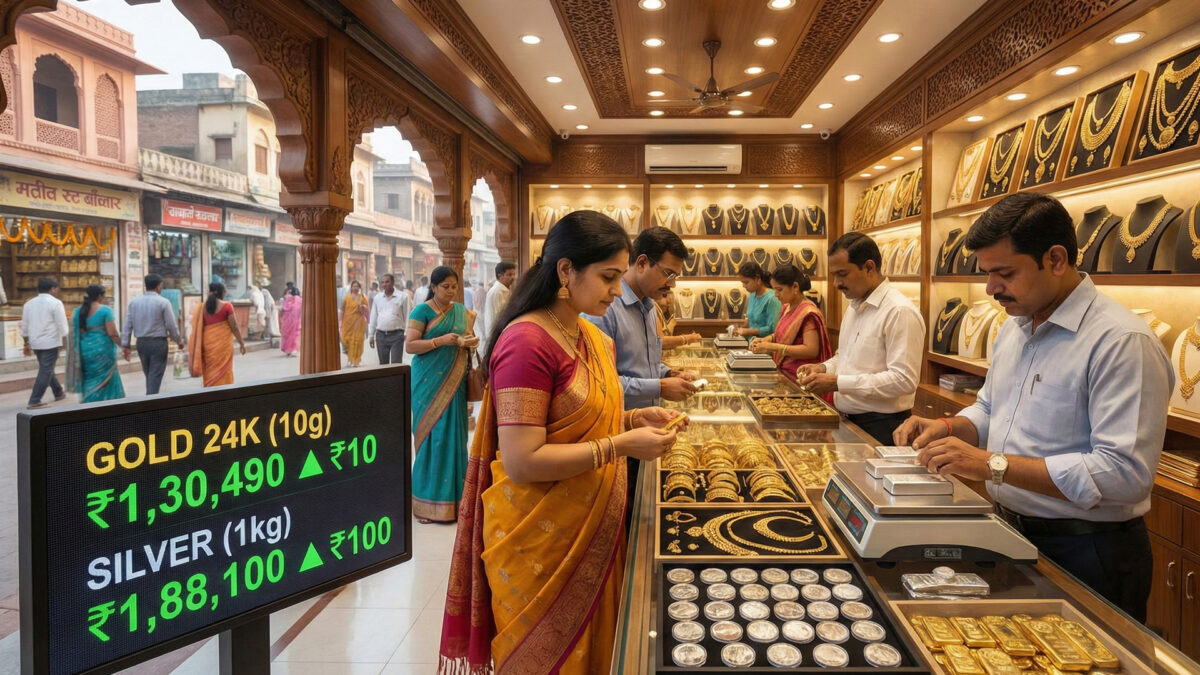
Gold and silver prices traded lower on Tuesday, October 13, as investors assessed global economic uncertainty, movements in crude oil prices and the outlook for US interest rates. While gold recovered from its early-session lows in international trade, domestic bullion prices remained under pressure, keeping buyers and investors alert to further fluctuations.
The focus has now shifted to upcoming US consumer price index (CPI) data, which could influence the Federal Reserve’s interest-rate outlook. Inflation figures are closely watched by precious metals traders because they can affect the dollar, bond yields and the attractiveness of gold as an investment.
According to market updates, international spot gold fell to around $4,121 per ounce during early trade before recovering to above $4,182. US gold futures edged up 0.29% to $4,202.80 per ounce in early trading. Silver, meanwhile, remained under pressure in international markets.
In the domestic market, spot gold closed Monday’s session at ₹1,47,681 per 10 grams, while silver settled at ₹2,20,717 per kilogram. On Tuesday morning, gold futures on the Multi Commodity Exchange (MCX) were trading around ₹1,49,525 per 10 grams, while silver futures declined 0.28% to ₹2,22,246 per kilogram.
The difference between spot prices and futures rates reflects variations in the contracts and trading sessions being compared. Retail prices also differ from exchange prices because of local market conditions, purity, taxes and jewellery-related charges.
In Mumbai, the reported retail price of 24-carat gold stood at ₹1,48,100 per 10 grams, while 22-carat gold was priced at ₹1,35,660. Silver was quoted at approximately ₹2,19,613 per kilogram. Rates can vary across cities, so buyers should check the latest local prices before making a purchase.
Gold prices have faced pressure from movements in the US dollar and changing expectations about the Federal Reserve’s monetary policy. A stronger dollar generally makes gold more expensive for buyers using other currencies, potentially limiting international demand. Expectations of higher interest rates can also weigh on bullion because gold does not pay interest or dividends.
The upcoming US inflation report is therefore a key event for the market. If inflation remains elevated, investors may expect interest rates to stay higher for longer. That could support the dollar and bond yields, creating additional headwinds for gold. Softer-than-expected inflation, on the other hand, could revive expectations of monetary easing and provide support to precious metals.
Geopolitical tensions in West Asia have added another layer of uncertainty. Gold is traditionally viewed as a safe-haven asset during periods of political and economic instability. However, its price does not always rise during geopolitical crises, particularly when higher energy costs raise inflation expectations and strengthen the case for tighter monetary policy.
Crude oil prices remain important to the bullion outlook. Any sustained rise in energy costs can push up transportation and production expenses and complicate the global inflation picture. For India, which imports a substantial share of its crude oil requirements, expensive energy can also put pressure on the rupee and increase imported inflation.
Silver faces a different set of influences because it serves both as a precious metal and an industrial commodity. Demand from solar energy, electronics and other industrial applications can affect its price alongside investment flows. This dual role can make silver more volatile than gold during periods of economic uncertainty.
For Indian households, daily changes in gold and silver prices are particularly relevant during the festive and wedding seasons, when jewellery purchases tend to attract greater attention. A fall in bullion prices may offer some relief to buyers, but a single session’s movement does not necessarily indicate a sustained downward trend.
Consumers should also remember that the final price of gold jewellery includes making charges and applicable taxes. The quoted market rate may therefore differ from the amount paid at a jewellery store. Comparing rates and understanding the purity of the metal can help buyers make more informed decisions.
Gold and silver are likely to remain sensitive to US inflation data, dollar movements, crude oil prices and geopolitical developments in the near term. While gold continues to attract interest as a store of value, silver’s industrial demand adds another variable to its price outlook. Investors and retail buyers will be watching these factors closely before deciding their next move.