
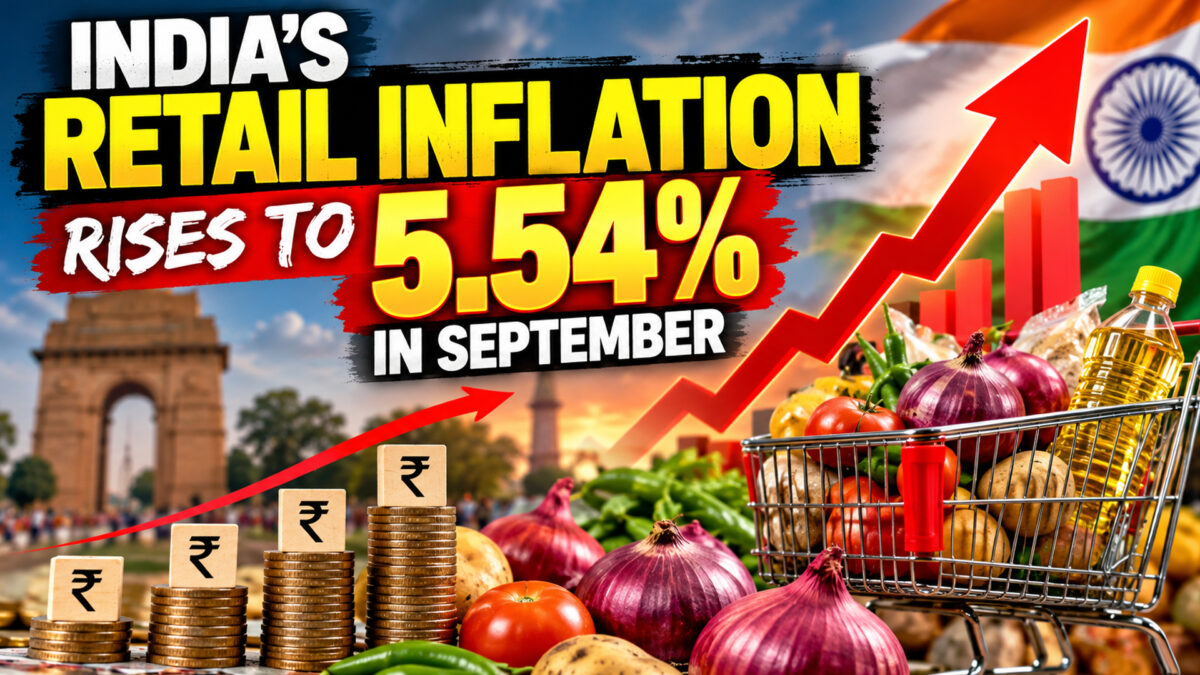
India’s retail inflation climbed to 5.54% in September, its highest level this year, as rising food prices added to the cost-of-living burden. The latest Consumer Price Index (CPI) data, released by the Ministry of Statistics and Programme Implementation, showed inflation rising from 4.83% in August. The increase takes inflation further above the Reserve Bank of India’s (RBI) medium-term target of 4%, adding to concerns over household spending, business costs and the direction of monetary policy.
Food inflation was the main driver of the increase, accelerating to 7.74% in September from 5.97% in August. The rise was visible across several everyday essentials, including onions, garlic and lemons. For households already managing expenses on groceries, transport and other necessities, higher food prices leave less room in monthly budgets for discretionary spending.
Onion prices recorded year-on-year inflation of 108.09% in September, sharply higher than 48.78% in August. Garlic inflation rose to 54.62% from 43.60%, while lemon inflation more than doubled to 36.41% from 15.15%. These increases highlight how price movements in a few widely used ingredients can quickly affect household expenses and food-related businesses.
Not every food item became more expensive. Potato prices were 11.50% lower than a year earlier, while tomato prices declined 8.62%. However, falling prices for some vegetables were not enough to offset the broader increase in food inflation. The overall trend suggests that consumers continue to face uneven price movements across their grocery baskets.
The pressure was also evident across rural and urban India. Rural retail inflation rose to 6.08% in September from 5.24% in August, moving above the RBI’s upper tolerance limit of 6%. Urban inflation increased to 4.88% from 4.31%. Food inflation stood at 8.06% in rural areas and 7.18% in urban centres, reflecting the broad reach of food price pressures.
The wider inflation picture shows that the increase is not limited to groceries. Inflation in personal care, social protection and miscellaneous goods and services reached 13.75%. Restaurants and accommodation services recorded inflation of 9.36%, while food and beverages rose 7.36%. Transport inflation stood at 5.01%, adding to costs for consumers and businesses that depend on logistics and mobility.
These trends matter for companies because higher prices for food, fuel, transport and other inputs can raise operating expenses. Businesses may absorb some of these costs to remain competitive or pass them on to customers. If price pressures persist, consumers could become more cautious about spending, potentially affecting demand in sectors such as retail, hospitality and consumer services.
Global energy markets are another source of concern. The conflict involving Iran has heightened uncertainty around oil prices and energy supplies. A sustained rise in crude oil prices can increase India’s import bill and push up costs across transport, manufacturing and distribution. Higher fuel-related expenses may gradually feed into the prices of goods and services, extending inflationary pressure beyond the energy sector.
Weather conditions also pose a risk to the inflation outlook. Below-normal monsoon rainfall can affect crop yields and agricultural supply, potentially keeping food prices elevated. The impact depends on the extent of production losses, the availability of supplies and how prices move in the coming months. If food and energy costs remain high, inflation could move closer to the RBI’s upper tolerance limit.
The September data also puts monetary policy in sharper focus. The RBI targets consumer inflation at 4%, with a tolerance band of 2% to 6%. Inflation at 5.54% remains within that band but is substantially above the central bank’s target. With price pressures building, policymakers face the challenge of containing inflation without placing unnecessary strain on economic growth and borrowing.
Economists have warned that persistent inflation could strengthen the case for further interest-rate increases. Higher policy rates can help curb demand and limit the spread of price pressures, but they also make borrowing more expensive for businesses and households. Home loans, vehicle finance and corporate credit could become costlier if monetary policy tightens further.
The latest figures are provisional, and the inflation trajectory will depend on food supplies, global energy prices and the pass-through of higher input costs. The next CPI release, scheduled for November 12, will provide a clearer indication of whether September’s increase marks a temporary spike or the beginning of a more persistent upward trend.
The latest data underlines the importance of tracking food and fuel prices closely, as their movement will shape both the near-term inflation outlook and the RBI’s policy decisions.