
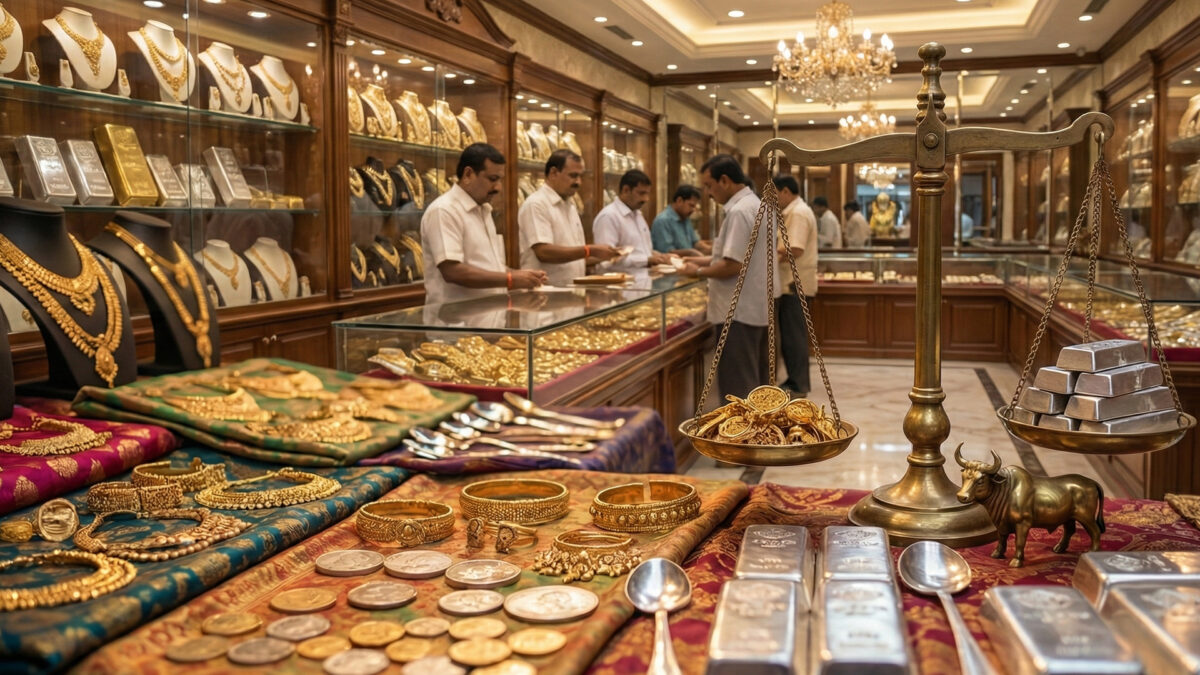
Gold and silver prices edged lower in India’s retail bullion market on Monday, October 12, as investors assessed geopolitical developments, movements in crude oil prices and expectations around upcoming US inflation data. The decline was marginal across major cities, keeping precious metals at elevated levels despite the day’s weakness.
According to retail price data, 24-karat gold was priced at ₹1,50,560 per 10 grams in Delhi, while the 22-karat variety stood at ₹1,38,013. In Mumbai, 24-karat gold was available at ₹1,50,820 per 10 grams and 22-karat gold at ₹1,38,252. Silver prices also softened, with 999-purity silver quoted at ₹2,24,970 per kilogram in Delhi and ₹2,25,360 in Mumbai.
In the futures market, gold contracts on the Multi Commodity Exchange (MCX) were trading 0.41% lower at around ₹1,51,100 per 10 grams in early trade. MCX silver futures declined about 0.16% to ₹2,25,770 per kilogram at around 9.13 am. The figures reflect early trading levels and may change as market activity progresses.
Internationally, gold prices remained above $4,200 an ounce, with US gold futures rising 0.42% to $4,234 an ounce in early trade, according to market reports. The contrast between international futures and domestic retail prices highlights how local bullion rates can respond differently to currency movements, domestic demand and pricing conventions.
Geopolitical uncertainty continued to influence investor sentiment. US President Donald Trump said he was considering joining Saudi Arabia in its response to Iran-backed Houthi forces following deadly strikes in Riyadh. The possibility of further escalation in the Middle East raised concerns about regional stability and its implications for energy markets and global financial conditions.
At the same time, traders were looking ahead to US consumer price index (CPI) data due later in the week. The inflation reading is expected to provide fresh clues about the Federal Reserve’s interest-rate outlook. Expectations of lower interest rates generally support gold because the metal does not pay interest, making it relatively more attractive when returns on interest-bearing assets decline.
Central bank buying has also remained an important factor supporting gold prices. The People’s Bank of China added around 23 tonnes of gold to its reserves in September, its largest monthly purchase in nearly three years, according to reported data. Continued purchases by central banks can provide support to the precious metal as countries diversify their reserves.
Retail prices varied across India’s major cities on Monday. In Bengaluru, 24-karat gold was quoted at ₹1,50,940 per 10 grams, while 22-karat gold stood at ₹1,38,362. Silver was priced at ₹2,25,540 per kilogram.
In Kolkata, 24-karat gold was available at ₹1,50,620 per 10 grams and 22-karat gold at ₹1,38,068. The silver rate stood at ₹2,25,060 per kilogram. Hyderabad recorded a 24-karat gold price of ₹1,51,060 per 10 grams, with 22-karat gold at ₹1,38,472 and silver at ₹2,25,720 per kilogram.
Chennai reported the highest gold and silver prices among these cities. The 24-karat gold rate stood at ₹1,51,400 per 10 grams, while 22-karat gold was priced at ₹1,38,783. Silver traded at ₹2,26,270 per kilogram.
These rates are indicative retail prices. The final amount paid by a jewellery buyer can differ because of local taxes, making charges, the jeweller’s pricing and the purity of the product.
The distinction between 24-karat and 22-karat gold is important when comparing prices. Pure 24-karat gold is commonly used for investment products such as coins and bars, while 22-karat gold is widely used for jewellery because the addition of other metals makes it more durable.
Silver prices, meanwhile, remain sensitive to both investment demand and industrial consumption. The metal is used in electronics, solar panels and several other applications, making its price responsive to changes in manufacturing demand as well as movements in precious metals markets.
The latest decline may offer some relief to buyers planning jewellery purchases, but the movement is too small to establish a sustained downward trend. Gold and silver prices can change quickly in response to international bullion rates, the US dollar, the rupee and geopolitical developments.
With US inflation data approaching and uncertainty continuing in global markets, investors and jewellery buyers are likely to monitor daily price movements closely before making purchasing decisions.