
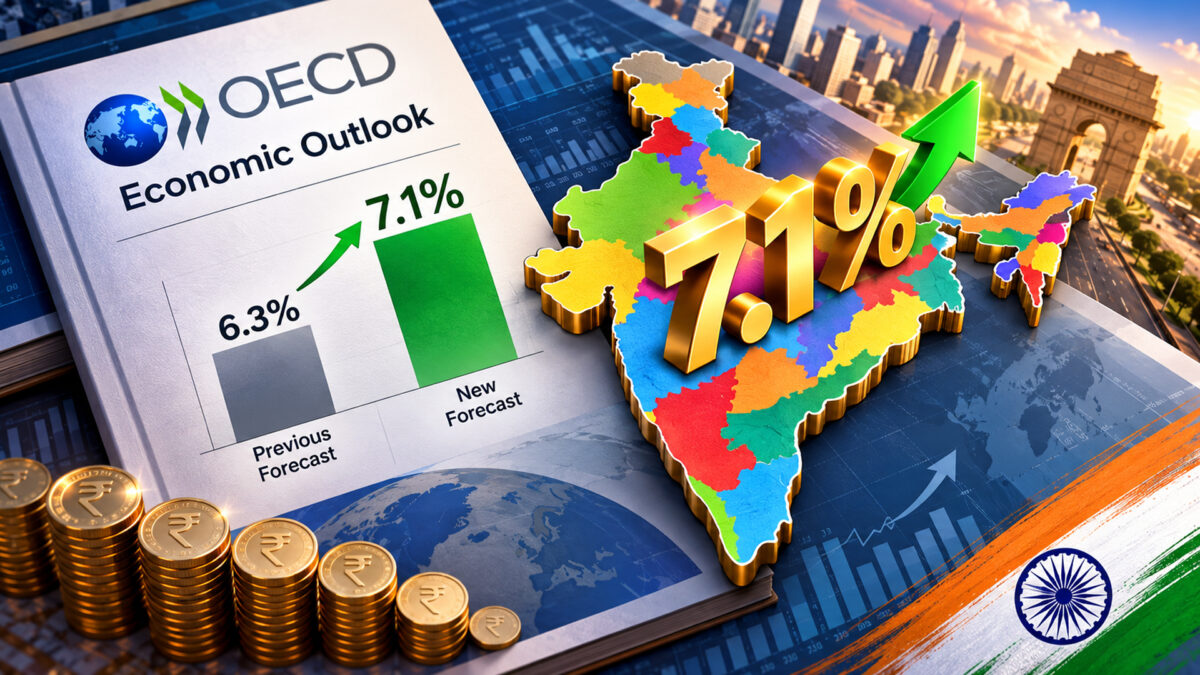
The OECD has raised its forecast for India’s economic growth in FY27 to 7.1%, offering a stronger outlook for Asia’s third-largest economy. The latest estimate is 80 basis points higher than the 6.3% forecast made by the organisation in June.
The upgrade comes after India’s economy grew faster than expected in the first quarter of FY27. India’s GDP expanded 7.8% in the April-June quarter, supported by strong investment, manufacturing, private consumption and services.
The revised forecast comes at a time when the Indian economy is facing several external challenges, including higher energy prices, geopolitical tensions and uncertainty over global trade.
Domestic demand remains strong
The OECD said India’s growth is being supported by resilient domestic demand and investment. Government measures have also helped households and businesses manage the impact of higher energy costs.
The April-June GDP data showed strength across several parts of the economy. Gross fixed capital formation grew 11.9%, pointing to continued investment activity. Manufacturing expanded 9.2%, while private consumption increased 7.1%.
Financial, real estate and professional services also performed strongly, growing by around 12.1%.
Strong domestic consumption is important for India because it reduces the economy’s dependence on external demand at a time when global trade remains uncertain.
Government spending and infrastructure investment have also continued to support economic activity, while businesses have maintained investment in sectors such as manufacturing, technology and services.
Growth expected to moderate
The higher FY27 forecast does not mean the OECD expects India to maintain the 7.8% growth rate recorded in the June quarter throughout the year.
The organisation expects economic growth to slow from 7.8% in FY26 to 7.1% in FY27, before easing further to 6.5% in FY28.
The OECD expects higher energy costs to reduce household purchasing power during the second half of FY27. Growth could then gradually improve as some of these pressures ease.
This suggests that while India’s overall growth outlook remains strong, the economy could see some moderation after the unusually strong performance recorded in the first quarter.
Other agencies also raise forecasts
The OECD is not the only global institution to have recently become more positive about India’s growth prospects.
S&P Global Ratings has raised its FY27 growth forecast for India to 7% from 6.6%, while Fitch Ratings increased its estimate to 6.9% from 6.4%. The Asian Development Bank also raised its projection to 7% from 6.6%.
Moody’s has put its FY27 growth forecast at 7%.
The series of upgrades reflects the stronger-than-expected performance of the Indian economy and the resilience of domestic demand.
Oil prices remain a major risk
One of the biggest risks to India’s economic outlook is the rise in crude oil prices.
The ongoing conflict in West Asia has disrupted oil supplies and increased uncertainty in global energy markets. Brent crude has recently moved above $100 a barrel, raising concerns for oil-importing countries such as India.
India imports a large share of the crude oil it consumes. Higher oil prices can increase the country’s import bill and put pressure on the rupee. They can also raise transportation and production costs for businesses.
For households, higher fuel and other energy costs can reduce disposable income and affect consumer spending.
The OECD expects government support measures, alternative energy supplies and existing oil inventories to soften some of the impact. However, a prolonged period of high crude prices could still weigh on India’s growth.
Inflation outlook
The OECD expects India’s inflation to remain manageable, although energy prices remain a risk.
It forecasts headline inflation to decline from 4.7% in 2026 to 4.2% in 2027.
Lower inflation could support household spending and provide some room for monetary policy to remain supportive of economic activity. However, a sharp increase in crude oil prices could change that picture by adding fresh pressure to consumer prices.
The inflation outlook will therefore remain important for investors and policymakers as they assess the future path of interest rates.
Global trade remains uncertain
India’s economic performance will also depend on global trade conditions. Higher tariffs, trade restrictions and geopolitical tensions have created uncertainty for exporters and businesses.
Despite these challenges, India’s domestic economy has remained relatively resilient. Services exports, manufacturing investment and consumer demand continue to provide support.
The OECD expects the global economy to grow 2.9% in 2026 and 3% in 2027. While this points to continued expansion, the outlook remains exposed to energy shocks, trade tensions and geopolitical developments.
Strong domestic demand in India could continue to act as a buffer against weaker external conditions.
The latest OECD upgrade strengthens the India GDP growth outlook for FY27, but several factors will determine whether the economy stays on track. Crude oil prices, inflation, interest rates, investment, consumer spending and global trade will remain closely watched in the months ahead.
The 7.1% growth forecast also places India among the fastest-growing major economies, even as the OECD expects growth to moderate from the exceptionally strong pace recorded in the first quarter.