
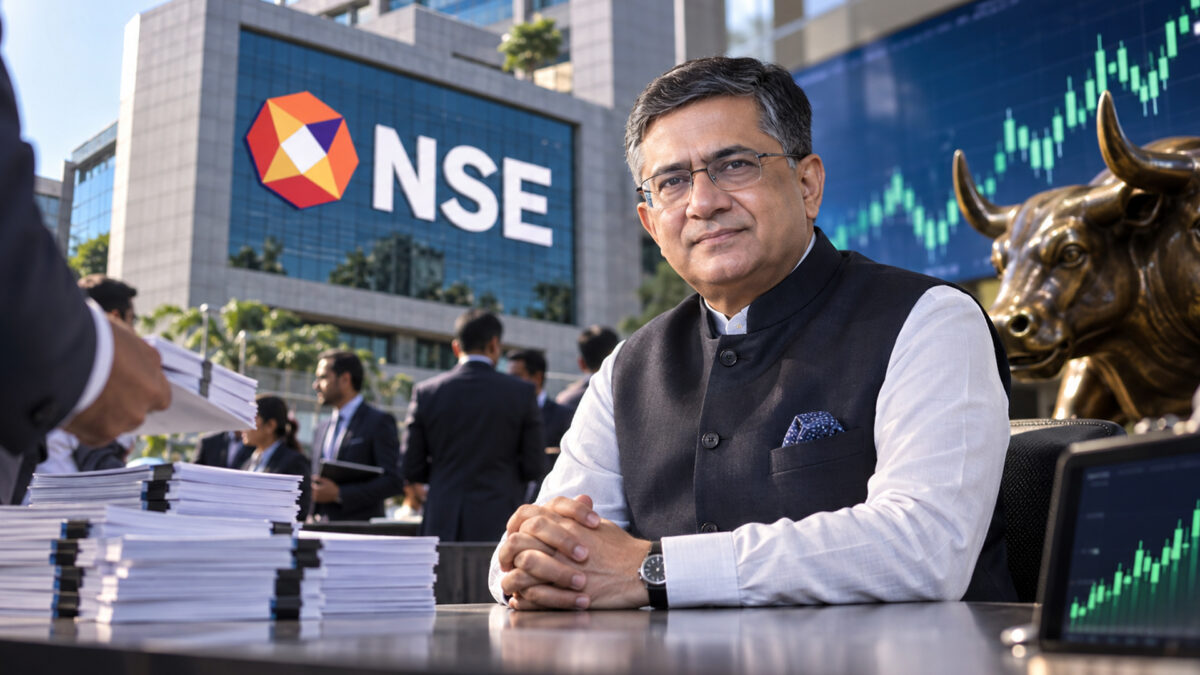
The much-awaited National Stock Exchange (NSE) IPO is entering the final stage before its public launch, with the issue drawing unexpectedly strong interest from institutional investors.
NSE Managing Director and CEO Ashishkumar Chauhan said demand from investors was significantly higher than expected during the anchor allocation process. The anchor book, which was earlier estimated at around ₹9,000 crore, has been sized at more than ₹6,000 crore amid strong demand.
The strong institutional response comes ahead of the IPO opening for retail and other investors on September 17. The issue will remain open until September 21.
The NSE IPO is expected to raise about ₹22,562 crore, making it one of India’s biggest public offerings. The price band has been fixed at ₹1,700 to ₹1,785 per share. The offering involves the sale of existing shares rather than the company raising fresh capital.
The issue will see existing shareholders sell around 12.64 crore shares. Since it is an offer for sale, the money raised will go to the selling shareholders rather than directly into NSE’s business.
Strong demand from large investors
The response from institutional investors has become one of the main talking points around the NSE IPO.
Chauhan said the demand was “unexpectedly large”, although the exchange did not disclose the final split between domestic institutions and foreign portfolio investors. Shares are being allocated among categories that include domestic mutual funds, other domestic institutions and FPIs.
The strong anchor demand gives an early indication of institutional interest in the listing. It does not, however, guarantee how the shares will perform after listing.
The NSE IPO comes at a time when India’s capital markets remain closely watched by global investors. NSE operates the country’s largest stock exchange by trading activity and has a particularly strong position in the derivatives market.
Its business model, however, is also closely linked to trading activity. Options trading has become a major source of revenue, making changes in derivatives volumes and market regulations important factors for investors to consider.
What retail investors need to know
Retail investors looking at the NSE IPO will need to consider both the size of the issue and the valuation at which the exchange is entering the public market.
The minimum lot size is eight shares. At the upper end of the price band, a retail investor would therefore need ₹14,280 for one lot, excluding applicable charges.
The IPO is structured as an offer for sale, meaning investors are buying shares from existing shareholders. NSE itself will not receive the IPO proceeds as fresh equity capital.
The issue has been divided among qualified institutional buyers, non-institutional investors and retail investors. The retail portion accounts for 35% of the net offer, while qualified institutional buyers have 50% and non-institutional investors 15%.
Investors should also remember that the initial response to an IPO can be driven by market sentiment, scarcity value and expectations around future growth. A strong subscription does not necessarily translate into gains after listing.
One of the biggest issues investors will be watching is NSE’s dependence on derivatives trading.
NSE has benefited significantly from the rapid growth of equity options trading in India. At the same time, regulatory measures aimed at curbing excessive retail participation in derivatives have affected trading volumes.
According to Reuters, derivatives account for about 60% of NSE’s revenue, while trading volumes have declined from their 2024 peak following regulatory changes and new trading rules. NSE’s FY2026 revenue and profit were also affected by these changes.
That makes the IPO particularly interesting because investors are being asked to value the exchange at a time when its core derivatives business is facing changing market conditions.
NSE has pointed to efforts to broaden its business beyond traditional equity derivatives. These include plans involving electricity and natural gas futures as well as other products that could help diversify revenue over time.
The NSE has remained unlisted for years despite being one of India’s most important financial market institutions. Its long-awaited IPO will finally give public-market investors an opportunity to own shares in the exchange.
The issue values NSE at roughly ₹3.5 lakh crore at the upper end of the price band, according to calculations based on the offer price and the company’s equity base. The offering is also expected to place NSE among India’s largest listed companies by market value.
The IPO is therefore attracting attention not only from retail investors but also from global institutions and domestic funds.
The strong anchor demand has added to the excitement ahead of the opening, but investors will still need to examine the company’s financial performance, valuation, regulatory environment and dependence on trading volumes before making an investment decision.
The NSE IPO opens to public investors on September 17 and closes on September 21. With the anchor book already showing strong institutional interest, attention will now shift to retail participation and the subscription numbers over the next few days.
The eventual listing will provide the first public-market test of how investors value India’s largest stock exchange at a time when trading patterns, derivatives regulations and market participation are evolving rapidly.