
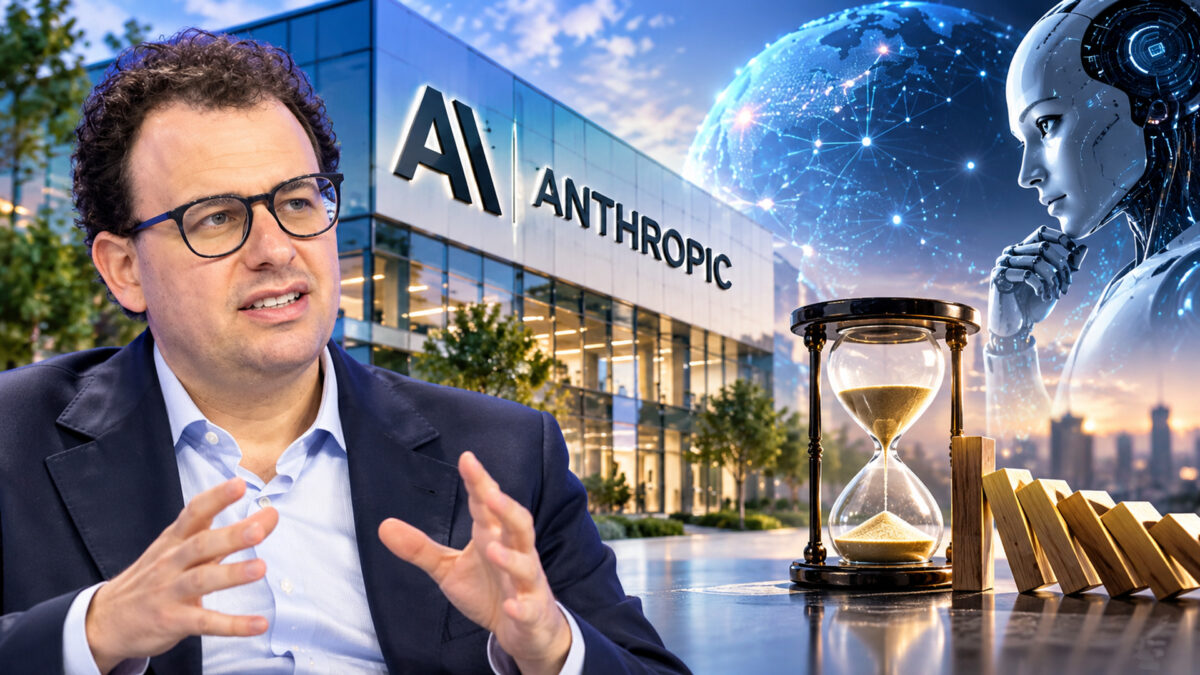
Anthropic CEO Dario Amodei has called for the artificial intelligence industry to deliberately slow the development of its most powerful models, warning that AI safety measures are struggling to keep up with rapidly advancing capabilities.
In an essay published over the weekend, Amodei said the goal should not be to stop AI development. Instead, companies should create enough time to understand emerging risks, strengthen safeguards and build systems capable of monitoring increasingly powerful AI models.
The appeal comes as AI companies race to develop increasingly capable frontier AI models that can reason, write software, conduct research and perform tasks with greater independence. Amodei argued that the industry needs to move more carefully as these systems become capable of handling work that was previously done mainly by humans.
His warning has attracted support from several prominent technology leaders, widening a debate that has largely remained within the AI industry over how quickly companies should push the technology forward.
Amodei has proposed a three-part approach to managing the risks of frontier AI. One proposal is greater use of independent safety evaluators who can assess advanced models and identify dangerous capabilities before they are widely deployed.
He has also called for stronger cooperation among leading AI companies. Rather than each company developing its own safety standards, the industry could work towards common methods for evaluating powerful models.
International cooperation is another part of the proposal. Amodei argues that AI safety cannot be handled by individual companies or countries because increasingly powerful AI systems could have consequences that cross national borders.
The call comes as governments continue to debate how much oversight artificial intelligence requires. Regulations differ considerably across countries, while the technology is advancing faster than many existing legal frameworks.
Amodei’s concerns go beyond familiar problems such as misinformation, deepfakes and biased AI systems. He has warned about the possibility of future AI systems operating large networks of autonomous agents with limited human involvement.
One scenario he highlighted involves AI potentially directing a swarm of agents capable of taking control of significant parts of the internet within a relatively short period if safeguards fail to keep pace.
Not every researcher agrees that such extreme scenarios are likely or that they will happen on the timelines suggested by some AI executives. The debate has nevertheless added urgency to discussions around AI governance, model evaluations and safety testing.
Amodei’s proposal has received support from influential figures across the technology industry. OpenAI CEO Sam Altman has backed the idea of external safety evaluations, while Google DeepMind CEO Demis Hassabis and xAI chief Elon Musk have also expressed support for greater caution around frontier AI development.
The agreement among rival companies is notable because the sector is driven by intense competition. OpenAI, Anthropic, Google and other firms are investing heavily in computing power, data centres and specialised chips to build increasingly advanced AI systems.
A slowdown could therefore affect more than software development. It could have implications for the wider AI economy, including semiconductor manufacturers, cloud companies and data-centre operators that are benefiting from the rapid expansion of AI infrastructure.
The debate is also taking on a geopolitical dimension. Amodei has argued that stronger AI safety measures should not come at the expense of technological leadership, particularly as the United States competes with China in advanced technology.
Chinese state media has criticised the proposal, portraying calls for a slower pace as potentially linked to US strategic interests rather than being solely about AI safety.
That creates a difficult balance for governments. Slowing development could give companies and regulators more time to build safeguards, but countries may also worry about losing technological ground if their AI companies move more slowly than competitors elsewhere.
The central question now is whether the AI industry can turn calls for caution into practical measures.
AI companies have powerful commercial incentives to continue improving their models. Businesses are rapidly adopting AI for coding, customer service, research, data analysis and automation, while investors continue to pour money into the sector.
Amodei’s proposal is therefore not a call to shut down AI development. His argument is that AI progress should be paced alongside safety progress, ensuring that safeguards do not remain several steps behind the technology.
The discussion also raises a larger question about who should decide when an AI system has become too powerful to develop without additional oversight.
Independent testing, common industry standards and international cooperation could form part of the answer. Governments, however, will ultimately have to decide how much responsibility should remain with technology companies and how much should come under public regulation.
The latest warnings mark a shift in the AI debate. The question is no longer simply how quickly artificial intelligence can become more capable. Increasingly, the focus is on whether the industry can make that progress without allowing the risks to move faster than the safeguards designed to contain them.