
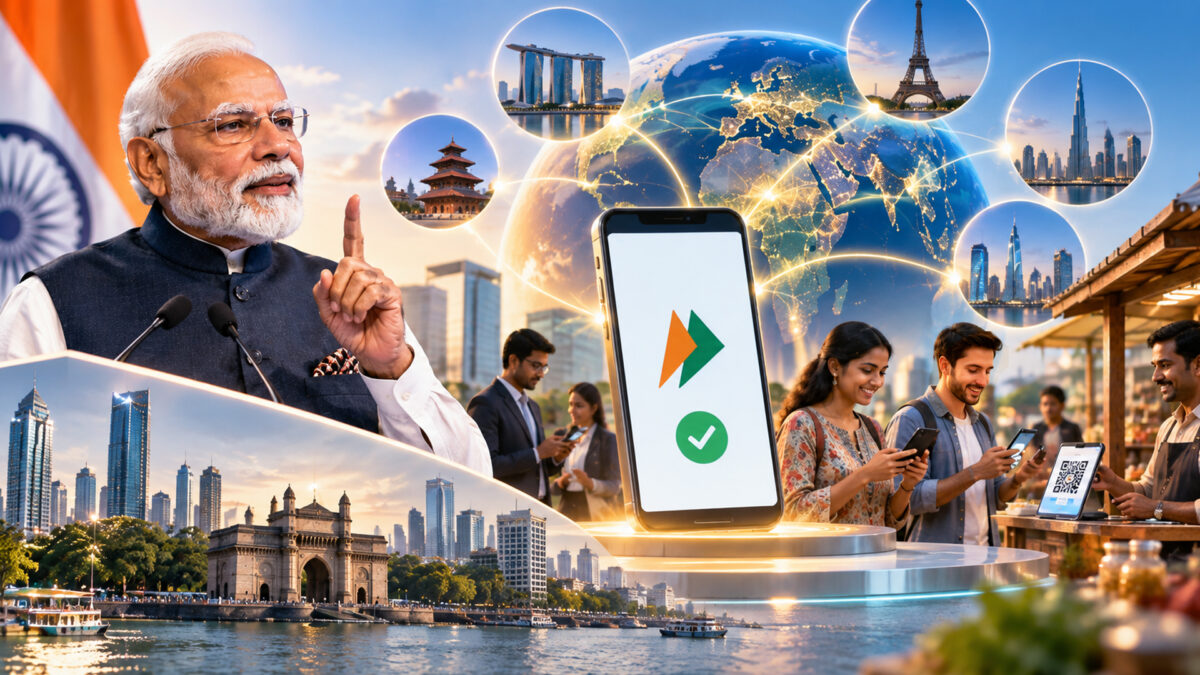
Prime Minister Narendra Modi has urged India’s fintech industry to take UPI beyond India’s borders and build stronger links with payment systems in other countries, as the sector looks towards its next phase of growth.
Speaking at the Global Fintech Fest 2026 in Mumbai, PM Modi said India’s fintech journey had reached a stage where the country could play a larger role in shaping global digital payments. He called for UPI to be connected with more international payment systems, particularly in countries with large Indian communities, strong trade ties with India or an interest in digital cooperation.
The push comes as UPI has grown into one of the world’s largest digital payment platforms by transaction volume. It is currently available in 11 countries, including Singapore, the UAE, France and Nepal. In August, UPI processed 24.51 billion transactions worth around $314 billion, highlighting the scale of India’s domestic digital payments market.
The international expansion of UPI could open a much larger market. Linking payment systems could make cross-border transactions faster and cheaper, while also helping Indian companies, travellers and overseas Indians make payments without relying entirely on traditional international payment networks.
He pointed to the UPI-PayNow connection with Singapore as an example of what such partnerships can achieve. The two systems allow users to transfer money between India and Singapore using mobile numbers or payment identifiers, making remittances more convenient.
The Prime Minister said similar arrangements could be explored with more countries. For India, lower remittance costs could be particularly significant as the country remains one of the world’s largest recipients of money sent home by overseas workers.
PM Modi’s message to the fintech industry was not limited to payments. He said the next phase of India’s fintech growth should move into areas such as credit, insurance, savings, investments and pensions.
That shift could create new opportunities for fintech companies that have traditionally focused on payments. Digital lending, wealth management, insurance technology and financial services for small businesses are increasingly becoming important parts of the ecosystem.
The government is also looking at emerging technologies that could reshape financial services. He highlighted agentic artificial intelligence, tokenisation and quantum technology, urging the industry to turn their potential into practical applications.
AI could help automate financial decisions, detect fraud and improve customer service for many businesses. Tokenisation could create new ways of handling financial and digital assets, while quantum technology could eventually have implications for security and financial computing.
At the same time, faster digital adoption brings new risks. PM Modi called for stronger cybersecurity and ethical data protection standards, along with better consumer protection. The government wants innovation to continue, but with safeguards that can maintain confidence in digital financial services.
The Reserve Bank of India is also focusing on this balance between innovation and regulation. RBI Governor Sanjay Malhotra said fintech has expanded access to financial services across India, helping bring banking closer to rural communities, small businesses and consumers who were previously underserved.
He highlighted the role of digital public infrastructure such as UPI, Aadhaar-enabled payments and Jan Dhan accounts in widening financial inclusion. Fintech is also increasingly being used to improve access to credit for micro, small and medium enterprises through data-based lending systems.
This creates a potentially larger business opportunity. The domestic market provides scale, while international payment partnerships could offer a route into new markets.
The Global Fintech Fest, being held in Mumbai from September 8 to 11, brings together financial institutions, technology companies, investors, regulators and startups from across the world. This year’s focus is on building trusted and connected financial systems using technologies including agentic AI, tokenisation and quantum computing.
India’s growing fintech ecosystem is also benefiting from increased investor and entrepreneurial interest. Modi said the country’s young entrepreneurs are showing a greater willingness to take risks and experiment with new business models.
That appetite could become important as the industry moves beyond the success of digital payments. UPI has already demonstrated that India can build and operate a digital financial platform at massive scale. The challenge now is to turn that success into a broader fintech ecosystem with global reach.
The internationalisation of UPI could also strengthen India’s position in the global digital economy. Instead of simply adopting payment standards created elsewhere, India is increasingly seeking to develop its own systems and connect them with international networks.
This opportunity for fintech companies is therefore moving from transaction volumes to a wider financial-services market. Payments remain the foundation, but credit, insurance, investments, cybersecurity, data services and emerging technologies could drive the next wave of growth.
PM Modi’s message at the Mumbai event was ultimately about scale, taking an Indian fintech success story to global markets while building the technology and safeguards needed for its next stage.
With UPI already handling billions of transactions every month, the focus is now shifting from how quickly India’s digital payment system can grow at home to how effectively it can connect businesses, consumers and financial institutions across borders.