
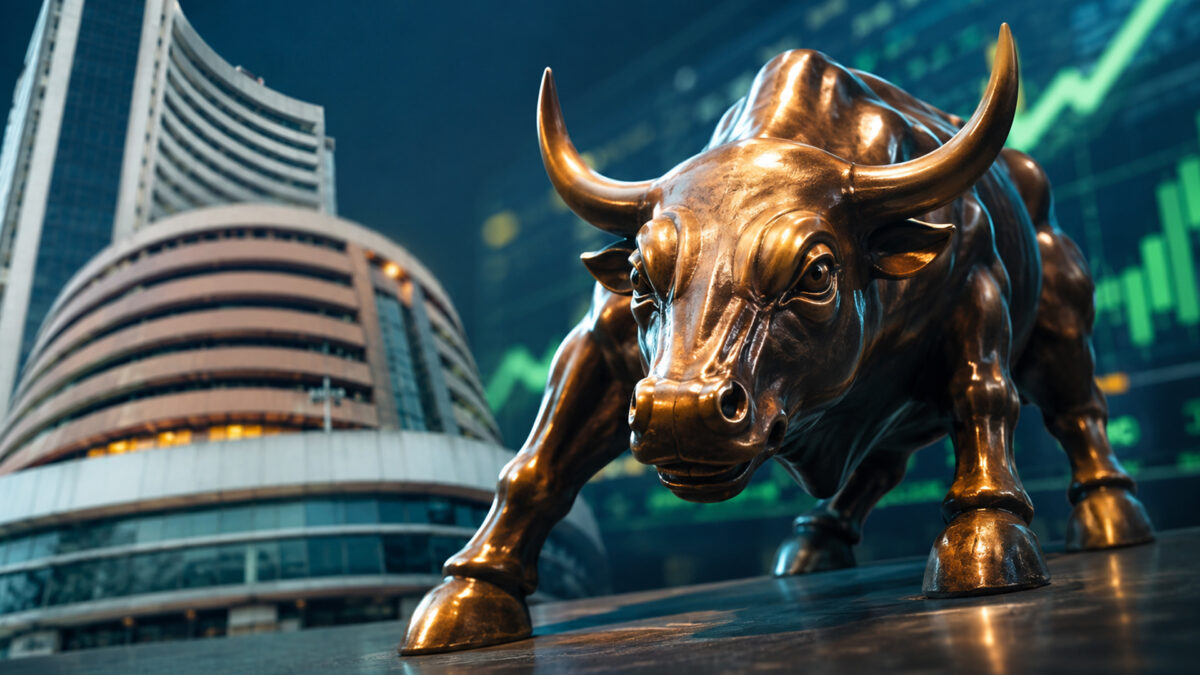
Markets bounced back on Thursday morning after three straight sessions of losses, helped by buying in banking and financial stocks, a stronger rupee and positive cues from global markets. The Sensex jumped more than 200 points in early trade, while the Nifty stayed comfortably above the 23,950 mark.
The BSE Sensex opened higher and gained 207.31 points to 76,777.66 in early trade. The NSE Nifty 50 rose 54 points to 23,968.45, putting the key 24,000 level back within reach. Banking stocks were among the biggest contributors to the recovery.
Among the major gainers, Adani Ports, IndusInd Bank and HDFC Bank rose strongly, while InterGlobe Aviation (IndiGo), Tech Mahindra and HCL Technologies were among the top losers. The mixed stock movement showed that investors were buying selectively rather than chasing the entire market higher.
Financial shares provided much of the strength to the Indian stock market on Thursday. Private banks as well as state-owned lenders attracted buyers after recent weakness.
Adani Ports gained around 1.6%, while IndusInd Bank was also up about 1.6%. HDFC Bank advanced more than 1%. Axis Bank, State Bank of India and Bharat Electronics were also trading higher during the morning session.
The banking sector received additional support from a major inflow of foreign currency into India.
Indian banks raised about $136.4 billion through special foreign-currency deposit and borrowing schemes, significantly strengthening the country’s foreign-exchange position. Around $127 billion came through FCNR(B) deposits.
The large inflows are expected to give the Reserve Bank of India greater flexibility in managing volatility in the foreign-exchange market. They could also improve liquidity conditions for banks.
The rupee reacted sharply to the development. It opened around 67 paise stronger at 94.30 against the US dollar, compared with Wednesday’s close of 94.97, touching its strongest level in more than two months.
A stronger rupee helped improve investor sentiment because it reduces some of the pressure created by expensive crude oil and India’s large import bill.
Not every corner of the market joined Thursday’s recovery.
InterGlobe Aviation, the parent company of IndiGo, fell around 1.5% and was among the biggest Sensex losers during morning trade.
Technology shares were also weak. Tech Mahindra dropped about 1.4%, while HCL Technologies declined around 1.3%. Infosys fell more than 1%.
Titan Company and Bajaj Finserv were also among the stocks trading lower.
The weakness in technology stocks meant that gains in banking, financial and infrastructure shares had to do much of the heavy lifting for the benchmarks.
Positive global cues provided another reason for investors to return to Indian equities.
Asian markets broadly moved higher on Thursday following gains on Wall Street. South Korea was among the strongest performers in the region, while Japanese equities also traded in positive territory.
US markets had recovered overnight after three sessions of losses. Easing US Treasury yields offered some relief to investors worried about high interest rates and borrowing costs.
The improvement in global risk appetite helped the Sensex and Nifty recover from Wednesday’s decline.
Foreign institutional investors also provided support. FIIs bought Indian equities worth around ₹6,688 crore on Wednesday, even as benchmark indices ended lower. Domestic institutional investors were also net buyers, purchasing shares worth around *₹2,813 crore.
Despite Thursday’s rebound, investors remained cautious because crude oil prices are still high amid continuing tensions between the US and Iran.
Brent crude eased slightly to around $95 a barrel, providing some immediate relief after oil prices had risen for three consecutive sessions.
Crude oil remains one of the biggest external risks. The country imports most of its oil requirements, meaning sustained high prices can increase the import bill, push inflation higher and put renewed pressure on the rupee.
Higher energy costs can also hurt the profitability of aviation, paints, chemicals and other industries that use crude oil or its derivatives.
Any fresh escalation in the Middle East could therefore quickly change the mood on Dalal Street.
Thursday’s recovery came after three consecutive sessions of losses.
Rising crude oil prices, geopolitical tensions and concerns about high global bond yields had weighed on Indian equities during the recent decline.
The latest rebound suggests buyers are returning at lower levels, particularly in banking and financial stocks.
Nifty 24,000 level will now remain an important near-term marker. A sustained move above it could strengthen market sentiment, while renewed selling could once again put the recent lows under pressure.
But with Brent crude still around $95 a barrel and US-Iran tensions unresolved, investors are likely to remain selective. Thursday’s trade is shaping up as a recovery session, but global oil prices and geopolitical developments will continue to decide whether the rebound can gather momentum.
Dalal Street has found some breathing room. Strong banking shares, a sharply stronger rupee, foreign fund inflows and improving global markets have helped the Sensex and Nifty return to positive territory.