
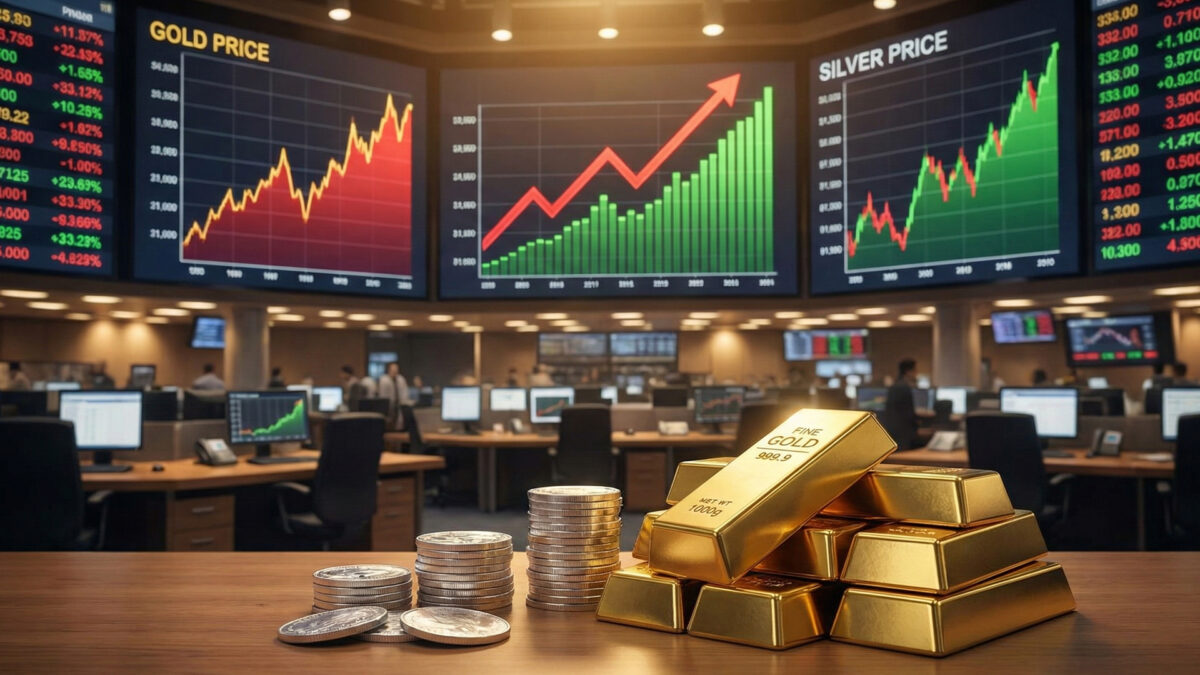
Gold and silver prices climbed sharply on Tuesday as investors sought safety amid renewed geopolitical uncertainty and concerns over the impact of the US-Iran conflict on global markets. MCX gold moved above ₹1.55 lakh per 10 grams, while silver approached ₹2.40 lakh per kg, extending the recent rally in precious metals. The jump came as elevated crude oil prices and uncertainty surrounding the Strait of Hormuz added to market nervousness.
On the Multi Commodity Exchange (MCX), the October gold futures contract opened at ₹1,54,699 per 10 grams, up ₹1,600 from its previous close of ₹1,53,099. The contract later climbed to ₹1,55,437 before trading around ₹1,55,100, representing a gain of about ₹2,001 at the time of the latest update.
Silver also recorded a strong move. The September silver futures contract opened at ₹2,39,999 per kg, gaining ₹3,132 from its previous close of ₹2,36,867. It was trading around ₹2,39,154 per kg, up ₹2,287, after touching an intraday high of ₹2,41,999.
The strength in bullion was not limited to India. On the international market, Comex gold opened at $4,446.90 per ounce against the previous close of $4,419.70. It was later trading at $4,474.10, up $54.40. Comex silver was around $65.96 per ounce, compared with its previous close of $65.27.
The latest gains reflect a broader move towards safe-haven assets. Gold is traditionally viewed as a store of value during periods of economic or geopolitical stress, while silver can benefit from both investment demand and its industrial applications.
Investors have been closely tracking developments around the Strait of Hormuz, a critical route for global energy shipments. Any prolonged disruption could keep crude oil prices elevated and raise concerns about inflation and economic growth. Higher oil prices are particularly important for India because the country relies heavily on imported crude.
The weaker US dollar has also provided some support to bullion. Since gold is priced internationally in dollars, a weaker US currency can make the metal more attractive to buyers holding other currencies. Expectations surrounding US interest rates and monetary policy remain another factor influencing precious-metal prices.
Demand from central banks and institutional investors is adding to the positive backdrop for gold. Increased purchases by central banks, particularly in emerging markets, have strengthened the perception of gold as a portfolio hedge. Investors have also increased exposure to the metal as uncertainty surrounding global growth and financial markets persists.
In India’s retail market, gold prices remained elevated across major cities. In New Delhi, 24-karat gold was priced at ₹1,54,660 per 10 grams, while 22-karat gold stood at ₹1,41,772. Silver 999 fine was quoted at ₹2,39,490 per kg.
In Mumbai, 24-karat gold was available at ₹1,54,930 per 10 grams and 22-karat gold at ₹1,42,019. The retail rate for 999 silver was ₹2,39,910 per kg. Kolkata recorded a 24-karat gold rate of ₹1,54,710 and a 22-karat rate of ₹1,41,818 per 10 grams, while 999 silver was quoted at ₹2,39,320 per kg.
Other major cities also recorded high prices. Bengaluru’s 24-karat gold rate was ₹1,55,050 per 10 grams, while Chennai recorded ₹1,55,370. Hyderabad’s 24-karat gold rate stood at ₹1,55,160. Silver prices in these cities were broadly around ₹2.40 lakh per kg.
For jewellery buyers, the quoted gold rate is only one part of the final bill. Making charges, taxes and other costs are added by jewellers, meaning the actual purchase price can be higher than the headline market rate. The distinction between 24-karat and 22-karat gold is also important. While 24-karat represents higher purity, 22-karat gold is commonly used for jewellery because it is more durable.
Silver has also emerged as a strong performer this year, supported by investment demand as well as industrial consumption. The metal is widely used in electronics, solar panels and other industrial applications, giving its price a different set of demand drivers compared with gold.
However, precious-metal prices can remain volatile. A stronger US dollar, easing geopolitical tensions or changes in expectations around US interest rates could encourage investors to book profits. On the other hand, any escalation in the Middle East or further pressure on global energy supplies could increase demand for bullion.