
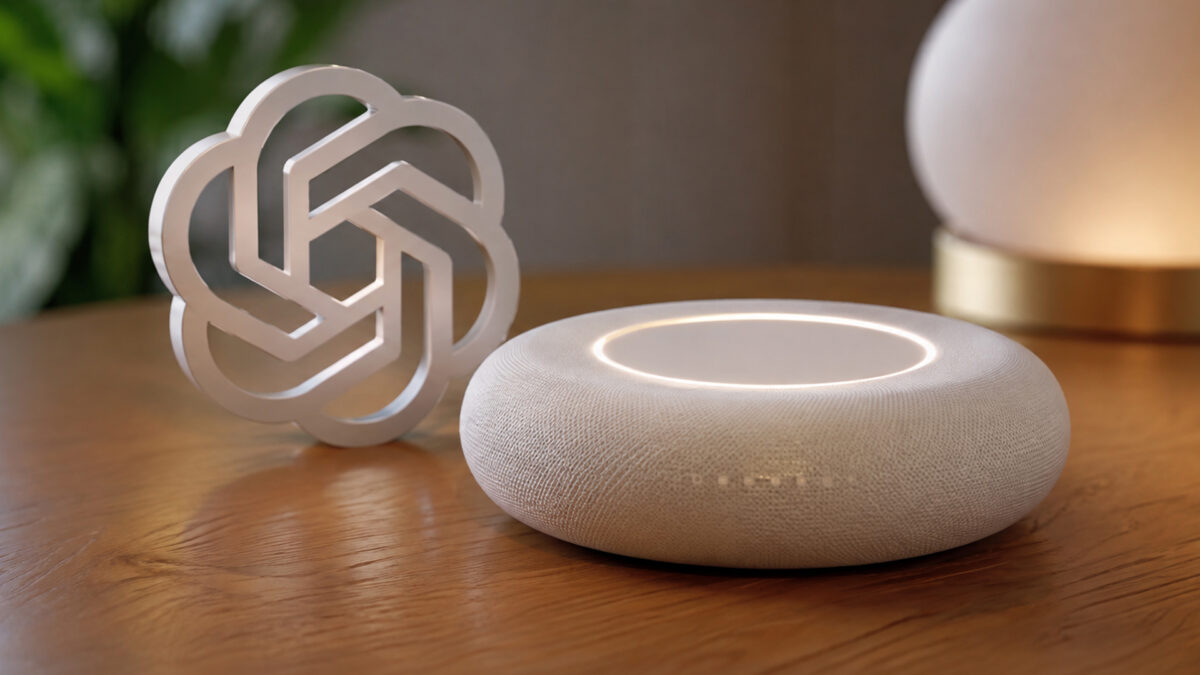
OpenAI is reportedly preparing to enter the consumer hardware market with an unusual new product: a small, donut-shaped artificial intelligence speaker that could cost between $300 and $400.
The device, which has not yet been officially unveiled by OpenAI, is expected to be the company’s first major consumer hardware product. Reports suggest it could arrive in 2027, giving OpenAI a physical presence in homes rather than limiting ChatGPT to smartphones, computers and other existing devices.
The reported price immediately sets the product apart from conventional smart speakers. Amazon’s Alexa and Google’s Nest devices have traditionally competed in a much lower price range, while OpenAI appears to be positioning its product as something more sophisticated than a conventional voice assistant.
The upcoming OpenAI device is reportedly about the size of a hockey puck and designed with a doughnut-like shape. It is expected to be battery-powered and portable, allowing users to move it around the home.
Unlike many smart home devices that rely on a display, the reported OpenAI speaker is expected to be screen-free. Instead, users would interact with it primarily through voice, similar to ChatGPT’s existing voice mode.
What could make the device different is the way it responds to people. Reports indicate that it may contain moving components that react during conversations, giving the device a more expressive and physical presence.
The hardware is also reportedly expected to include cameras and other sensors. These could allow the AI assistant to understand more about its surroundings and the context in which a user is interacting with it.
That would take the idea of a smart speaker beyond simply answering questions, setting timers or playing music. The ambition appears to be creating an AI companion capable of having more natural conversations and helping users perform tasks around the home.
One of the most closely watched aspects of the project is its connection with renowned designer Jony Ive, the former Apple design chief.
OpenAI has been working with Ive and his design company, LoveFrom, on consumer hardware. In 2025, OpenAI announced that the team behind io had officially merged with the company, while Ive and LoveFrom retained independent creative and design responsibilities across OpenAI.
That collaboration has fuelled expectations that OpenAI’s hardware will place unusual emphasis on industrial design and the way people interact with technology.
The reported doughnut-shaped design appears to reflect that philosophy. Rather than looking like another traditional smart speaker, the device is being developed as a new kind of physical interface for artificial intelligence.
The biggest strategic shift is perhaps not the shape or price, but the idea of moving ChatGPT away from screens.
For years, consumers have interacted with AI largely through keyboards, touchscreens and apps. OpenAI’s reported hardware strategy suggests the company wants AI to become more ambient — something people can simply talk to without opening an application.
A dedicated AI device could potentially handle tasks such as answering questions, controlling compatible smart-home products, playing media, sending messages and assisting users with everyday activities. Earlier reports have also pointed to the device being designed as a more human-like assistant for the home.
OpenAI has already been investing heavily in voice technology. In May 2026, the company introduced new realtime voice models designed to reason, translate and transcribe as people speak. OpenAI described voice as an important interface between people and products.
The hardware could therefore become a natural extension of that strategy, putting ChatGPT voice AI into a dedicated physical device.
The move into hardware could give OpenAI greater control over how people experience its technology.
At present, ChatGPT operates through devices made by Apple, Google, Samsung and other manufacturers. A dedicated OpenAI product would allow the company to control the hardware, software, sensors and AI experience together.
It could also create a new consumer revenue stream at a time when AI companies are searching for ways to turn enormous computing costs into sustainable businesses.
OpenAI has been scaling rapidly. The company said in March 2026 that it had closed a funding round with $122 billion in committed capital at a post-money valuation of $852 billion. It has also stressed the importance of consumer adoption, enterprise deployment, developers and computing infrastructure to its broader AI strategy.
The reported $300–$400 price tag could be one of the biggest challenges.
Consumers already have access to inexpensive smart speakers from established companies. Convincing people to pay several hundred dollars for an AI-first device will require OpenAI to offer capabilities that feel substantially more useful than today’s voice assistants.
OpenAI has not publicly confirmed the final design, specifications, price or launch date reported for the device. Those details could change before the product reaches consumers.
If OpenAI succeeds, its first device could turn ChatGPT from something people open on a screen into something they simply talk to at home. That would make the company’s hardware launch much more than another smart speaker release, it could be an early attempt to redefine how consumers interact with artificial intelligence.