
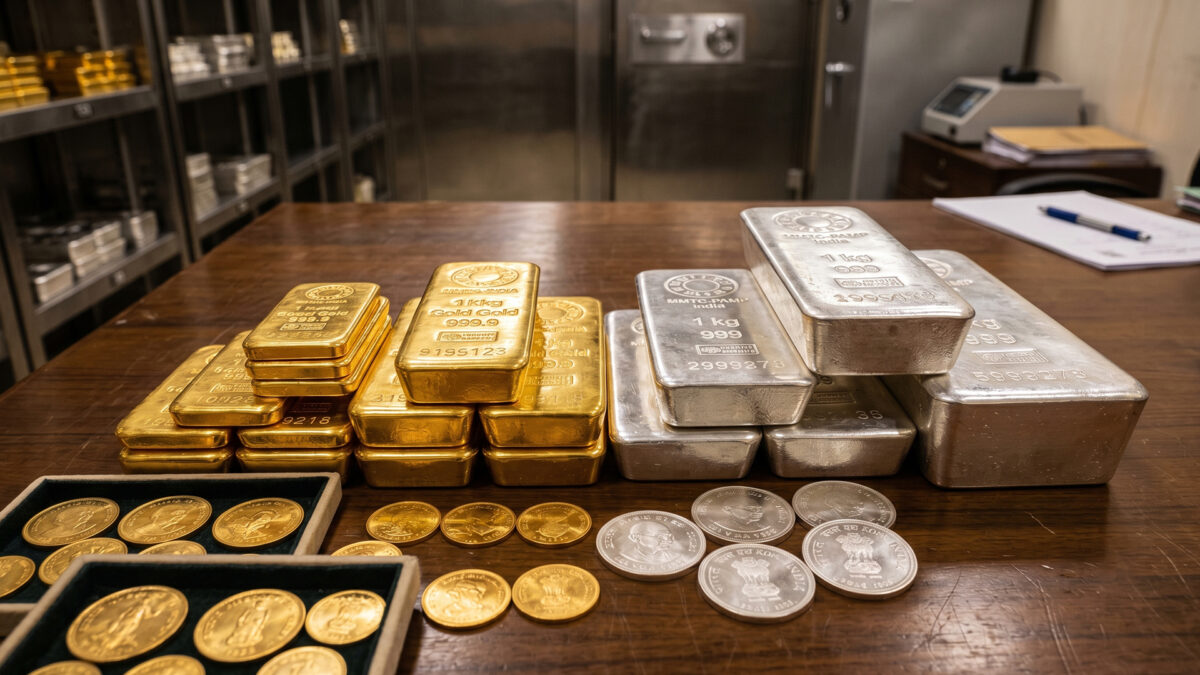
Gold and silver prices remained elevated in India on Thursday, August 6, with the yellow metal holding above ₹1.45 lakh per 10 grams and silver moving close to ₹2.40 lakh per kg. The precious metals market remained firm as investors continued to track global interest rate expectations, currency movements and geopolitical developments.
In the retail market, 24-carat gold was priced at ₹1,45,760 per 10 grams in Mumbai, Bengaluru, Kolkata, Hyderabad and Chennai. Delhi recorded a slightly higher rate of ₹1,45,910 per 10 grams. The 22-carat gold rate stood at ₹1,33,610 per 10 grams in most of these cities, while Delhi quoted ₹1,33,760.
Silver prices were broadly uniform across major cities. The metal was priced at ₹2,40,100 per kg, or ₹24,010 per 100 grams, in Delhi, Mumbai, Bengaluru, Kolkata, Hyderabad and Chennai.
The latest movement comes as investors continue to watch global interest rate expectations, currency movements and geopolitical developments for clues about the next direction of precious metals.
On the Multi Commodity Exchange, gold futures were trading around ₹1.49 lakh per 10 grams, up 0.58%, while silver futures gained about 0.25% to ₹2.28 lakh per kg at the time of the report. The domestic futures market remained relatively firm despite some pressure on international bullion prices.
Internationally, gold prices extended their gains for a fourth straight session on Thursday and touched a seven-week high. Spot gold rose 0.5% to $4,265.22 an ounce, its highest level since June 18. The rally was supported by a weaker US dollar, falling Treasury yields and expectations of progress in talks involving Iran and Oman over the Strait of Hormuz.
A softer dollar generally makes gold cheaper for buyers holding other currencies, which can support demand. Lower bond yields can also make non-yielding assets such as gold more attractive to investors.
Gold continues to draw attention because of its traditional role as a safe-haven asset. Investors often turn to bullion when uncertainty rises around interest rates, inflation, currencies or geopolitical risks. However, the current rally is being shaped by several factors rather than a single trigger.
Expectations around US monetary policy remain particularly important. Traders are closely watching economic data for clues about the Federal Reserve’s next interest-rate decision. Any change in expectations for US rates could influence the dollar, bond yields and gold prices.
The Indian rupee is another key factor for domestic buyers. Since international gold prices are quoted in US dollars, changes in the rupee-dollar exchange rate can affect domestic gold rates even when global prices remain relatively stable.
Investors are also monitoring crude oil prices and developments around the Strait of Hormuz. Any improvement in geopolitical tensions could reduce concerns over energy supplies and inflation. At the same time, a sharp movement in oil prices could influence inflation expectations and central bank policy.
For consumers, the latest retail rates show only a small difference between major Indian cities. Delhi remained the costliest among the listed markets for 24K gold at ₹1,45,910 per 10 grams. Mumbai, Bengaluru, Kolkata, Hyderabad and Chennai were at ₹1,45,760.
For 22K gold, Delhi was at ₹1,33,760 per 10 grams, while the other five cities quoted ₹1,33,610.
The distinction between 24K and 22K gold is important for jewellery buyers. While 24K represents the highest purity commonly traded, 22K gold is widely used for jewellery because the addition of other metals makes it stronger and more suitable for everyday use.
Retail jewellery prices may not exactly match headline bullion rates. Jewellers typically factor in making charges, taxes, procurement costs and their own margins when calculating the final price. Buyers should therefore compare the complete jewellery bill rather than relying only on the quoted gold rate.
Silver has also remained firmly in focus. At ₹2.40 lakh per kg in the retail market, the metal continues to trade at elevated levels. Unlike gold, silver has a significant industrial demand component, with the metal widely used in electronics, renewable energy equipment and other industrial applications.
This means silver prices can respond not only to investor demand but also to expectations for global economic growth and manufacturing activity.
For now, both gold and silver remain sensitive to the same broad themes, US interest rates, the dollar, geopolitical developments, crude oil prices and global economic data.
For Indian investors and consumers, the elevated prices underline the importance of checking purity, comparing rates and considering the purpose of the purchase before making a decision. With global markets still responding quickly to economic and geopolitical signals, precious metal prices could remain volatile in the near term.