
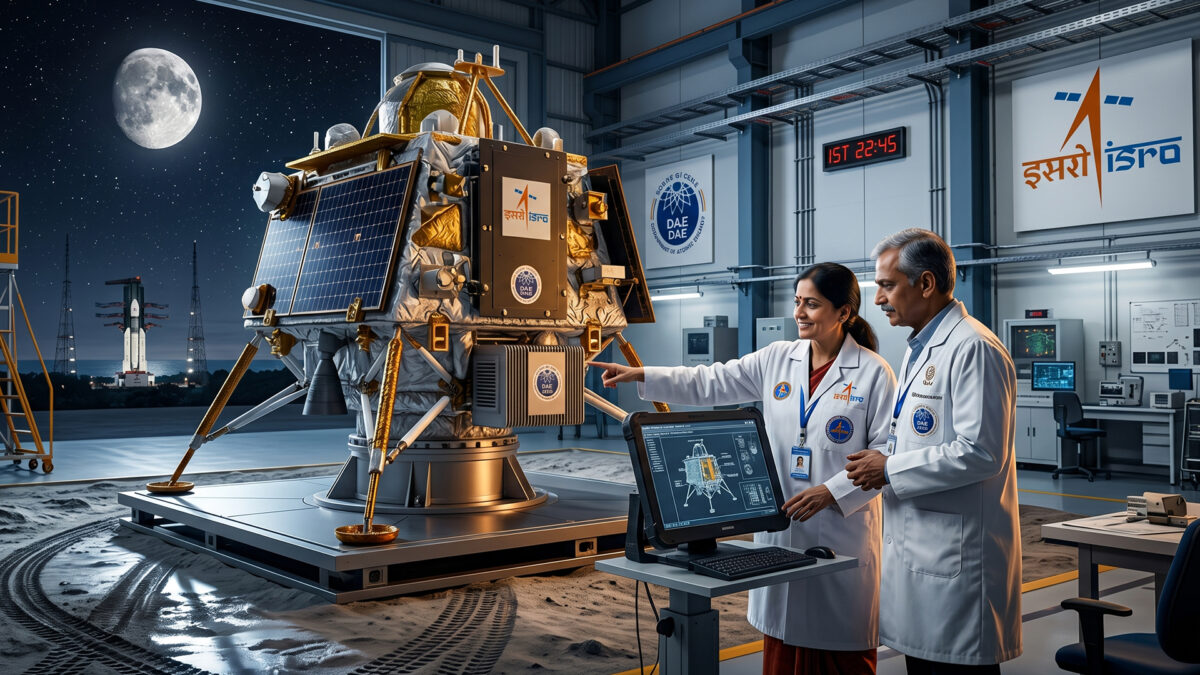
India’s space programme is taking another ambitious step forward, with the Indian Space Research Organisation (ISRO) working on a new lunar lander designed to survive on the Moon for up to 200 days.
ISRO Chairman V. Narayanan said the space agency is collaborating with the Department of Atomic Energy (DAE) to develop technologies that will allow future spacecraft to function through the Moon’s harsh and prolonged nights.
Unlike Earth, a lunar night lasts about 14 Earth days and temperatures can plunge to nearly minus 180 degrees Celsius. These extreme conditions have posed a major challenge for space missions, as most landers and rovers are designed to operate only during the lunar daytime when solar power is available.
According to ISRO, the proposed lander will incorporate advanced power and thermal management systems to remain operational even when sunlight is unavailable. Scientists are exploring the use of nuclear-based energy solutions and other technologies that can keep critical systems functioning during extended periods of darkness and freezing temperatures.
The project builds on the success of India’s Chandrayaan missions, particularly Chandrayaan-3, which achieved a historic soft landing near the Moon’s south pole in 2023. While the Vikram lander and Pragyan rover exceeded their planned mission life, they were not designed to survive the extreme lunar night.
The mission is expected to help India gather valuable scientific data over a much longer period than previous lunar missions. A lander that can survive multiple lunar day-night cycles would allow scientists to study the Moon’s environment in greater detail and support future plans for sustained exploration.
The development is also aligned with India’s broader space ambitions, including plans for advanced lunar exploration, human spaceflight and participation in future international missions.