
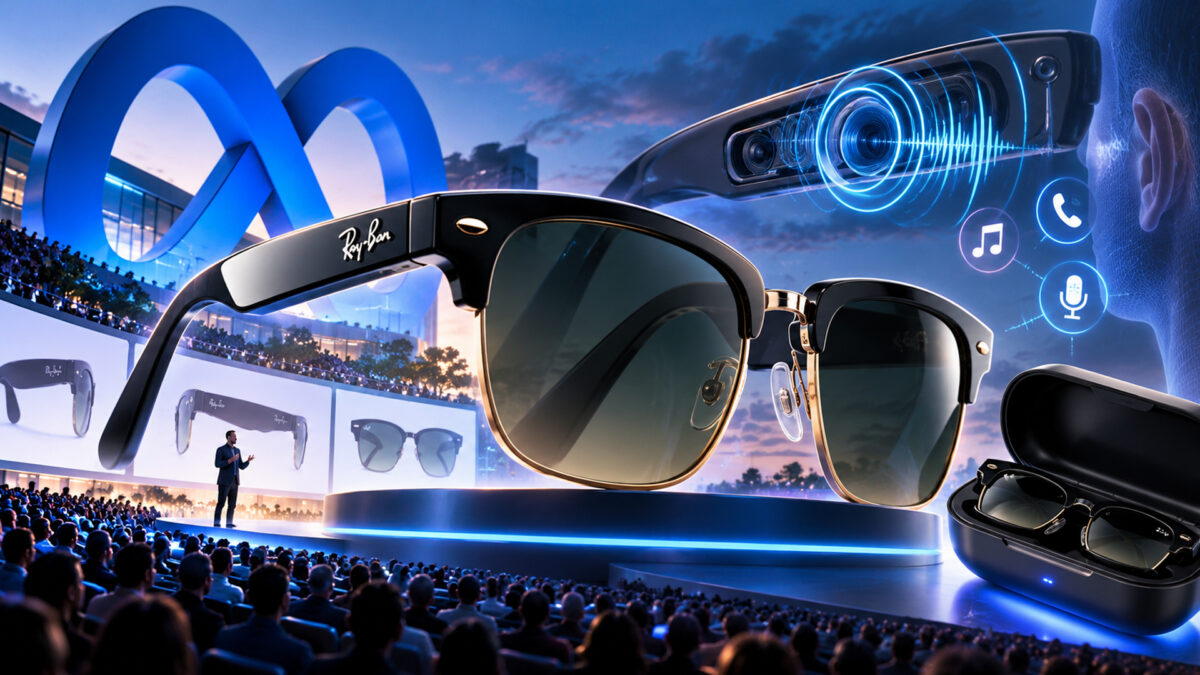
Meta is making a bigger bet on glasses as the next major platform for artificial intelligence, unveiling a new range of smart glasses, a lightweight virtual reality device and a pocket-sized AI gadget at its annual Connect event.
The company showcased the products as it works to make AI more useful without requiring users to constantly reach for a smartphone. Its new lineup combines Meta AI, virtual reality, hands-free computing and audio technology, while also addressing growing concerns about privacy around camera-equipped wearables.
One of the biggest announcements was the arrival of Muse, Meta’s personal AI agent, on its AI glasses. The company says users will be able to interact with Muse hands-free and ask it to understand what they are seeing, answer questions and carry out tasks.
Muse can, for example, identify a product on a shelf, read information from a flyer or help with a list of items. Meta is also adding connectors to services including shopping, travel, productivity and payments, allowing the AI agent to do more than simply answer questions.
The move reflects Meta’s broader effort to turn AI glasses into everyday computing devices rather than accessories for taking photos or listening to music.
New camera-free smart glasses
Meta also introduced Ray-Ban Meta Audio, its first audio-only glasses. Unlike camera-equipped smart glasses, the new model focuses on music, calls and AI interaction without a camera.
Weighing about 43 grams, the glasses are designed for all-day use and offer up to 12 hours of battery life on a single charge, according to Meta. They can play music and podcasts, handle phone calls and provide access to Meta AI through voice commands.
The Ray-Ban Meta Audio glasses are available for pre-order from $349, with shipments scheduled to begin on October 13.
The camera-free design also comes as smart glasses face increasing scrutiny over privacy. Camera-equipped wearables have raised concerns about people being recorded without their knowledge, making devices without cameras one way for manufacturers to address some of those concerns.
Ray-Ban Meta gets an upgrade
Meta also unveiled Ray-Ban Meta Gen 3, the latest version of its popular AI glasses.
The new model has a slimmer design, longer battery life and a customisable action button for quicker access to Meta AI. Battery life has increased to up to nine hours, while a six-microphone system is designed to reduce background noise during calls and voice interactions.
The glasses include a 12-megapixel camera capable of recording 3K Ultra HD video. Meta has also introduced dynamic photos and plans to add Dolby Atmos capture with spatial audio later this year.
Ray-Ban Meta Gen 3 starts at $449.
Meta is also expanding its range of frame designs and collaborations. The company said it expects to have more than 100 AI glasses options across Ray-Ban, Oakley and Meta Glasses by the end of 2026.
Hearing assistance comes to AI glasses
Another significant addition is hearing enhancement, a software feature designed for adults with perceived mild to moderate hearing loss.
Meta said the feature has received FDA clearance and can be set up at home without a clinic visit or prescription. It will initially launch in the US later this year for supported AI glasses at $149.99, or through a Meta One subscription.
The company is positioning the feature as part of a wider attempt to make wearable technology useful for everyday accessibility, rather than limiting smart glasses to entertainment and AI functions.
Meta unveils $1,299 VR glasses
Meta’s most ambitious hardware announcement was its new Meta VR Glasses, which bring virtual reality into a glasses-style design.
The device weighs about 100 grams, roughly the weight of a deck of cards, and is designed to provide immersive entertainment, gaming and productivity without the bulky headset form associated with conventional VR devices.
Meta says the VR glasses can function as a personal cinema, gaming display and portable workspace. Users can also turn a flat surface into a virtual keyboard and touchpad.
The device is priced at $1,299 and is expected to ship in spring 2027. Meta is positioning it as a lighter alternative to traditional VR headsets, while also competing in a market where Apple’s Vision Pro has set a premium benchmark.
The VR glasses will support immersive entertainment from services including Prime Video, YouTube, ESPN and other platforms. Meta also said users will be able to watch selected 3D content and experience more than 100 immersive live sports events each year.
Privacy remains a challenge
Meta’s push into wearable AI comes at a time when privacy has become a major issue for the industry.
Smart glasses that can see, hear and respond to their surroundings raise questions about recording, data collection and consent. Meta’s existing camera-equipped glasses have faced criticism over potential covert recording, while privacy concerns have also emerged more broadly around AI-powered wearable devices.
The company’s camera-free glasses therefore offer a different approach, while its existing models continue to include an LED indicator intended to signal when photos or video are being captured.
With Muse, new AI glasses, hearing assistance and lightweight VR hardware, Meta is increasingly treating eyewear as a central part of its technology strategy.
The challenge now is moving these products from impressive demonstrations into devices people are comfortable wearing every day. Their success will depend not only on AI capabilities and design, but also on battery life, price, privacy and whether consumers see enough practical value to leave their phones in their pockets.