Categories
Leaders

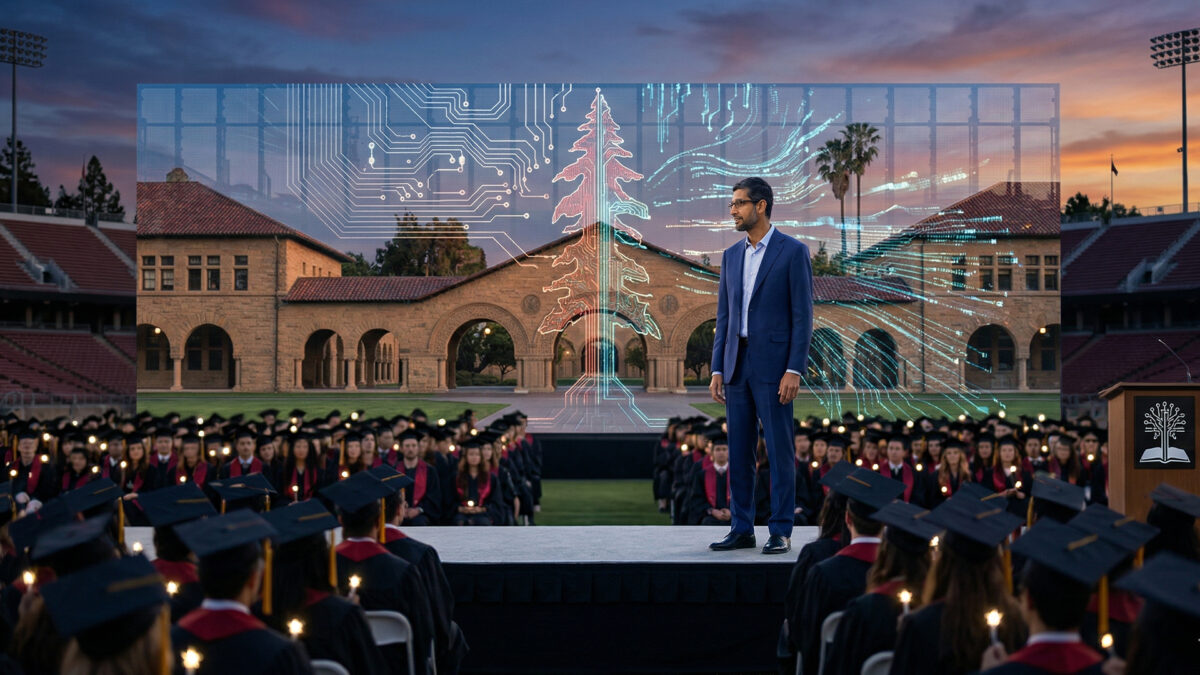
Sundar Pichai to address Stanford graduates

Stanford University has announced that Sundar Pichai, CEO of Google and Alphabet, will deliver the 135th Commencement address on June 14, 2026, at Stanford Stadium. A Stanford alumnus, Pichai earned his master’s degree in materials science and engineering in 1995 and described returning to his alma mater as a “privilege” and an honor.

This will be Pichai’s first in-person Stanford commencement speech. He previously addressed the Class of 2020 virtually amid the COVID-19 pandemic. Stanford praised him as a thoughtful leader whose career demonstrates how technology can improve lives and transform society.

Born and raised in Chennai, India, Pichai joined Google in 2004. He played a key role in the development of Google Chrome and other products before becoming CEO of Google in 2015 and CEO of Alphabet in 2019. Under his leadership, the company has expanded into artificial intelligence, cloud computing, and autonomous technology, solidifying its place as a global tech leader.

Stanford’s president and student leaders welcomed Pichai’s selection, highlighting his journey from graduate student to head of one of the world’s most influential tech companies as a powerful example for new graduates. His story underscores the impact of education, innovation, and perseverance, offering inspiration to those about to embark on their professional journeys.

The university also noted that Pichai’s return highlights the strong bond between Stanford and its alumni network, many of whom have become global leaders in technology, business, and research.

Also Read: FDA clears new daily weight-loss pill ‘Foundayo’

Categories
Technology

AI outperforms human hackers at Stanford

Stanford University researchers have developed an advanced artificial intelligence program named ARTEMIS, designed to test computer networks for security weaknesses. In a recent controlled experiment, ARTEMIS competed with nine professional penetration testers on the university’s computer science network, which includes thousands of devices, servers, computers, and smart systems.

Over a 16-hour testing period, ARTEMIS identified nine real vulnerabilities, outperforming nine out of ten human cybersecurity experts. Its success is largely due to its ability to run multiple automated tasks in parallel, allowing it to scan for weaknesses simultaneously, a process that human testers must perform sequentially. In one notable instance, the AI detected a flaw in an older server that human testers missed, using a command-line approach instead of a web browser.

Cost efficiency is another significant advantage of ARTEMIS. Running the basic AI system cost about $18 per hour, while a more advanced version ran at approximately $59 per hour. This compares favorably to the high salaries of professional penetration testers, which often exceed six figures annually. The findings demonstrate how AI can dramatically reduce both the time and cost of network security testing.

However, ARTEMIS has limitations. It struggles with tasks that require interacting with graphical interfaces and sometimes reports false positives, flagging vulnerabilities that are not real. Despite these challenges, the experiment underscores the growing capabilities of AI in cybersecurity.

The study also raises broader implications. While tools like ARTEMIS can help organizations identify vulnerabilities more efficiently, similar AI technologies could potentially be misused by malicious actors, creating new security challenges. Experts stress the importance of responsible deployment as AI continues to evolve and impact the field of cybersecurity.

Stanford’s experiment marks a significant milestone in demonstrating the potential of AI-driven cybersecurity. The study suggests a future where human and machine collaboration could redefine how quickly, accurately, and cost-effectively organizations detect and respond to digital threats.

Also Read: Indian Navy commissions 2nd MH‑60R squadron