
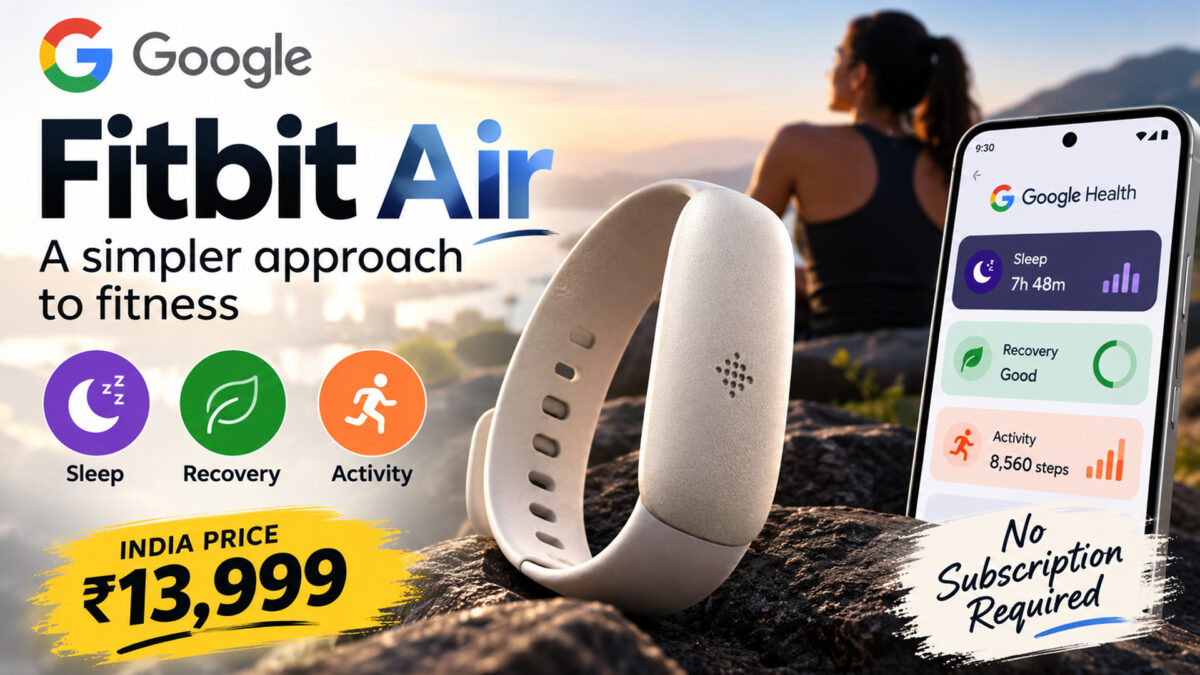
Google’s Fitbit Air offers a different take on wearable technology, focusing on health monitoring rather than notifications, apps and smartwatch features. Priced at ₹13,999 in India, the screenless fitness tracker is designed for people who want to understand their sleep, exercise and recovery without constantly checking their wrists.
Launched in India on October 2, 2026, the Fitbit Air collects health and fitness information and displays it through Google’s Health app on a smartphone. Its approach is simple: monitor everyday wellness in the background and let users review the results when they choose.
The device also enters a market where screenless trackers are gaining attention as alternatives to conventional smartwatches and subscription-based fitness bands.
Minimalist design for everyday wear
The Fitbit Air features a small, lightweight sensor module attached to a wristband. With no conventional display, it cannot show the time, messages or live workout statistics. It also lacks smartwatch functions such as contactless payments and app notifications.
For some users, this simplicity could be its biggest advantage. Without a screen demanding attention, the tracker can remain on the wrist during work, exercise and sleep without encouraging frequent interactions.
Google offers the Fitbit Air in four colours: Obsidian, Berry, Lavender and Fog. The tracker supports interchangeable bands, allowing users to choose different styles for everyday wear or workouts.
However, the fabric band’s long-term durability remains a consideration, particularly for people who sweat heavily during exercise. A silicone band may be more practical for intensive workouts or frequent exposure to water.
Health tracking and sleep monitoring
The Fitbit Air’s main strength lies in its health-monitoring capabilities. It tracks heart rate throughout the day, resting heart rate, heart-rate variability, blood oxygen levels and sleep stages. It also supports heart-rhythm monitoring with alerts for possible atrial fibrillation, or AFib.
These measurements help users identify changes in their daily patterns. For instance, variations in resting heart rate, sleep duration or recovery scores may encourage users to reconsider their exercise schedules or sleeping habits. However, wearable readings are not a substitute for professional medical advice or diagnosis.
Sleep tracking is particularly important because the device is designed for continuous use. It records sleep duration and stages, along with overnight waking and daytime naps. Wearing it consistently can provide a clearer picture of sleeping habits than relying on occasional measurements.
The tracker also records steps, calories and workouts. Its cardio-load feature measures exercise demands over time, while an estimate of VO2 max helps users follow changes in aerobic fitness. The latter requires sufficient activity data before a useful estimate becomes available.
Testing suggests that step counting and sleep tracking are among the device’s stronger features. However, automatic workout recognition is not always consistent, and users may occasionally need to identify or correct an activity manually.
Battery life and charging
Battery life is another key attraction. Google claims the Fitbit Air can last up to seven days on a single charge. Real-world endurance can vary with usage and settings, so users may experience shorter or longer battery life.
A five-minute charge can provide approximately a day’s use, according to Google, while a full charge takes around 90 minutes.
This matters because continuous wear can help users collect more complete health information. Many smartwatch owners remove their devices overnight to charge them, potentially missing sleep measurements. The Fitbit Air’s longer battery life makes overnight monitoring more convenient.
The device also includes silent vibration alerts for functions such as alarms and low-battery warnings, despite not having a conventional screen.
Google Health Coach and subscription costs
The Fitbit Air connects to Google’s Health app, which brings together health measurements, workout records and recovery information. Its AI-powered Health Coach, built using Gemini technology, aims to turn this data into personalised guidance.
The coach can help users plan workouts, understand recovery scores and adjust routines according to sleep and recent activity. For example, after a restless night, it may suggest taking a lighter approach to exercise.
However, the advanced AI coaching experience requires Google Health Premium. The Fitbit Air includes a three-month trial, after which users must pay ₹499 per month or ₹4,999 annually to continue accessing the subscription service.
The core tracking features remain available without a compulsory subscription, making the device different from trackers that require paid memberships for continued use. Buyers should nevertheless check which detailed insights and coaching tools are included in the free experience.
Google has also said it will not use health and wellness data from its Health app to serve advertisements. Users can manage and delete their health information through the app.
Is Fitbit Air worth buying?
Priced at ₹13,999, the Fitbit Air is aimed at users who prioritise health tracking over smartwatch convenience. Its lightweight design, detailed sleep monitoring, useful activity measurements and week-long claimed battery life make it an appealing option for people seeking a less distracting wearable.
There are limitations. The absence of built-in GPS means outdoor route tracking depends on a connected smartphone. Users who need live workout statistics, advanced sports metrics or notifications may find a conventional smartwatch more practical. The optional coaching subscription is another cost to consider.
The Fitbit Air is not intended to replace every smartwatch. Instead, it offers a focused approach to everyday fitness, collecting information quietly and allowing users to review it through their phones.
People who want to monitor sleep, activity and recovery without another screen competing for their attention may find Google’s screenless tracker a compelling alternative. Its long-term appeal will depend on how consistently its software turns health measurements into useful, easy-to-follow insights.