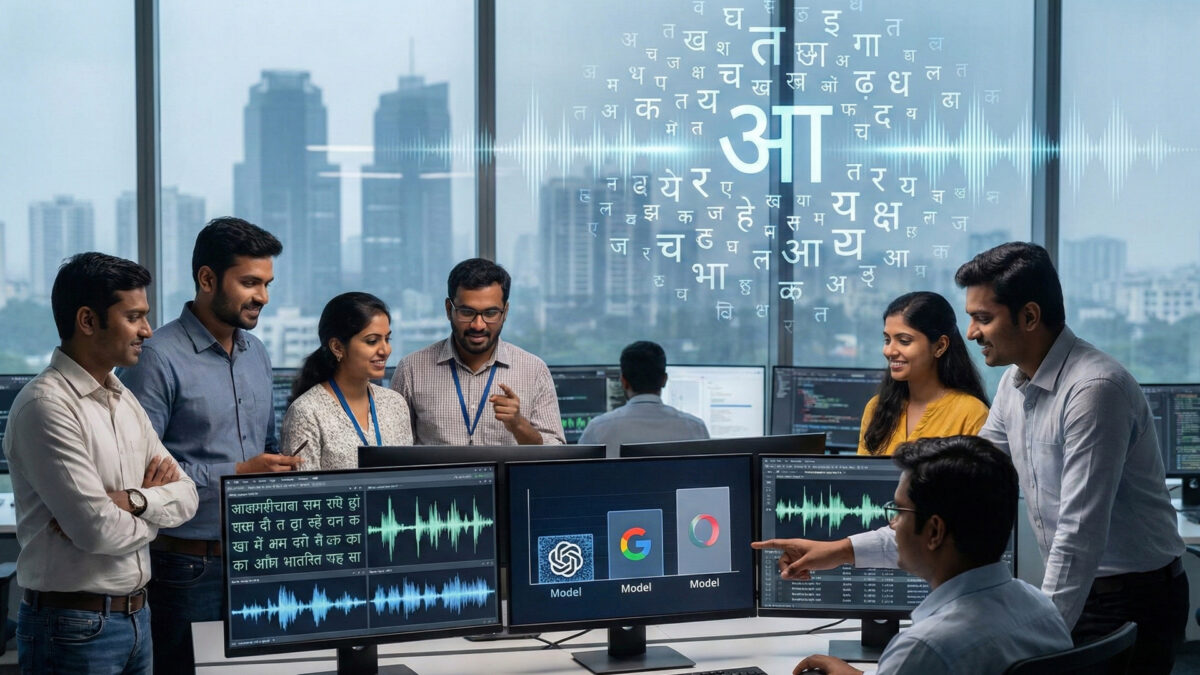
India’s artificial intelligence ecosystem has received a major boost as Sarvam AI, a Bengaluru-based startup, has outperformed global AI models such as Google Gemini and OpenAI’s ChatGPT in several benchmarks designed around India-specific use cases. The achievement has attracted international attention and highlighted the growing strength of indigenous AI innovation.
Sarvam AI’s success comes from its focus on challenges unique to India, including multilingual content, diverse scripts, and complex document formats. While many global AI models are designed for broad, international applications, they often struggle with regional languages and locally used documents. Sarvam has addressed this gap by building models specifically trained for Indian conditions.
One of its key products, Sarvam Vision, is an advanced optical character recognition (OCR) system capable of reading and understanding complex documents. These include scanned government records, handwritten text, tables, and pages containing multiple Indian languages in a single layout. In recent benchmark tests, Sarvam Vision scored higher than competing systems from major global players, demonstrating superior accuracy and reliability.
Another major highlight is Bulbul V3, Sarvam’s text-to-speech model. Bulbul V3 has been developed to generate natural-sounding voices in Indian languages and accents. The system currently supports more than 35 voices and is designed to eventually cover all 22 official Indian languages. In listening and performance tests, Bulbul V3 delivered clearer pronunciation and more natural speech than several international alternatives, particularly for Indian language outputs.
Experts say Sarvam’s performance shows the importance of building AI systems that are locally trained rather than globally generic. Its models are seen as especially useful for sectors such as government services, banking, education, healthcare and customer support, where Indian languages and document formats are widely used.
The achievement has also strengthened the idea of “sovereign AI” technology developed within the country to meet national needs and reduce dependence on foreign platforms.
Also Read: Over a billion Android phones at risk