
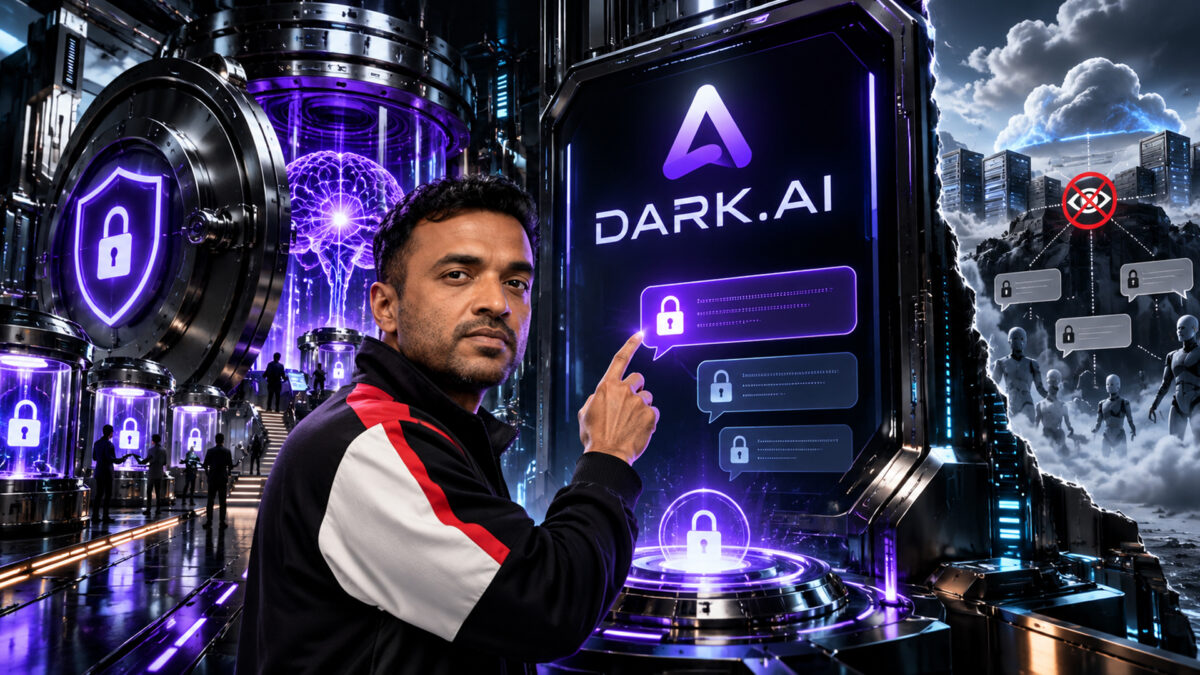
Deepinder Goyal, founder of Eternal, is exploring a new opportunity in artificial intelligence with Dark.ai, a privacy-focused AI assistant designed to give users greater control over their conversations and personal information. The platform is being developed with a clear objective: to make people feel more comfortable using AI for sensitive questions, confidential business discussions and research that they may hesitate to share with conventional chatbots.
Eternal, the parent company of Zomato and Blinkit, is targeting a global launch for Dark.ai by the end of 2026. The platform is currently being tested internally, and Goyal has indicated that the team has been using it for several months. However, the company has not yet announced a confirmed public launch date.
The central idea behind Dark.ai is that users should not have to choose between the convenience of artificial intelligence and the privacy of their conversations. While several AI services offer settings that limit the use of chats for model training, Goyal believes broader concerns remain around data storage, human access, third-party logging and requests for user information.
In Eternal’s second-quarter FY27 shareholders’ letter, Goyal explained the thinking behind the project and said privacy would be built into the platform’s design rather than treated as an optional feature. Dark.ai is being developed with end-to-end encryption and an encrypted memory system that users can control. The memory feature is intended to help the assistant retain context across conversations without allowing the company to read the contents of those interactions.
Goyal has said Eternal itself would not be able to access users’ conversations, even if it were legally compelled to do so. That promise is central to the platform’s positioning in an increasingly crowded AI market. However, the technical details of the system and independent verification of its security claims have not yet been fully disclosed. The platform’s actual privacy protections will therefore need to be assessed once more information becomes available.
Dark.ai is expected to use fine-tuned versions of advanced open-weight AI models running on Eternal’s own infrastructure. Open-weight models allow developers to adapt existing AI systems for specific requirements. By combining these models with its own infrastructure and privacy-focused design, Eternal hopes to build an assistant that can deliver useful responses while limiting access to personal information.
The company is also working to make the AI more focused on truthful answers rather than simply agreeing with users. Goyal has said benchmark results will be shared later, but the platform’s performance has not yet been independently established against competing AI assistants.
The intended audience includes startup founders, researchers, scientists, businesses and government organisations that may need to discuss confidential information. For founders, the assistant could provide a space to explore early-stage business ideas. Researchers could use it to examine unpublished work, while businesses may find it useful for analysing sensitive internal information. Individual users could also benefit from having greater privacy when asking personal questions or exploring subjects they consider confidential.
Goyal has described how using the platform internally changed his own approach to AI. With fewer concerns about who might see his conversations, he said he became more comfortable asking questions and exploring topics that he would otherwise hesitate to discuss. This experience has helped shape Dark.ai’s underlying proposition: users may receive more meaningful assistance when they can share the context necessary for useful answers without worrying about unnecessary exposure.
For Eternal, the initiative represents a possible expansion beyond its established food delivery and quick-commerce businesses into the broader AI market. The company has already developed Nugget, a no-code AI customer support platform that it opened to businesses in 2025 after using it internally. Dark.ai would represent a further move into general-purpose AI assistance, with privacy serving as its main differentiator.
The launch also comes as companies assess how AI agents could change consumer behaviour and online transactions. Goyal has suggested that Eternal’s businesses face different levels of disruption from this shift. Zomato and Blinkit rely on physical infrastructure, delivery partners, restaurant relationships, inventory, payments and operational coordination, which could make them less vulnerable to being replaced entirely by AI agents.
District, Eternal’s platform for restaurant discovery, reservations and events, could face greater pressure if AI assistants become a preferred way for consumers to find and book experiences. The development of Dark.ai therefore comes at a time when Eternal is considering both the opportunities created by artificial intelligence and the challenges it could pose to existing business models.
Despite its ambitious positioning, Dark.ai remains an early-stage project. Eternal has not disclosed its pricing, revenue targets, investment requirements or detailed commercial model. Its success will depend on whether the company can deliver strong AI performance, demonstrate reliable privacy safeguards and persuade users to adopt another assistant in an already competitive market.
Dark.ai reflects Goyal’s attempt to address a growing concern about how personal information is handled by AI services. The planned global launch by the end of 2026 will be an important milestone. Until the platform becomes publicly available and its capabilities are independently assessed, its commercial prospects remain uncertain. If Eternal can demonstrate that its privacy promises work in practice without compromising the quality of its answers, Dark.ai could establish a distinct position in the evolving AI landscape.