Categories
Beyond

Bitcoin faces sharp fall during market chaos

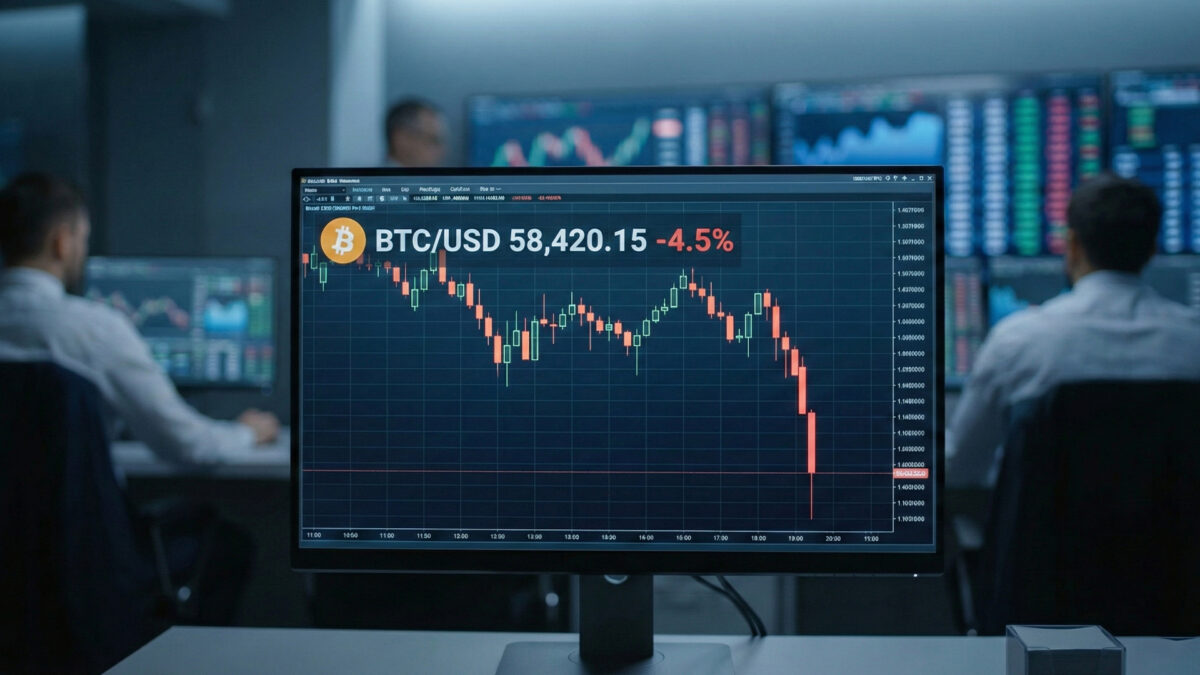
Bitcoin has fallen to its lowest level since the 2025 tariff shock, dropping roughly 7% to $76,500 before slightly recovering to $78,000, about 11% below early-year levels.

The decline highlights growing caution among investors as geopolitical tensions and expectations of tighter monetary policy weigh on markets.

Long seen as “digital gold,” Bitcoin is increasingly behaving like a risk-sensitive asset. The downturn has also affected major altcoins, prompting corporate and institutional investors to carefully reassess exposure and balance potential opportunities against market volatility.

Categories
Beyond

Bitcoin slides 21% in November, sparks concern

Bitcoin, the world’s largest cryptocurrency, has plunged 21% in November, recording its steepest monthly decline since June 2022. The digital currency fell from around US$126,000 in early October to below US$81,000 by late November, shedding nearly a third of its value in just over a month.

The sell-off has been driven by several factors. Large outflows from crypto exchange-traded funds (ETFs) contributed heavily to the decline, with one fund alone seeing close to US$3 billion withdrawn this month. Such withdrawals signal reduced investor confidence and have added pressure on prices.

Forced liquidations of leveraged positions also played a major role. Many traders who had bet on Bitcoin’s rise with borrowed funds were forced to sell as prices dropped, triggering a cascade of selling across the market. Analysts note that this has intensified volatility, especially in a market where large holders, often called “whales,” can sway prices significantly.

Global economic uncertainty, particularly concerns about interest rates and regulatory policies, has further contributed to investor caution. High-risk assets such as cryptocurrencies are being sold off in favor of safer investments, adding to the downward pressure.

Despite strong gains over the past two years,  153% in 2023 and 122% in 2024,  this sudden correction underscores the volatile nature of the crypto market. Market experts suggest that while short-term losses may continue, long-term investors could view the current dip as a potential buying opportunity, provided they can tolerate high levels of risk.

Also Read: Trump’s “Gold Card” lets wealthy buy US residency

Categories
Beyond

Bitcoin drops below $90,000, rebounds fast

Bitcoin had a shaky night. For the first time since April, the world’s largest cryptocurrency slipped below the $90,000 mark, touching around $89,500. The sudden fall came as global markets turned nervous, with investors pulling back from risky assets.

But the slump didn’t last long. By late Tuesday morning, Bitcoin was already climbing again, trading close to $93,600. The quick recovery shows that despite growing uncertainty, buyers are still willing to step in when prices fall sharply.

This turbulence comes just weeks after Bitcoin nearly hit $125,000 in early October, powered by strong optimism and a pro-crypto mood in the US. That excitement has cooled as investors now question whether the US Federal Reserve will cut interest rates soon. Concerns about the global economy have added to the caution.

It wasn’t just Bitcoin that felt the heat. Shares of major crypto-linked companies like Coinbase and Robinhood also dropped sharply during the sell-off, reflecting the broader anxiety in the market.

Analysts say the sudden dip is a reminder that cryptocurrencies remain highly sensitive to big economic signals. If the negative sentiment continues, Bitcoin could test lower support levels. But if calm returns to global markets, the recent dip may simply be seen as a temporary pause in its larger rally.

For now, the message is clear: Bitcoin may be strong, but it’s not immune to the mood swings of global finance.

Also Read: ₹623 crore laundered via 27 crypto exchanges

Categories
Corporate

Bitcoin falls 26% to $94,000, erases 2025 gains

Bitcoin has dropped sharply over the past few days, completely erasing the gains it had made since January. The world’s largest cryptocurrency fell below $94,000, slipping under last year’s closing price and signalling a clear shift toward a bear market.

In early October, Bitcoin had touched a record high of $126,000, driven by strong investor excitement and heavy buying through crypto exchange-traded funds (ETFs). But the mood changed suddenly after political uncertainties in the US triggered fear across global financial markets. As investors became cautious, Bitcoin was one of the first assets to react, sliding faster than many stocks or commodities.

Analysts say one major reason for the fall is that big institutional investors,  who had supported Bitcoin through much of the year, have stepped back for now. Several Bitcoin ETFs, which had attracted billions earlier, have seen large withdrawals recently. Nearly $870 million left these funds in just a few days, removing an important source of steady demand.

Market liquidity has also weakened. Traders report that the number of active buyers and sellers in the market has dropped, which means even medium-sized trades can now push the price up or down very quickly. This makes the market more sensitive and increases volatility.

The decline has also affected companies that hold large amounts of Bitcoin. One major US-based firm, well known for building its business strategy around Bitcoin, has seen its own market value fall close to the value of the Bitcoin it owns. This suggests investors are becoming doubtful about companies heavily tied to crypto price movements.

For retail investors, the sudden drop has come as a shock. Many who joined the rally earlier this year are now worried about whether the slide will continue. Experts say Bitcoin’s price could remain unstable in the near future unless confidence returns and new buyers step in.

Also Read: Tata Motors PV shares fall 7% despite profit surge