
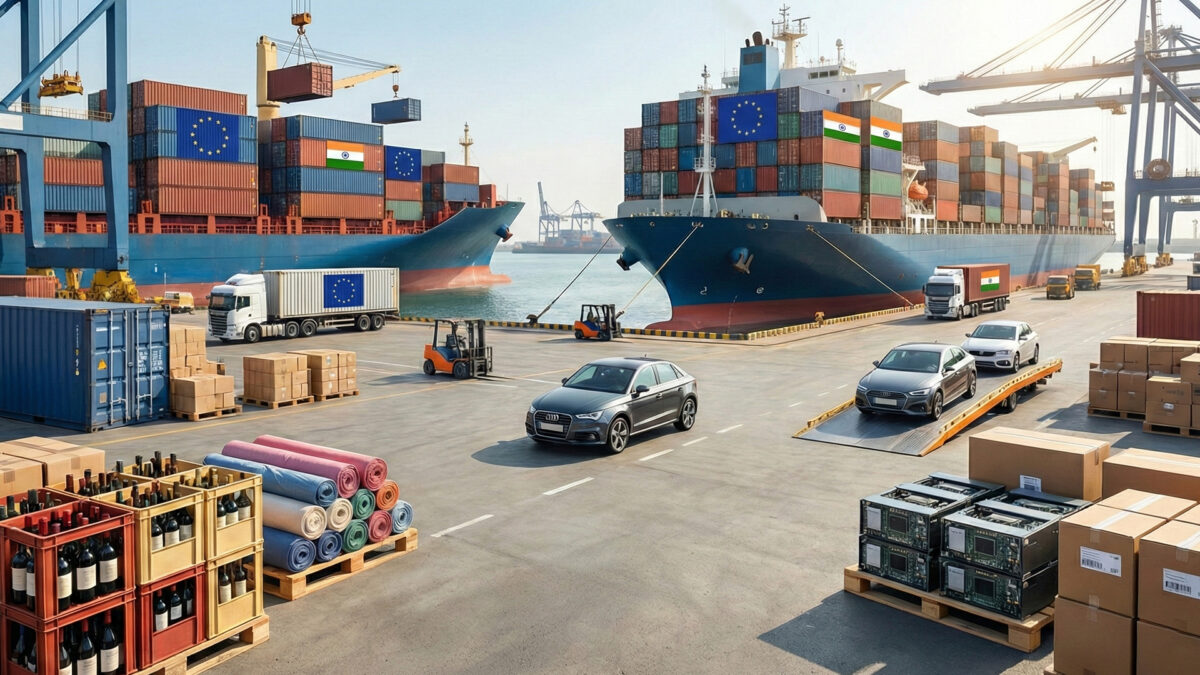
India and the European Union have finally signed a Free Trade Agreement (FTA) on January 27, 2026, ending nearly 20 years of negotiations. The agreement was announced at the India-EU Summit in New Delhi by Prime Minister Narendra Modi and European Commission President Ursula von der Leyen, and is being seen as a major step forward in strengthening ties between the two sides.
The deal brings together two huge markets, India and the EU together account for about 2 billion people, nearly a quarter of the world’s economy, and around one-third of global trade. At a time when global trade is facing uncertainty and higher tariffs in many countries, the agreement is expected to create new opportunities for businesses and workers on both sides.
Under the FTA, import duties will be removed or sharply reduced on about 96–97% of goods traded between India and the EU over the coming years. This is expected to help Indian exporters, especially in sectors such as textiles, leather, gems and jewellery, chemicals, engineering goods, and marine products, by making it easier and cheaper to sell their products in Europe.
European companies will also benefit. The EU is expected to save around €4 billion every year as tariffs come down. One of the most talked-about decisions is India’s agreement to cut car import duties from as high as 110% to about 10%, in phases and within a fixed annual limit. Taxes on wines and spirits from Europe will also be reduced gradually.
At the same time, both sides have been careful to protect sensitive areas. Dairy products, cereals, and small cars have been kept out of full tariff cuts to protect local producers, especially in India.
Beyond goods, the agreement opens the door to closer cooperation in services, investment, supply chains, standards, and regulations. It also allows room for future discussions on professional mobility and people-to-people exchanges, which could benefit students, professionals, and businesses.
The agreement now needs to go through legal checks and approvals in India and the EU. Once cleared, it is expected to take effect in late 2026 or early 2027, setting the stage for closer economic cooperation and stronger trade ties between India and the European Union.